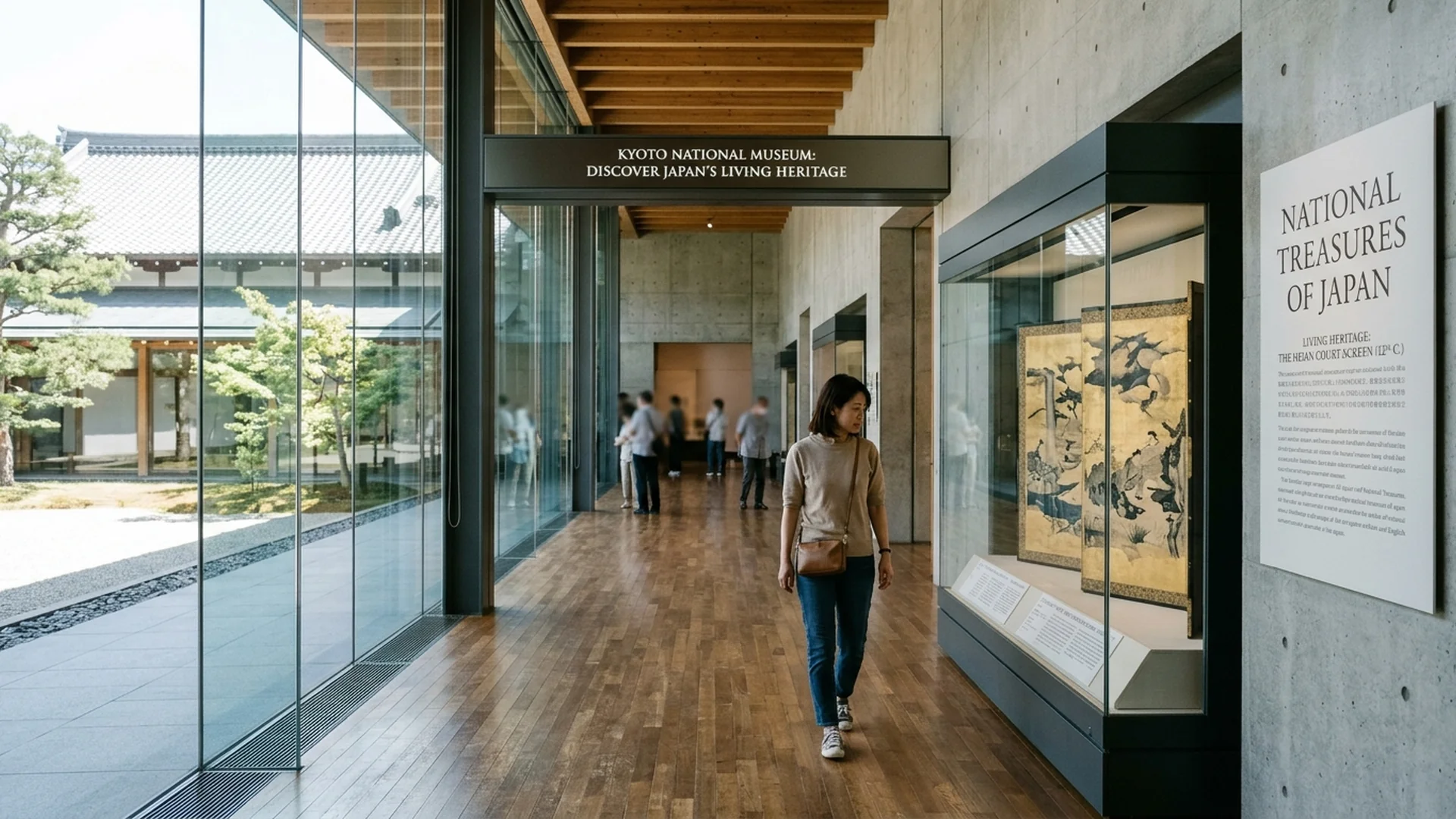
Cross the threshold of the century-old gates in the historic Higashiyama district, and the bustling hum of Japan’s ancient capital dissolves into profound stillness. Kyoto is celebrated for its venerable wooden temples and contemplative Zen rock gardens, yet it also safeguards a deep sanctuary of cultural memory that preserves the pure spirit of the realm. This is the Kyoto National Museum, a realm where time is folded and meticulously unfurled across more than ten thousand priceless antiquities.
What immediately arrests the discerning traveler is the cross-era dialogue between two architectural philosophies: the grand, imposing red-brick Meiji-period Western style standing in graceful contrast to razor-sharp contemporary lines. These structures are not merely passive enclosures for ancient artifacts; they are spatial sculptures that invite visitors to contemplate timeless beauty.
An Architectural Dialogue: Meiji Kotokan and Heisei Chishinkan
The intellectual and visual journey of the Kyoto National Museum begins long before entering the galleries. The original main building, known as the Meiji Kotokan, was completed in 1895 by the architect Tokumatsu Katayama. Designed in a Western Renaissance revival style utilizing red brick and granite, it exudes solidity and grandeur, reflecting Japan’s ambitious synthesis of Western civilization and indigenous roots during the Meiji era.
Directly opposite stands the Heisei Chishinkan, a masterwork by Yoshio Taniguchi, the world-renowned minimalist architect celebrated for his redesign of the Museum of Modern Art in New York. Taniguchi employed expansive glass curtain walls and clean geometric lines to create airy, light-filled spaces where natural illumination gently caresses the antiquities. This juxtaposition of two distinct architectural eras acts as a living bridge between a glorious past and contemporary refinement.
Sanctuaries of Faith: National Treasures from Kyoto’s Temples and Shrines
As a national institution dedicated to safeguarding cultural heritage, the museum’s holdings are composed largely of National Treasures and Important Cultural Properties entrusted by Buddhist temples and Shinto shrines throughout the Kansai region, including Kyoto and Nara. The collections span powerful Buddhist devotional sculptures, exquisite emakimono scroll paintings, fine lacquerware and ceramics, and masterfully forged samurai swords crafted through sophisticated ancient techniques. Every piece resonates with historical depth, spiritual devotion, and imperial craftsmanship rarely witnessed in the modern world.
The Art of Exhibition: Curatorial Precision and Rotating Masterworks
Owing to the delicate nature of antiquities aged over a millennium, the museum carefully curates its special exhibitions and permanent rotation galleries. Each visit offers refined, contemplative perspectives, whether exploring the profound aesthetics of Zen Buddhist art, tracing the legacies of historical master painters, or observing hereditary samurai blades. The interior gallery lighting is meticulously engineered to protect fragile materials while drawing the observer’s eye into the subtle nuances of each artistic creation, free from distraction.