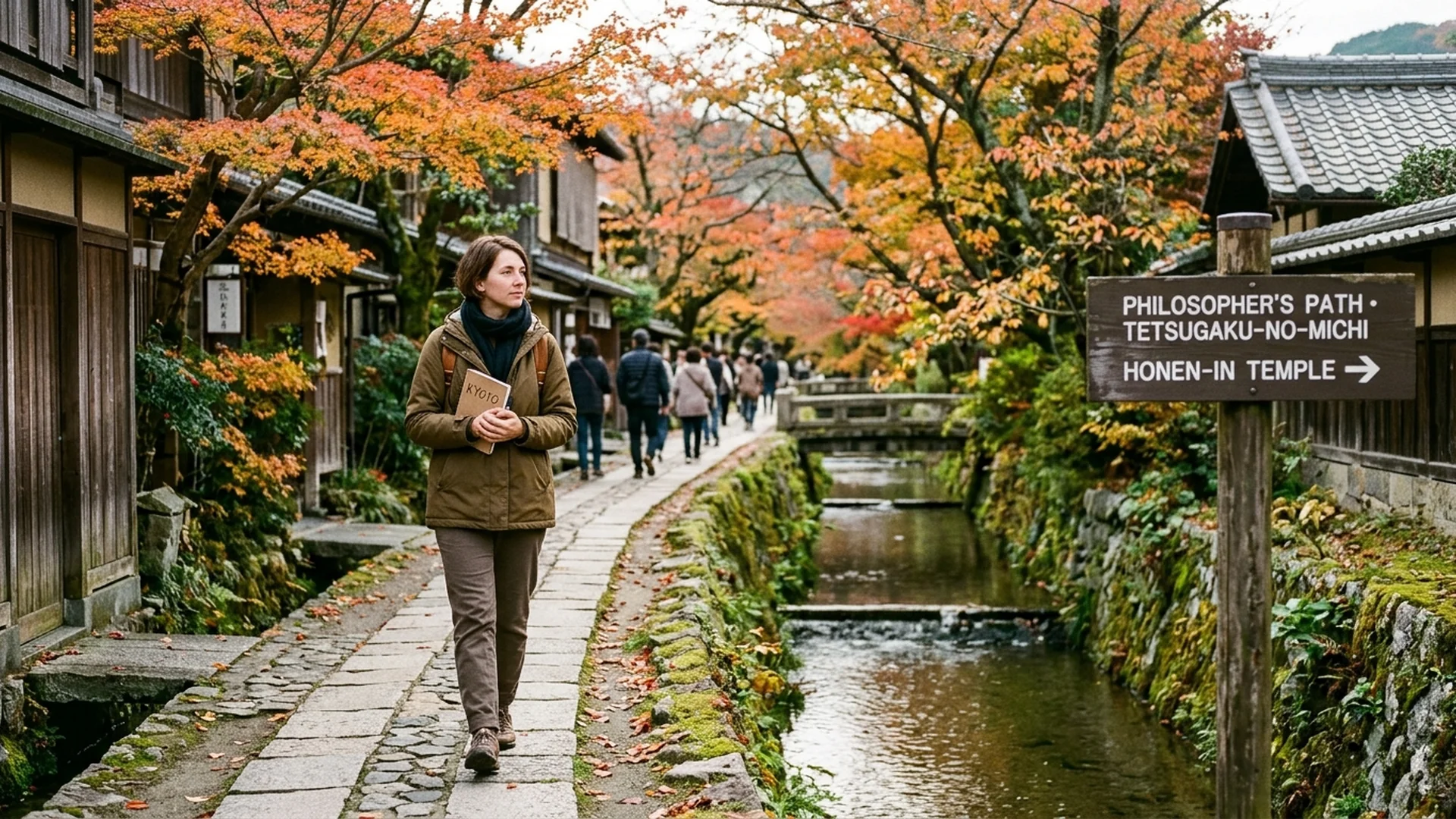
As the crystal waters of the Lake Biwa canal murmur past the moss-draped roots along the foothills of Kyoto’s Higashiyama mountains, they serve a purpose far beyond mere irrigation. For centuries, this gentle stream has acted as a living mirror, reflecting the profound inner dialogues of humanity. Spanning roughly two kilometers along a narrow stone pathway known as Tetsugaku no Michi, or the Philosopher’s Path, this corridor exists as a delicate threshold between the restless modern world and an ancient realm of stillness.
To press one’s footsteps onto these paving stones—stretching southward from the silver pavilion of Ginkaku-ji toward the cavernous halls of Nanzen-ji—is not merely to traverse a physical geography, but to step inward. Here, one walks in the quiet footprints of Nishida Kitaro, the pioneering philosopher who famously used this very route to pace his thoughts, refine his philosophy of absolute nothingness, and cultivate the exquisite wabi-sabi aesthetic of impermanence. This is a sanctuary never meant for racing against the clock; rather, it is an invitation to slow one’s breathing, trace the fall of a cherry petal upon the current, and attune oneself to the silent, majestic rhythm of the cosmos.
Architecture of Thought: The Origins of the Path and Higashiyama’s Waters
The Philosopher’s Path was born not from arbitrary chance, but from a monumental chapter in Kyoto’s infrastructural history: the late-Meiji era engineering feat that diverted fresh waters from Lake Biwa directly into the urban grid. This meandering canal not only revitalized local agriculture and hydroelectric power, but it inadvertently birthed one of the world’s most evocative riparian landscapes. By the 20th century, Nishida Kitaro—a philosophy professor at Kyoto University and a foundational architect of the Kyoto School—adopted this quiet canal-side route as his daily promenade. As he walked, he unraveled complex metaphysical inquiries and meditated on the fundamental truths of existence. His contemplative pacing etched itself into the collective memory of the city, ultimately bestowing upon the lane its enduring moniker. Flanked by mature cherry trees, cascading maples, and traditional domestic architecture, the surroundings naturally quiet the nervous system, granting the human spirit rare permission to converse directly with nature.
A North-to-South Pilgrimage: Sacred Geographies and Living Traditions
To fully appreciate the sensory tapestry of the Philosopher’s Path, one must approach it from its northern terminus near Ginkaku-ji, the Silver Pavilion. This architectural masterpiece embodies the understated refinement of Higashiyama culture, featuring its iconic raked sand gardens and the Moon-Washing Pavilion facing outward toward wild, forested slopes. Weaving southward along the canal brings one to Honen-in, an intensely secretive Zen sanctuary tucked behind a heavy wooden gate crowned by a thick thatch of moss and ferns. The interior atmosphere feels entirely severed from secular time, offering an ideal setting to pause and simply listen to the rustling canopy. Continuing onwards reveals intimate artisan workshops, delicate pottery galleries, and softly lit tearooms, until the path finally dissolves into the grand domain of Nanzen-ji. As one of Japan’s most preeminent Rinzai Zen temples, Nanzen-ji astounds visitors with its towering Sanmon gate and the striking red-brick Romanesque aqueduct of Suirokaku—a breathtaking fusion of European industrial design and solemn Buddhist architecture.
The Four Seasons: Nature as Kyoto’s Master Painter
The visual temperament of the Philosopher’s Path shifts with breathtaking fluidity across the wheel of the year. During spring, spanning late March to early April, hundreds of weeping cherry trees arch gracefully over the canal, merging their blossoms into a continuous pastel-pink canopy. When these delicate petals finally surrender to gravity, they blanket the moving water in a silken pink carpet known in Japanese as hanaikada, or flower rafts—a profoundly moving spectacle for international pilgrims. Summer arrives draped in deep emerald foliage, offering cool shelter accompanied by the steady, resonant hum of cicadas. By November, autumn claims the landscape, setting the maples and ginkgo trees ablaze in brilliant hues of crimson, amber, and gold that shatter against the crystalline water like an impressionistic oil painting. Even in the depths of winter, when silent snowfalls dust the dark ceramic tile roofs, the monochrome hush offers a profound interior quietude nearly impossible to find in contemporary life.