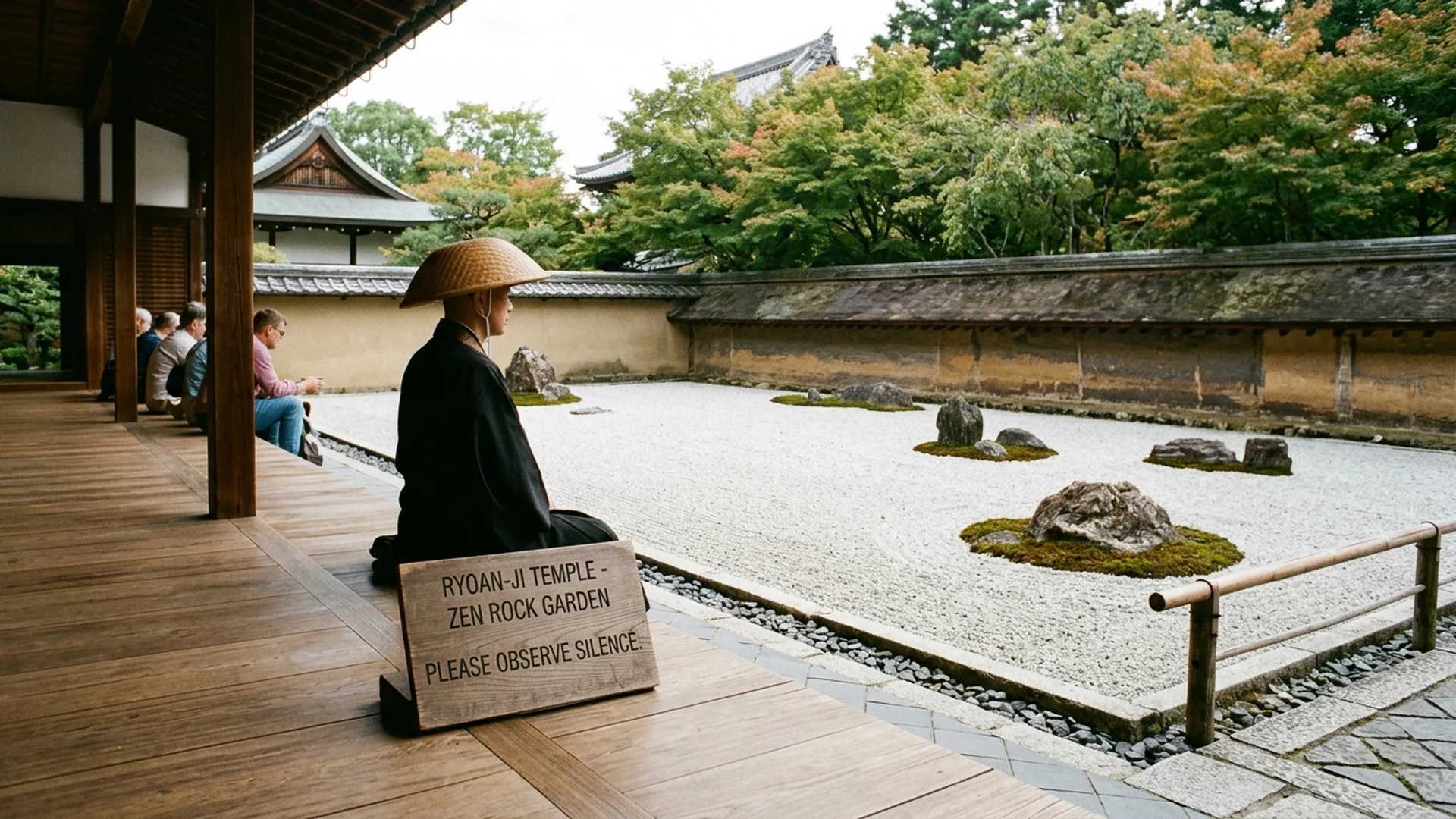
When your bare feet first meet the cool, polished wooden boards of Ryoan-ji’s ancient veranda, your gaze is instantly arrested by an expanse of immaculate white gravel, raked into rhythmic, ocean-like waves that stretch into quiet infinity. Across this monochrome sea rest fifteen mysterious stones, anchored without a single blade of grass or vibrant flower, embraced entirely by weathered, oil-rubbed earthen walls that have absorbed centuries of silent contemplation. This is far more than a celebrated garden; it is one of the world’s most enduring spiritual laboratories of Zen Buddhism. For generations, discerning travelers and seekers have journeyed here to decode a singular architectural riddle: why, no matter where one stands along the wooden corridor, is it physically impossible to take in all fifteen stones at a single glance? This deliberate geometric paradox is not a mere optical illusion, but a profound philosophical teaching reflecting the eternal truth that human limitation prevents us from ever perceiving the totality of the universe in a single lifetime.
Architecture of the Void: The Philosophy Behind Karesansui
The rock garden, or Karesansui, at Ryoan-ji represents the absolute pinnacle of dry landscape artistry during the Muromachi period. Spanning a compact rectangular canvas of roughly ten by twenty-five meters, the composition consists solely of pristine white gravel and five distinct stone groupings arranged with immaculate precision, entirely devoid of botanical ornamentation. The white gravel serves as an abstract ocean or infinite emptiness, while the weathered boulders—symbols of towering mountains and remote islands—are embraced by cushions of deep green moss. The reigning aesthetic here embodies yugen, a subtle, profound grace that escapes the grasp of ordinary sight. By stripping away extraneous sensory decoration, the space invites the observer to quiet the restless chatter of the mind and confront the vast expanse of internal emptiness.
The Riddle of the Fifteen Stones: When Perfection is an Illusion
The enduring wonder of this sanctuary lies in its masterful geometry: no matter where a visitor pauses along the hondo (main hall) veranda, at least one stone is invariably obscured by another in the foreground, capping the visible count at fourteen. Legend and philosophy suggest that only those who have achieved total spiritual enlightenment—those whose minds are completely liberated from worldly illusions—can truly ‘see’ all fifteen stones simultaneously in their mind’s eye. This poignant design whispers a humbling truth to humanity: we navigate existence through narrow, biased perspectives, perpetually mistaking our fragmentary view for absolute reality. Ryoan-ji stands as an exquisite monument to human limitation and our shared, imperfect quest for understanding.
Intellectual Heritage and the Tsukubai Basin: Lessons in Contentment
Beyond the celebrated gravel expanse, nestled behind the temple’s historic tea house, rests an antique stone water basin known as a tsukubai. Carved into its surface are four kanji characters that share a central square aperture. Read in sequence with the central square, they spell out a profound four-character Zen maxim: ‘Ware tada taru o shiru,’ translatable as ‘I learn only to be satisfied.’ Traditionally utilized for ritual purification before partaking in the chado tea ceremony, this humble basin serves as an enduring philosophical reminder of sufficiency and inner contentment, encapsulating the very essence of a Zen lifestyle lived in graceful harmony with nature.