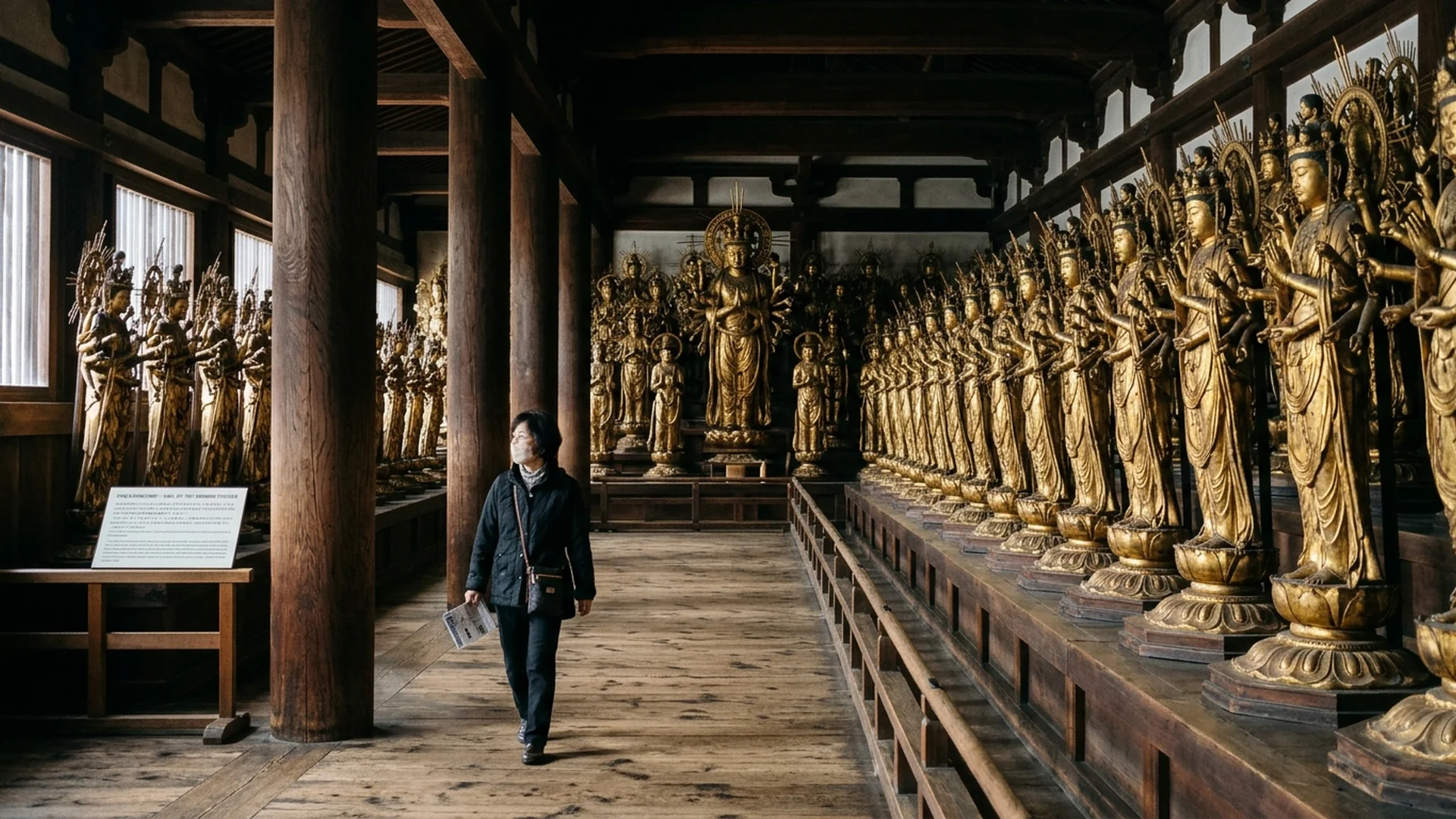
Transcending the surface-layer itineraries of modern tourism, a journey to Sanjusangendo offers a profound encounter with structural mastery and centuries of preserved devotion. As Kyoto’s longest ancient wooden hall, this sanctuary conceals the passage of time within its towering cypress beams and quiet, incense-scented air. It functions far beyond a mere historical landmark, operating instead as a living gallery of faith where supreme mercy and striking artistry merge.
Crossing the threshold immediately stills the wandering mind, replacing outside commotion with the hush of polished timber and subdued natural light. The strict prohibition against interior photography acts as an unexpected catalyst, compelling visitors to set aside digital distractions and absorb the magnificent scale before them with pure presence. This is an elite spiritual and cultural immersion designed for the discerning traveler seeking genuine encounters with Japan’s heritage.
Architecture of Devotion: The Longest Wooden Hall in Japan
Formally known as Rengeo-in, Sanjusangendo was established in the southeastern expanse of Kyoto in 1164 under the patronage of Emperor Go-Shirakawa. Its defining architectural hallmark is the magnificent main hall, stretching an astonishing 120 meters and holding the distinction of being the longest ancient wooden structure in Japan. This impressive length is gracefully divided into thirty-three distinct pillar intervals, giving rise to the name Sanjusangendo, which translates to ‘hall with thirty-three spaces.’
Late-Heian and Kamakura architectural sensibilities shine through the resilient joinery, where massive cypress pillars and intersecting beams lock together without metal fasteners—a testament to ingenious traditional craftsmanship. Having endured fires and turbulence through the centuries, the hall stands today following meticulous restorations, serving as an enduring monument to a golden age of Buddhist artistry.
An Army of Compassion: 1,001 Golden Deities and Ancient Guardians
Beyond the dark wooden doors lies an astonishing visual symphony: regimented tiers housing one thousand life-sized statues of Avalokiteshvara, the Thousand-Armed Kannon, carved from Japanese cypress and covered in shimmering gold leaf. At the center of this formidable formation sits the supreme primary deity, an intricate masterwork sculpted by the celebrated artisan Tankei during the thirteenth century.
Adding the central sculpture to the surrounding thousand yields precisely one thousand and one distinct representations. Each figure possesses individual facial nuances and subtle postural variations, reflecting the Mahayana belief that the bodhisattva assumes infinite forms to answer human suffering. Local tradition whispers that among the sea of faces, one will eventually encounter features resembling a familiar friend or even oneself.
Guarding the front of the divine assembly stand twenty-eight celestial attendants, flanked by the iconic and dynamic figures of Fujin, the God of Wind, and Raijin, the God of Thunder. Rendered in vivid, dramatic realism, these guardian sculptures showcase the bold, expressive mastery of classical Japanese statuary.
The Esoteric Code of Thirty-Three and Mahayana Philosophy
The recurring number thirty-three transcends simple architectural division, holding profound spiritual meaning rooted in the Lotus Sutra. According to sacred scripture, the Kannon bodhisattva manifests in thirty-three distinct forms to guide sentient beings across various realms of existence. Traversing the 120-meter expanse of the hall mirrors an inner pilgrimage of liberation and spiritual purification.
Absolute interior silence elevates the faint echoes of history and centuries of accumulated devotion. Visitors encounter a palpable resonance born from generations of meditative stillness, heightened by the interplay of gold leaf and dim amber lighting. This creates an elevated aesthetic dimension rarely found in commercialized sightseeing destinations.