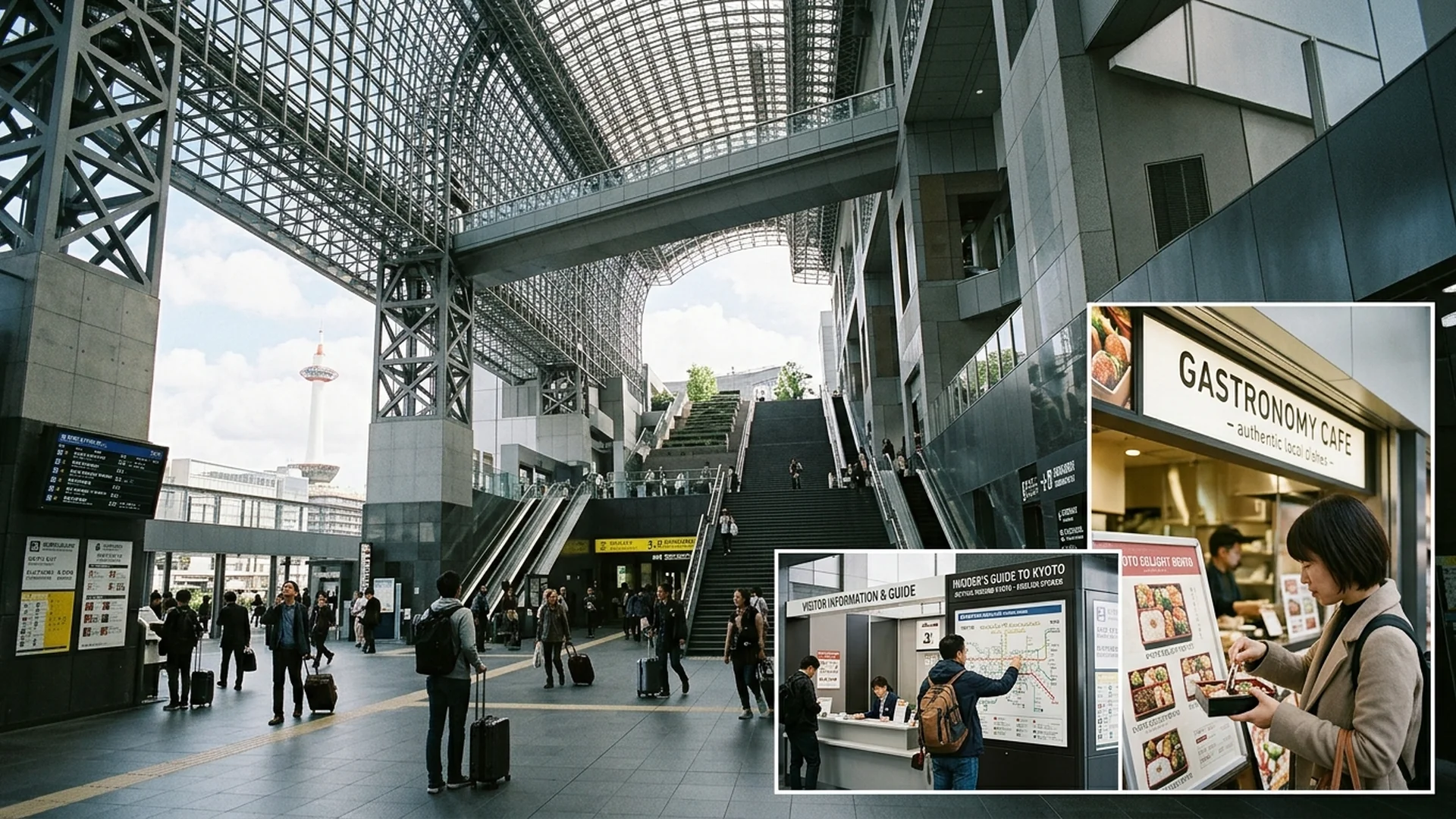
When stepping off the Shinkansen onto the sunlit platforms of Kyoto Station, the initial revelation is rarely the quiet solemnity of ancient wooden temples. Instead, one is greeted by a cavernous, soaring atrium wrapped in gleaming steel and glass, shimmering like a spacecraft anchored in the heart of an ancient capital. This is the captivating paradox woven deliberately into the urban fabric. In a city famed for its reverence for the past, the railway station acts as a temporal bridge connecting 21st-century engineering prowess with a spiritual legacy stretching back over a millennium.
Beneath this intricate framework lies a profound architectural philosophy that challenges the traveler’s perspective. Kyoto Station functions as far more than a mere transit hub; it is a monumental sculpture echoing the ancient grid of the Heian-kyo capital. It invites visitors to decode beauty in every detail, from the lofty skywalks suspended above the roofline to the world of refined flavors waiting to be discovered.
Futuristic Architecture Reflecting the Past: The Philosophy Behind the Cathedral of Steel and Glass
When the original Kyoto Station was destroyed by fire in 1950, its massive reconstruction to mark the 1200th anniversary of the capital’s founding posed a formidable challenge. Architect Hiroshi Hara, entrusted with the transformation, rejected the notion of erecting low-rise buildings mimicking ancient shrines. Instead, he chose 16 stories of steel and glass spanning over half a kilometer, anchored by a vast central atrium known as ‘The Matrix,’ which operates as a canyon of shifting light and shadow.
Hara’s genius lies in the arrangement of voids and pathways, evoking the sensory experience of wandering through Kyoto’s historic machiya townhouses. The sweeping, curved roofline mirrors the surrounding skies and the adjacent Kyoto Tower, functioning as a grand gateway welcoming travelers into a cultural legacy without disturbing the city’s cherished skyline.
Aerial Perspectives: Navigating the Heights and Luminescent Artistry
To truly appreciate Kyoto Station, one must ascend to its upper reaches. The journey begins on the Skyway Bridge, a transparent glass walkway suspended between the eastern and western terminal buildings at an altitude equal to an 11th-floor viewing deck. From this vantage point, visitors are treated to a 360-degree panorama of the city, framed by the lush green mountains encircling the basin, while the bustling concourse below resembles a miniature, bustling metropolis.
As night falls, the Grand Staircase—spanning 171 tiers—transforms into a colossal digital canvas driven by tens of thousands of LEDs. Dynamic seasonal graphics, from drifting cherry blossoms to autumnal maple leaves and cityscapes, illuminate the steps, offering a luminous gathering space where travelers and locals pause to catch the evening breeze.
A Sanctuary of Taste: Exploring Elite Dining and Regional Flavors
For culinary seekers, Kyoto Station is an elite gastronomic destination requiring no extensive transit. The journey begins in the basement depachika of JR Kyoto Isetan, a renowned department store housing a treasury of traditional confections, premium matcha, and meticulously curated bentos that distill the artistry of kaiseki dining into miniature masterpieces.
For those seeking local warmth, Kyoto Ramen Koji, situated on the 10th floor, gathers celebrated noodle artisans from across Japan’s distinct prefectures. Whether savoring rich Kyoto-style shoyu broth, creamy Kyushu tonkotsu, or warming Hokkaido miso, each bowl is prepared with unwavering dedication within a nostalgic recreation of a Showa-era streetscape.