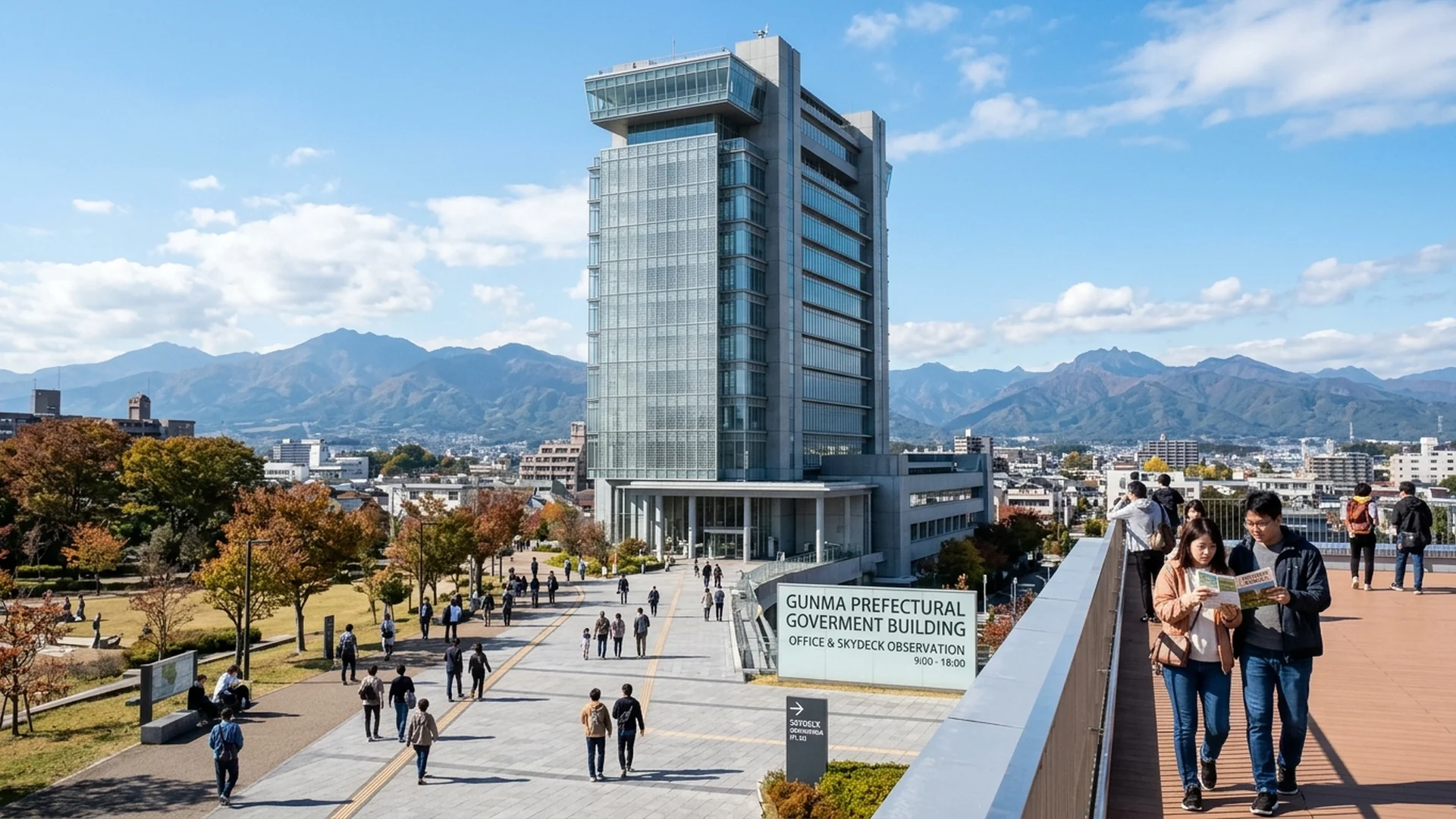
When conjuring the image of a governmental headquarters in Japan, the mind often wanders to utilitarian concrete monoliths weighed down by bureaucratic austerity. Yet in the heart of Maebashi, the capital of Gunma Prefecture, a magnificent exception defies convention, elevating civic architecture to a refined art form. The Gunma Prefectural Government Building functions not merely as an administrative hub, but as a soaring architectural landmark stretching 153.8 meters into the Kanto sky—making it one of the tallest prefectural offices outside the Tokyo metropolis. Here lies a captivating convergence of forward-looking structural elegance and the enduring resonance of the early Showa era.
Approaching this commanding edifice is akin to unlocking a serene parallel dimension of the Kanto region. Discerning travelers are invited to experience unhurried poise, surrounded by ancient volcanic mountains and historic rivers. Far from the frenetic pulse of the capital, this sanctuary delivers an architectural and scenic encounter that deeply nourishes the contemplative traveler’s spirit.
A Dual-Era Architectural Dialogue: The Showa Era Meets the 21st Century
The primary allure of the Gunma Prefectural Government Building lies in its harmonious architectural juxtaposition. The complex is anchored by the 32-story Main Building, conceived by visionary master planners to emphasize structural transparency, expansive volume, and reflective glass facades that mirror the shifting moods of the sky. Yet, a short stroll across the grounds reveals a striking counterpoint: the Showa Building. Erected in 1928, this historic gem exemplifies Western neo-classical design, featuring deep red brick masonry and preserved interior detailing that evokes a profound sense of suspended time. Standing between these twin expressions of distinct eras feels akin to traversing a living museum, where the quiet passage of a century is elegantly inscribed in stone and glass.
The 32nd-Floor Skydeck: A 360-Degree Panorama Across the Kanto Plains
For connoisseurs of elevated vistas, the 32nd floor of the main tower is an essential destination. High-speed elevators whisper upward, breaching the 150-meter mark in mere seconds. Upon arrival, floor-to-ceiling glass panels unfold an uninterrupted 360-degree theater of the surrounding terrain. To the north and east, the majestic ‘Jomo Sanzan’—Gunma’s three venerated peaks of Mount Akagi, Mount Haruna, and Mount Myogi—rise in layered silhouettes, often wreathed in morning mist. Below, the Tone River traces a silvery, serpentine ribbon through the verdant flatlands of Maebashi. As the sun dips toward the horizon, amber light bathes both the distant ranges and the urban grid, rendering this one of the Kanto region’s most celebrated landscapes for photography.
Elevated Culinary Arts and Stillness Above Maebashi
Beyond the sweeping panoramas, the 31st floor houses a sophisticated dining venue that invites visitors to savor exceptional gastronomy while observing the shifting light of day. Pausing here over a thoughtfully prepared meal or a warm infusion, far removed from the bustling commercial circuits of Tokyo, grants the rare luxury of unhurried introspection. This quiet indulgence embodies the truest essence of luxury travel: an uncompromising appreciation for quality, space, and the meticulous beauty of the mundane elevated to art.