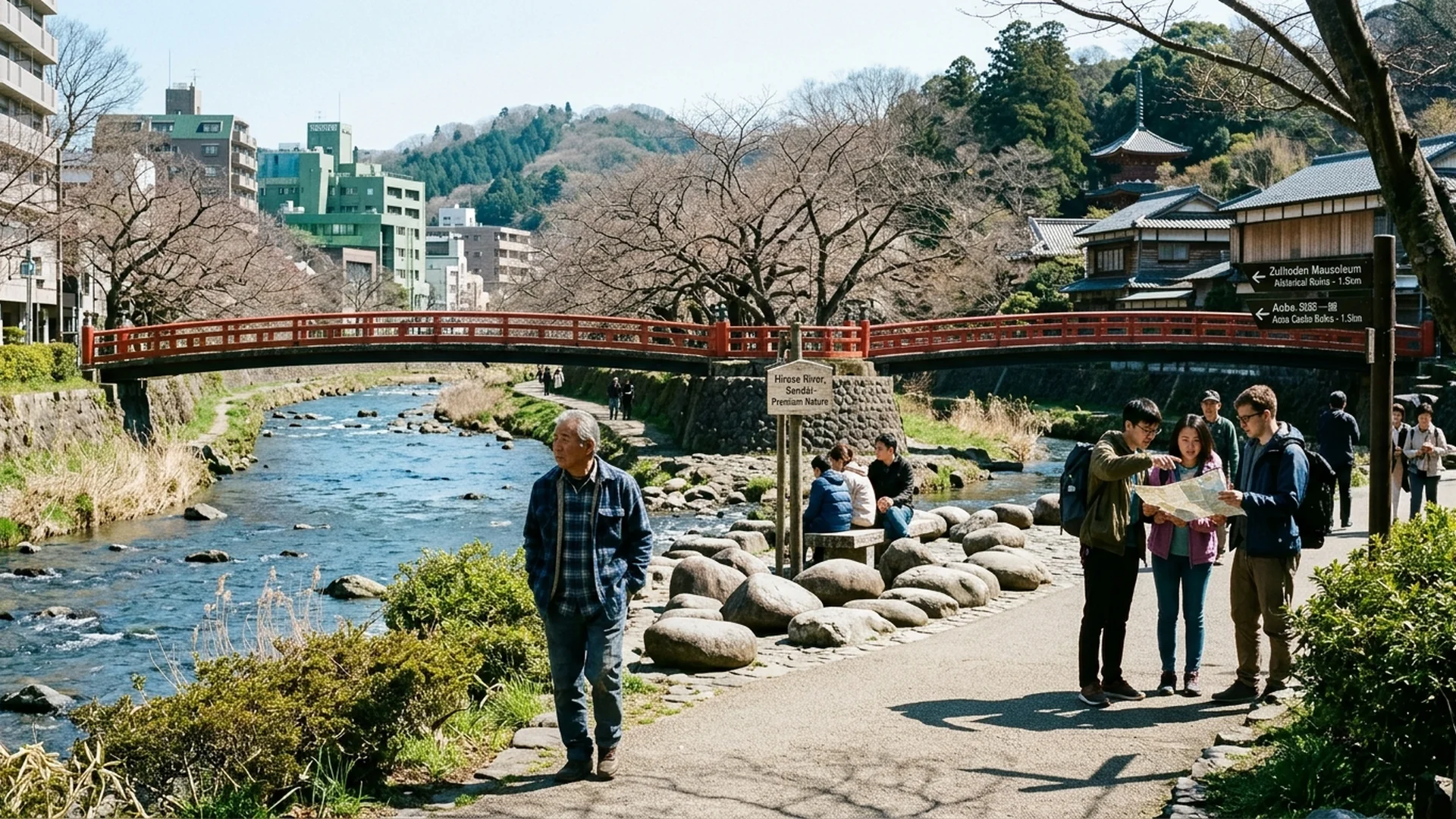
When Sendai is mentioned, the capital of Japan’s Tohoku region immediately evokes the lush canopy that earned it the moniker ‘City of Trees.’ Yet beneath the urban landscape and modern architecture lies a spiritual and geographical lifeline that has nourished the city’s vitality for centuries: the tranquil, crystalline currents of the Hirose River.
This storied waterway is far more than a scenic geographic feature; it is the vital arterial current of civilization that the legendary one-eyed samurai lord, Date Masamune, surveyed with a visionary gaze when laying out Sendai in 1601. Harnessing the river’s sweeping curves and formidable steep cliffs as an unassailable natural fortification for Aoba Castle, Masamune forged an enduring legacy. Across more than four centuries, the river has functioned as a living archive, preserving the strategic brilliance, refined artistry, and unhurried rhythm of life that defines the Tohoku region.
The Samurai Lifeblood: From Strategic Moat to Sendai’s Soul
In the annals of the Edo period, Lord Date Masamune’s selection of Sendai’s topography stands as a masterwork of architectural and military strategy, extracting maximum advantage from the surrounding terrain. He designated the Hirose River to envelop the northern and eastern perimeters of Mount Aoba, upon which the formidable Sendai Castle (or Aoba Castle) was erected. The precipitous cliffs, carved by rushing torrents in antiquity, constituted a defensive rampart far superior to any masonry wall.
Today, while the main citadel is reduced to weathered stone foundations and meticulously restored watchtowers, these historical echoes retain an undeniable gravity. As travelers pause at the expansive plaza before the bronze equestrian monument of Lord Masamune, gazing down at the emerald canopy parted by the meandering river below, a profound bridge is forged. It spans the chasm between a formidable past and the present tranquility, where residents and mindful visitors alike stroll along the banks, cycle beneath the boughs, or pause for quiet contemplation as dusk descends.
The Aesthetics of the Seasons: Embracing Nature Along the Water’s Edge
The Hirose River undergoes a breathtaking metamorphosis through the turning of the wheel of seasons. With the arrival of spring, the dual riverbanks are adorned with the soft, blush-pink petals of hundreds of cherry trees, their delicate branches dipping toward the reflective surface of the water to create an impressionistic tableau that draws appreciative walkers seeking the lingering crispness of the morning air.
When autumn unfurls its tapestry, the forested hillsides flanking the Hirose River ignite in brilliant hues of vermilion, amber, and ochre. Especially along the meandering nature trails and historic footbridges that parallel the current, the simple act of walking to the gentle susurrus of flowing water while breathing in the pristine pine-scented air embodies the purest definition of Tohoku slow travel—a meditative ritual capable of washing away the friction of modern existence.
Venture Upstream: Immersive Onsen Sanctuaries on the Hirose
Tracing the current upstream toward the northern mountain reaches reveals a secluded valley harboring Sakunami Onsen, a legendary hot spring retreat with a history spanning over thirteen centuries. Positioned gracefully along a primary tributary of the Hirose River, this enclave features premier ryokan inns designed in seamless harmony with Zen architectural philosophies.
Discerning travelers are invited to experience open-air Rotenburo baths situated directly among the river stones, where the thermal mineral waters soothe the skin while the acoustic symphony of rushing water and forest birds provides a restorative soundtrack. Nearby, the cascading waters of the Hōmeishijuhachi Falls chime against the stone like the song of a mythical phoenix, elevating the journey into an exercise in multisensory rejuvenation.