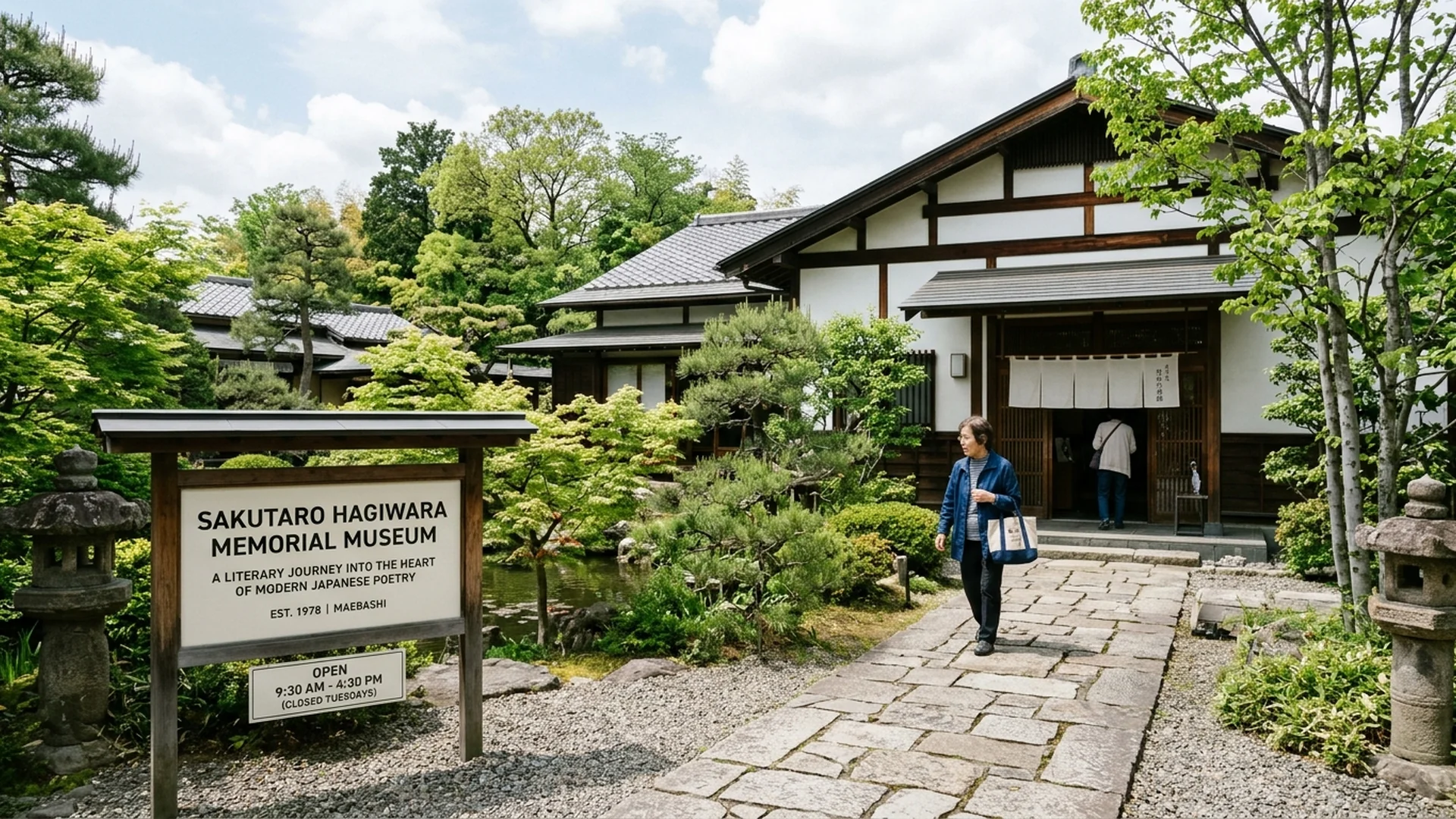
As the spring breeze whispers across the shimmering waters of the Hirose River in Maebashi, Gunma Prefecture, the resonant echoes of Sakutaro Hagiwara’s poetry continue to linger in the cultural memory. This sanctuary is far more than a conventional biographical archive; it is a realm of profound aesthetic stillness where time appears to pause, inviting the discerning traveler to step deep into the solitary, luminous, and endlessly influential interior world of modern Japanese literature.
Approaching the Sakutaro Hagiwara Memorial Museum is akin to undertaking a quiet intellectual pilgrimage for those devoted to the written word. Surrounded by the gentle scent of aged timber and tatami mats within a meticulously preserved traditional wooden residence, visitors encounter the tangible traces of the thought, spirit, and inspiration that earned this towering literary figure the title of ‘Father of Modern Japanese Poetry.’ Every creak of the polished wooden floorboards and every shifting pattern of sunlight filtering through paper shoji screens speaks of an enduring legacy.
Architecture of Memory: The Cradle of Luminous Melancholy
The architectural composition of the Sakutaro Hagiwara Memorial Museum eloquently captures the refined aesthetic sensibilities of the late Taisho to early Showa periods. This carefully conserved dark-timber structure stands close to the poet’s original birthplace—the very soil that nurtured masterpieces such as Howl’s Barking (Tsuki ni Hoeru). The evocative fragrance of weathered rush mats, the soft daylight diffusing through translucent sliding doors, and the profound spatial simplicity allow us to vividly imagine Hagiwara by night, dipping his brush in ink to translate the modern existential alienation of humanity into verse that forever altered the trajectory of Japanese letters.
Decoding Literary DNA: From Maebashi to the Global Stage
Sakutaro Hagiwara was not merely a master of sublime phrasing; he was a revolutionary who integrated spoken colloquial language into contemporary poetic metrics, granting his verses an unprecedented lyrical freedom, psychological depth, and spiritual vastness. Within the museum’s galleries lie handwritten journals, original manuscripts, personal belongings, and a specialized library housing rare first editions. Here, literary pilgrims are granted the rare privilege of examining the precise ink strokes, corrections, and rhythmic pauses—physical testaments to a relentless pursuit of the exact phrasing required to articulate both the anguish and the sublime beauty of existence.
Aesthetics Along the Hirose River: Completing the Landscape
The true distinction of visiting this memorial lies within its surrounding geography. Maebashi is celebrated as a city of waterways and weeping willows bordering the Hirose River, motifs that recur frequently throughout Hagiwara’s oeuvre. A meditative afternoon stroll along the riverbanks naturally slows one’s internal rhythm, attuting the senses to subtle nuances of light and shadow. Furthermore, the nearby Maebashi City Museum of Literature—featuring a striking contemporary design and rotating exhibitions dedicated to local luminaries—complements the journey, weaving a richer tapestry of the northern Kanto region’s cultural heritage.