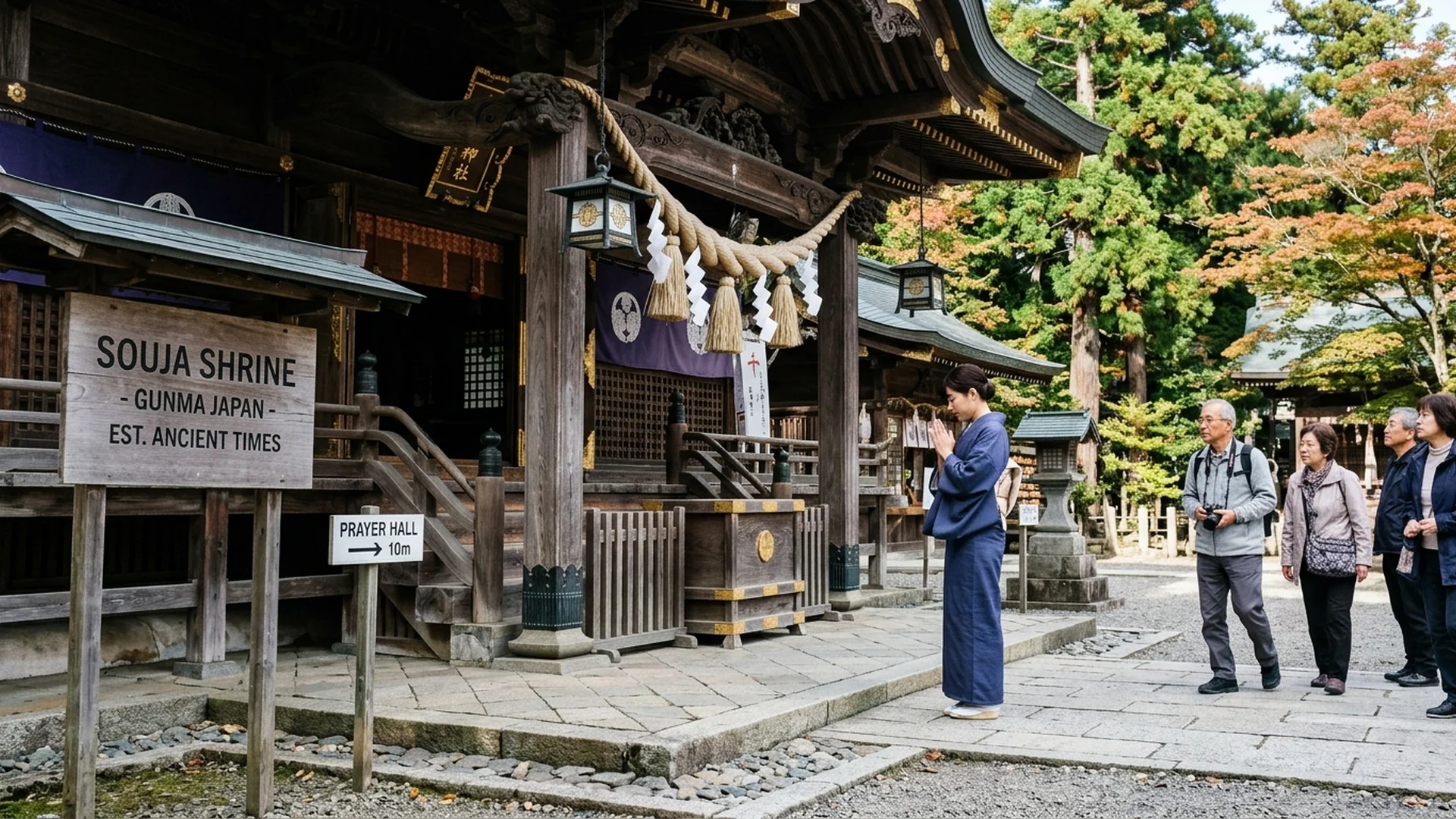
Crossing the ancient torii gate into the tranquil precincts of Souja Shrine, one is immediately enveloped not merely by the cool shade of towering centenarian trees, but by the quiet mist of millennia-old history that drapes across Maebashi in Gunma Prefecture. This is far more than a conventional sanctuary; it is the beating spiritual heart of the former Kozuke Province, meticulously consecrated to enshrine guardian deities from across the entire region within a single sacred space. For the discerning traveler captivated by the deep roots of Japanese culture and the pursuit of profound stillness, Souja Shrine stands as an antique treasure chest waiting to be unlocked, offering tales whispered across epochs through exquisite woodwork and an atmosphere where time itself seems to hold its breath.
Decoding the ‘Soja’ Concept: The Spiritual Axis of an Ancient Province
In the administrative hierarchy of ancient Japan, embarking on personal pilgrimages to every principal shrine scattered across regional domains was an arduous undertaking requiring months of arduous travel. The ingenious concept of the ‘Soja’ thus emerged as an administrative and spiritual nexus, uniting the guardian deities of the entire Kozuke Province within a single enclosure. This allowed provincial governors and commoners alike to offer their prayers for the realm’s protection in one comprehensive act of devotion. To visit Souja Shrine today is to replicate a comprehensive pilgrimage across the breadth of historical Gunma. This profound historical resonance infuses the air with an enduring palpable reverence and a deep communal unity cultivated over centuries.
Timber Architecture and the Aesthetics of Passing Time
The architectural framework of Souja Shrine articulates an eloquent narrative of artistic prosperity through seasoned hardwoods weathered gracefully by the elements. The main sanctuary hall (Honden) and its surrounding auxiliary structures embody the sophisticated aesthetic of ancient builders, achieving a delicate equilibrium between grand majesty and austere Shinto simplicity. Intricate wood carvings adorning the gables and corridor balustrades depict legendary folklore, auspicious beasts, and floral motifs with astonishing precision. When soft afternoon sunlight filters through the pine canopy, casting gentle shadows across the venerable timber walls, it creates a shifting tableau of light and shadow that invites the contemplative traveler to stand motionless and absorb this timeless beauty.
Traces of Devotion Through Calligraphy and the Art of Goshuin
For the discerning traveler who preserves memories upon paper, the Goshuin of Souja Shrine—featuring vermilion cinnabar seals and powerful, expressive brushstrokes—stands as a masterwork documenting a meaningful journey. The shrine custodian inscribes each character with meditative intention, reflecting the quintessential spirit of traditional Japanese hospitality. Receiving a Goshuin from this ancient provincial sanctuary transcends mere souvenir collection; it serves as a spiritual travelogue, tethering the modern visitor to the sprawling, layered history of the Gunma territory.