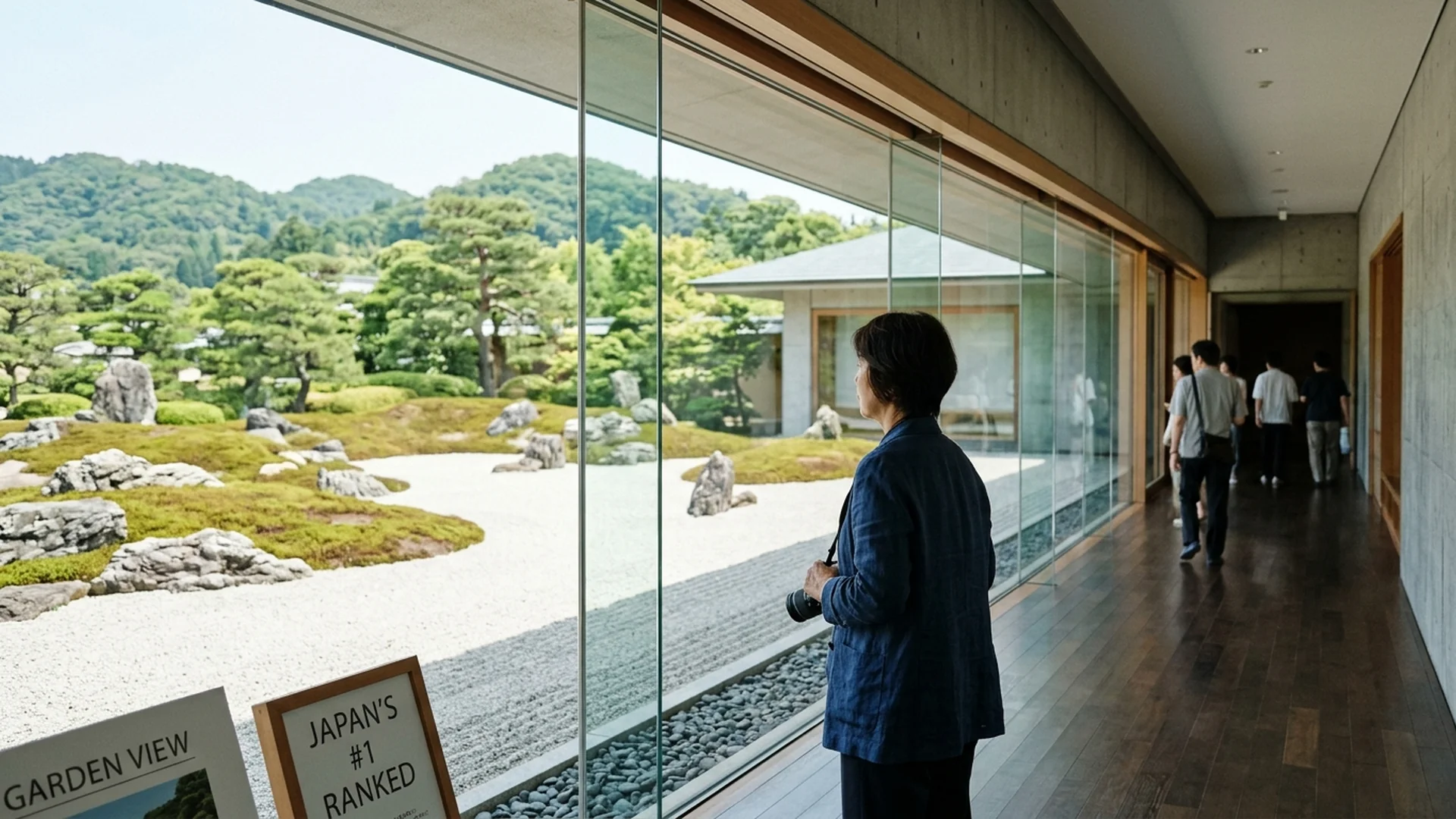
When the boundary between canvas and the natural world dissolves, what unfolds before the eye is not merely a landscape, but a living poem composed across time. At the Adachi Museum of Art in Shimane Prefecture, tranquility is absolute, and beauty refuses to be contained by interior wooden frames. Instead, it extends outward, embracing distant mountains, open skies, and rolling earth to forge a living masterpiece celebrated across the globe.
For more than two decades, the sanctuary’s gardens have reigned supreme, capturing the No. 1 ranking for Japanese gardens by the Journal of Japanese Gardening for twenty-one consecutive years, alongside the highest three-star distinction from the Michelin Green Guide Japan. This destination transcends casual sightseeing; it invites connoisseurs of aesthetics to immerse themselves in the profound philosophies of traditional landscaping, harmoniously paired with legendary collections of Nihonga Japanese paintings.
The Philosophy Behind the Living Canvas: Nature as Master Painter
Adachi Zenko, who founded the museum in 1970 with unwavering dedication, firmly believed that “a Japanese garden is itself a living canvas.” This guiding principle echoes through more than 50,000 square meters of meticulously landscaped grounds, subdivided into distinct environments including the Dry Landscape Garden (Karesansui), the White Gravel and Pine Garden, the Pond Garden, and the Moss Garden.
The true wonder lies in the precise curation of every element: distant ridgelines borrowed as natural backdrops (a technique known as shakkei), pine trees pruned to perfection down to every individual needle, and natural boulders positioned with profound intent. Every square inch is tended by master gardeners with the rigorous precision of high art, leaving zero room for error. Viewed through the expansive glass panes of the museum galleries, these vistas are framed to resemble classic scrolls that shift subtly with the passing winds, seasonal rains, and shifting daylight.
The Aesthetics of Living Scrolls and Framed Vistas
Beyond the arresting outdoor grounds, the museum interiors are thoughtfully designed to serve as contemplative galleries intimately linked to the outside world. A premier highlight is the wide architectural opening styled after a traditional hanging alcove (tokonoma), aptly termed the ‘Living Scroll.’ When visitors pause before this architectural aperture, the manicured stone garden and cascading waterfall outside compose themselves into a composition so balanced it feels touched by the brush of an ancient master.
Journeying through the exhibition rooms creates a meditative rhythm, alternating between the intimate contemplation of human-crafted artistry and the restorative greenery of the natural world just beyond the glass. The profound indoor silence amplifies the gentle murmur of water and the rustling of leaves, curating a sensory immersion rarely found in traditional museums.
Nihonga Treasures and the Spirit of Yokoyama Taikan
At the beating heart of the museum’s artistic holdings is a collection of over 1,300 traditional Japanese paintings, or Nihonga, which trace the evolution of modern Japanese aesthetics. The collection centers significantly on the influential works of Yokoyama Taikan, a titan of the Meiji to Showa eras.
Masterpieces by Taikan and esteemed contemporaries such as Kawai Gyokudo and Uemura Shoken are rotated seasonally to mirror the natural shifts occurring in the gardens outside. The delicate application of natural mineral pigments, crushed seashells, and genuine gold leaf upon fine silk or Japanese paper eloquently captures the nuance of nature, spirit, and quiet reflection. Contemplating these refined works while gazing out at the living gardens creates an ultimate aesthetic synthesis that binds artist, nature, and observer into a single experience.