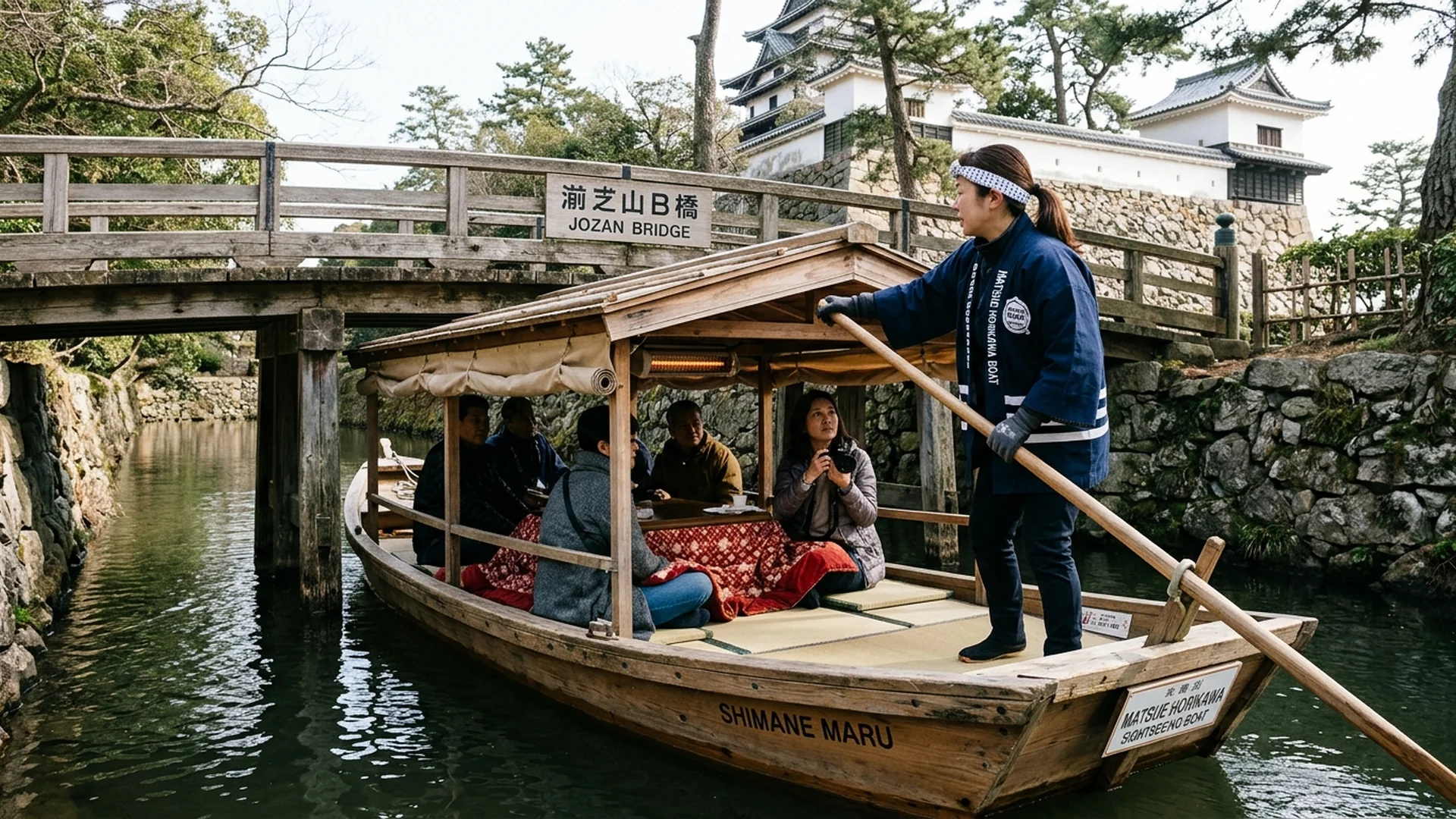
As the current of time flows quietly past the enduring foundations of Matsue Castle—one of Japan’s few remaining feudal fortresses retaining its authentic wooden keep—the echoes of the Edo period linger far beyond tiled gables and blackened beams. They ripple gently across the tranquil waters of the Horikawa moat, which encircles the historic town like a protective, silver ribbon.
Stepping aboard a compact, traditional vessel known locally as a Haikara-sen is akin to opening the pages of a living history book. Amidst the crisp breeze rustling through ancient maples and weeping willows along the banks, the rhythmic creak of wooden oars harmonizes with the gentle folk melodies sung by a veteran boatman. Slowly, passengers are carried backward into an era when samurai once patrolled these very fortifications. This is travel unhurried—an intimate immersion into the breathing soul of a destination rightfully celebrated as the City of Water.
A Four-Century Legacy: The Waters of Horikawa and Matsue Castle
Constructed in 1611 under the direction of daimyo Horio Yoshiharu, Matsue Castle was conceived with the Horikawa moat serving a dual purpose: a formidable natural defense barrier and a vital artery for transport and commerce. Navigating these waters today transcends a mere recreational pastime; it offers an authentic lesson in feudal urban planning, where defensive stone ramparts and aquatic pathways function in seamless harmony. Over the course of the 50-minute voyage, travelers gaze past seasonally shifting foliage, impeccably stacked granite retaining walls assembled without mortar, and heritage residences preserving the immaculate aesthetic of traditional Japan.
Low-Bridge Craftsmanship: The Art of the Lowering Canopy
A defining highlight that consistently delights travelers is the intricate choreography of passing beneath low bridges. Along the moat route, the vessel must navigate seventeen bridges, several of which hang so low that the boat’s roof appears destined to brush the stone arches. Here lies a masterclass in local ingenuity: the experienced boatman signals passengers to duck and lean forward while operating a specialized sliding canopy mechanism that lowers the roof flush against the hull. Sharing this brief moment of unified posture, accompanied by shared laughter and smiles, captures the graceful human adaptation to the physical contours of the landscape.
Four-Season Aesthetics: From Wind Chimes to Winter’s Warmth
The enduring charm of the Horikawa sightseeing boats lies in their chameleon-like adaptation to the turning of the year. During summer, gentle breezes coax delicate chimes from furin glass wind chimes hung around the cabin, creating a soothing acoustic backdrop to the gentle splashing of the oars. Conversely, when winter arrives and snow blankets the dark castle roofs, every vessel transforms into a Kotatsu Boat. These floating sanctuaries feature low heated tables draped with plush quilts, allowing bundled passengers to sip steaming green tea amid a pristine landscape reminiscent of classic monochrome ink paintings—a striking seasonal contrast offering profound, lasting memories.