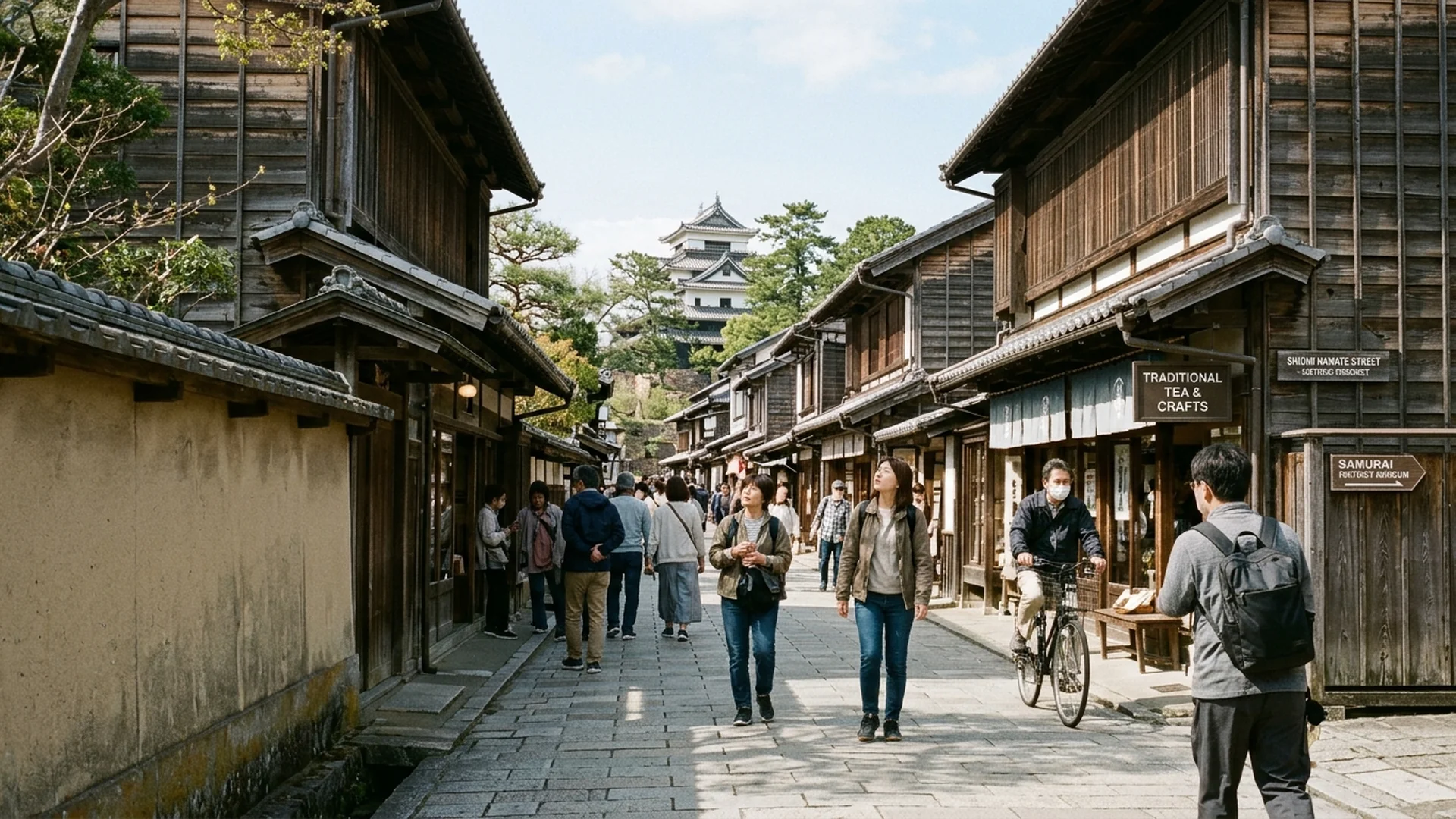
Passing beneath the boughs of ancient pine trees and alongside pristine whitewashed earthen walls, the clamor of the modern world simply dissolves. There remains only the whisper of wind across the moat’s surface and the soft crunch of footfalls on gravel paths. Shiomi Nawate Street, nestled in the historic castle town of Matsue within Shimane Prefecture, stands as a flawlessly preserved living archive of the Edo period. Stretching approximately five hundred meters, this boulevard transcends a mere historical landmark; it operates as an open-air museum where discerning travelers encounter the stoic spirit of the samurai through meticulously conserved architecture.
Visiting this designated cultural treasure offers an aesthetic distinctly removed from conventional tourism. The frantic neon and sensory overload of Japan’s megalopolises are replaced here by profound quietude, the refined minimalism of samurai residences, and the gentle grace of waterside living. For the global traveler seeking true cultural immersion and historical resonance, Shiomi Nawate provides an unhurried, contemplative sanctuary.
Architectural Aesthetics: Exploring Samurai Residences and Feudal History
Along the length of Shiomi Nawate, traditional dwellings adhere strictly to the external symmetry and austere dignity once mandated for high-ranking feudal retainers. The Matsue Samurai Residence, or Buke Yashiki, welcomes guests inward to study the domestic realities of the warrior elite. Within these generous tatami chambers, formal reception rooms, and meticulously tended zen rock gardens, every detail speaks to a philosophy of power tempered by profound simplicity.
Just a short stroll away stands the former residence of Lafcadio Hearn—subsequently known as Koizumi Yakumo—the Irish-Greek writer whose deep fascination with Japanese folklore led him to naturalize and chronicle the nation’s ghost stories for the Western world. The atmosphere surrounding his nineteenth-century home retains a contemplative literary grace, its rear garden framing tranquil views of the historic moat.
The Horikawa Waters and Culinary Heritage: Perspectives from Canal and Table
Another dimension of Shiomi Nawate reveals itself from the water aboard a traditional Horikawa Sightseeing Boat. These open, low-slung wooden vessels glide beneath low historical bridges, requiring the clever boatman to lower the canopy—and passengers to duck in unison—in a charming choreography rarely witnessed in modern cities. Drifting quietly along the castle moat affords an intimate perspective of towering stone ramparts and ancient timberlands.
Upon returning to dry land, seeking out a traditional parlor for Izumo Soba constitutes an essential culinary ritual. Crafted from whole-grain buckwheat, these rich, earthy noodles are typically served stacked in tiered lacquered baskets known as saru, accompanied by delicate local broths. The springy texture and nutty fragrance provide a thoroughly satisfying conclusion to a culturally immersive afternoon.