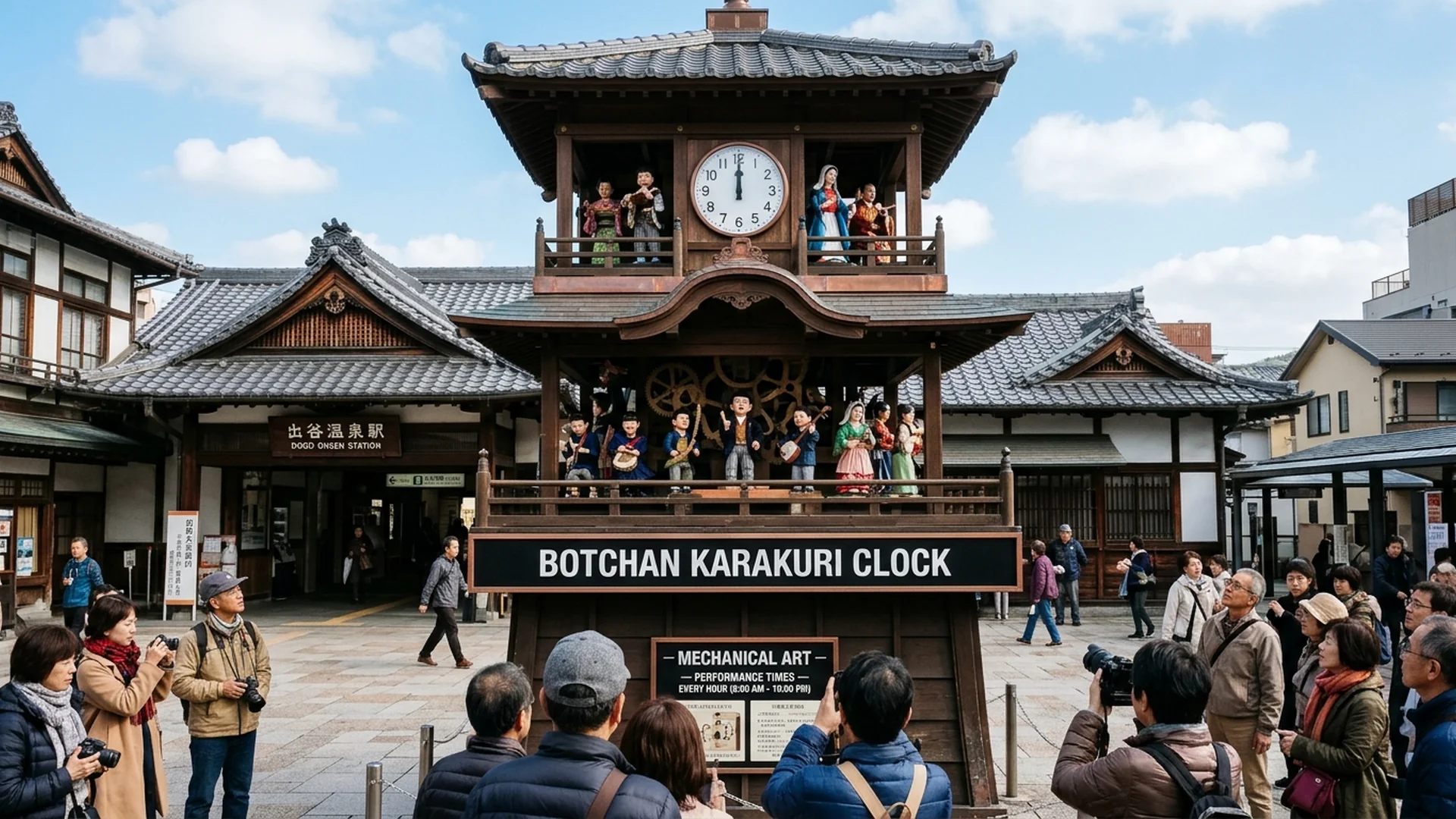
When the crystalline chime echoes across the historic precincts of Dogo Onsen, the veil between reality and literary masterpiece quietly parts. The towering clock tower—architectural homage to the anniversary turret of the legendary Dogo Onsen Honkan—springs to life through intricate mechanical choreography. This is far more than a mere timekeeper; it is a wondrous ‘karakuri’ automaton theater that brings the characters of Natsume Soseki’s classic Meiji novel, Botchan, dancing into the bustling Hojo-en square.
To journey to Matsuyama within Ehime Prefecture on the island of Shikoku is incomplete without standing in contemplative appreciation before this kinetic marvel. It serves as an effortless bridge connecting nineteenth-century nostalgia with the present day. We invite you to decode its precise gears, steep your senses in the restorative warmth of natural mineral springs, and absorb a spiritual dimension of cultural travel that transcends ordinary sightseeing.
Decoding Karakuri Artistry: Bringing Meiji Literature to Life
Standing tall in Hojo-en square directly before the Dogo Onsen Station, the Botchan Karakuri Clock was erected in 1994 to commemorate the station’s centenary. The tower draws its architectural inspiration from the ‘Yushinden’ and the distinctive gabled rooflines of the celebrated Dogo Onsen Honkan. Yet, the heartbeat that transfixes discerning travelers is the ancient Japanese tradition of ‘karakuri’—sophisticated historical mechanical puppet theater.
As the clock hands reach the appointed hour, the structure gracefully expands to the cadence of a distinct melodic theme, revealing hand-crafted figures from Soseki’s ‘Botchan’ stepping forth in sequence. From the righteous young schoolteacher protagonist and the ethereal Madonna to the formidable headmaster and other vibrant personalities, more than twenty figures come alive. The immaculate precision of the concealed gears and pulleys pays deep homage to both traditional craft and Matsuyama’s enduring affection for Natsume Soseki, who once resided here as an educator before immortalizing the city in print.
The Ritual of Thermal Warmth: Soaking Amidst Dogo’s Mists
At the base of the Botchan Karakuri Clock lies a public foot bath (ashiyu), thoughtfully provided complimentary for all visitors. Lowering one’s feet into the soothing, naturally heated mineral waters that rise from Dogo’s subterranean depths, contrasted against the crisp Shikoku air, offers a remarkably grounding aesthetic pleasure.
The thermal waters here are pristine, free of harsh sulfurous odors, and rich in minerals designed to alleviate the fatigue of travel while encouraging circulation. Sitting quietly at this junction while awaiting the clock’s next performance invites time to slow down. It affords every traveler the space to attune their senses to the cadence of passing footsteps, the rustle of traditional yukata robes, and the vibrant vitality of a thermal sanctuary that has thrived for over a millennium.
Bridging Paths to the Past: From Hojo-en Square to the Old Town Heart
Encountering the Botchan Karakuri Clock serves merely as the threshold to Matsuyama’s historical realm. A brief stroll from Hojo-en square leads through Dogo Haikara-dori, a pedestrian shopping lane paved in stone and lined with artisan boutiques, traditional confections like Matsuyama tarts, and renowned Ehime citrus wares, offering a seamless blend of heritage and contemporary craft.
This atmospheric route ultimately culminates at the Dogo Onsen Honkan, the venerable three-story timber bathhouse that famously served as a muse for animated masterpieces such as Spirited Away. Wandering through these lanes as golden afternoon light catches the ceramic-tiled roofs reveals precisely why Matsuyama remains an essential destination for connoisseurs of authentic Japanese aesthetics and literature.