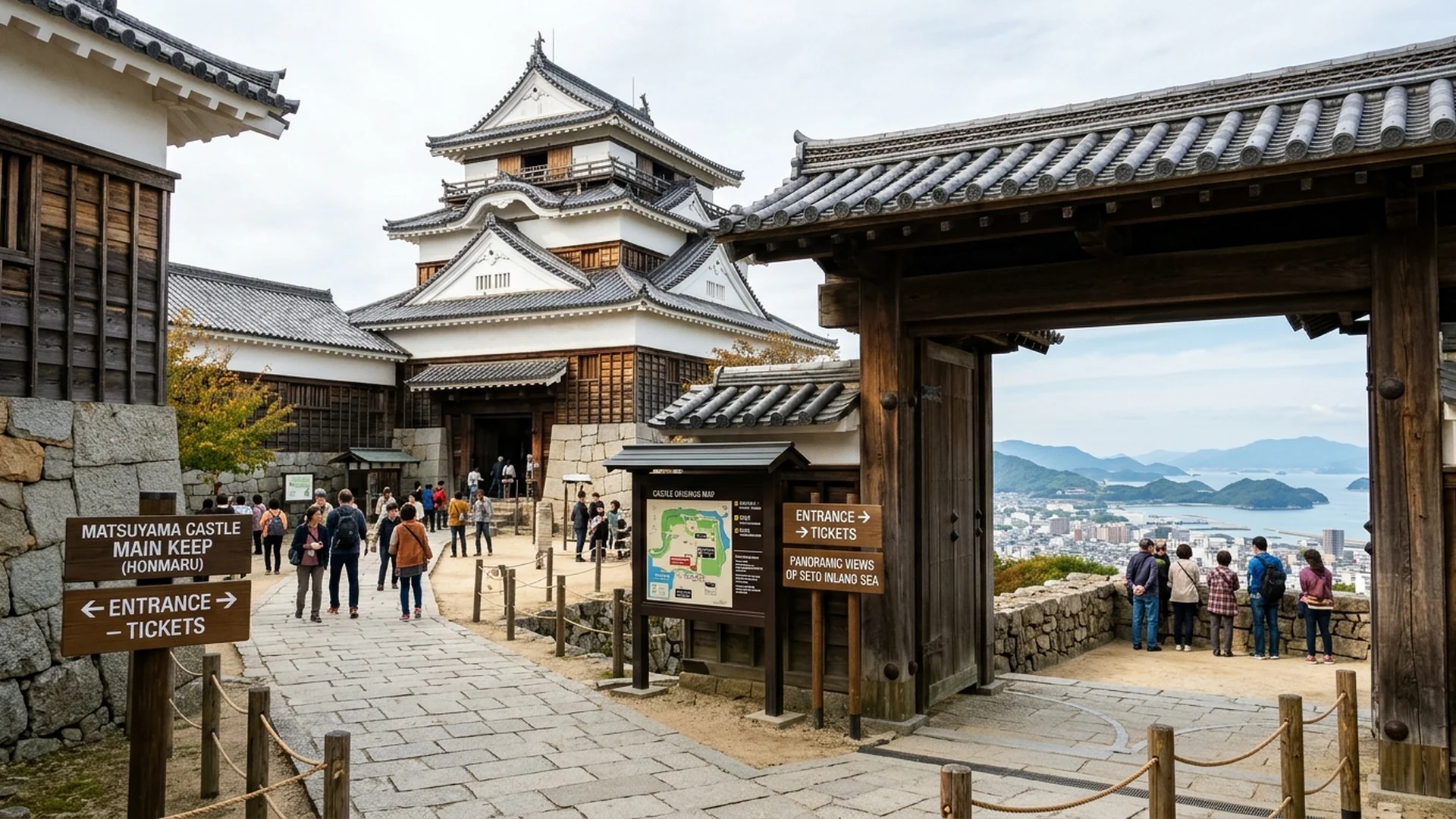
Rising serenely above the heart of Matsuyama in Ehime Prefecture, Mount Katsuyama is crowned by a pristine white fortress that has quietly defied the passage of centuries. This is far more than a mere historical landmark; it is one of Japan’s revered Twelve Original Keeps—sanctuaries of timber and stone that miraculously escaped the ravages of war, time, and the sweeping demolition policies of the Meiji restoration. Every square meter of its intricate wooden framework and defensive stone bastions functions as a grand architectural time capsule, eloquently whispering tales of samurai prestige and sophisticated feudal military strategy.
The ascension to this mountaintop stronghold offers an aesthetic rhythm entirely distinct from conventional sightseeing. As the cable car or open-air chairlift glides gently through dense canopies of emerald foliage, a breathtaking panorama unfolds: the orderly rooftops of Matsuyama blending seamlessly into the shimmering expanse of the Seto Inland Sea. Enveloped in profound tranquility and the living breath of history, Matsuyama Castle reveals itself as an irreplaceable pilgrimage for discerning travelers captivated by the authentic soul and architectural mastery of classical Japan.
Renritsushiki Architecture: The Art of Samurai Defense and Symmetry
Commissioned in the early Edo period by the visionary daimyo Kato Yoshiaki and constructed over two decades, Matsuyama Castle exemplifies a level of fortification artistry rarely seen today. Its defining architectural hallmark is the ‘Renritsushiki’ style—an intricate configuration where the main keep (Tenshu) connects directly to secondary towers and fortified gates through enclosed corridors and courtyards. This layout not only achieves a striking, balanced symmetry but was engineered for supreme tactical superiority, allowing defenders to cross-fire upon intruders from multiple blind angles. The surrounding stone ramparts utilize the sophisticated ‘Musha-gaeshi’ curving technique, designed to be steeply insurmountable even for the most seasoned warriors. Within the historic timber halls, carefully curated exhibitions of armor, weaponry, and peerless katana swords offer a profound glimpse into the austere elegance of the lords who once commanded this domain.
Mount Katsuyama Aesthetics: A 360-Degree Panorama of the Seto Inland Sea
Stepping out onto the grand stone plaza before the mountaintop keep feels akin to crossing a threshold into another dimension of time. Standing at the apex, the traveler is enveloped in an unbroken horizon. To the north, rugged mountain ranges fold into the distance; to the south, the orderly grid of Matsuyama unfolds below; and to the west, the azure waters of the Seto Inland Sea sparkle beneath the sun, dotted with the quiet silhouettes of distant islands. This sublime scenery transforms with the turning hours—from the soft golden glow of dawn where lingering mists embrace the city, to the dramatic rose-gold twilight casting long shadows across the dark tile roofs of the fortress, evoking a sense of enduring peace and quiet majesty.
Connected Heritages: From Mountain Keep to the Legends of Dogo Onsen
The true luxury of visiting Matsuyama lies in the seamless harmony between its martial history on the heights and the restorative repose found in the valley below. The castle does not exist in isolation; it shares a profound historical kinship with Dogo Onsen, one of Japan’s most ancient thermal bathhouses situated just moments away. In centuries past, the feudal lords and vigilant samurai who garrisoned this mountaintop relied upon the pristine, healing mineral waters of Dogo to soothe the fatigue of governance and martial drills. To spend the morning tracing the polished wooden corridors of the fortress, followed by an evening immersed in the restorative steam of a centuries-old bathhouse, is to complete a uniquely transcendent Shikoku journey.