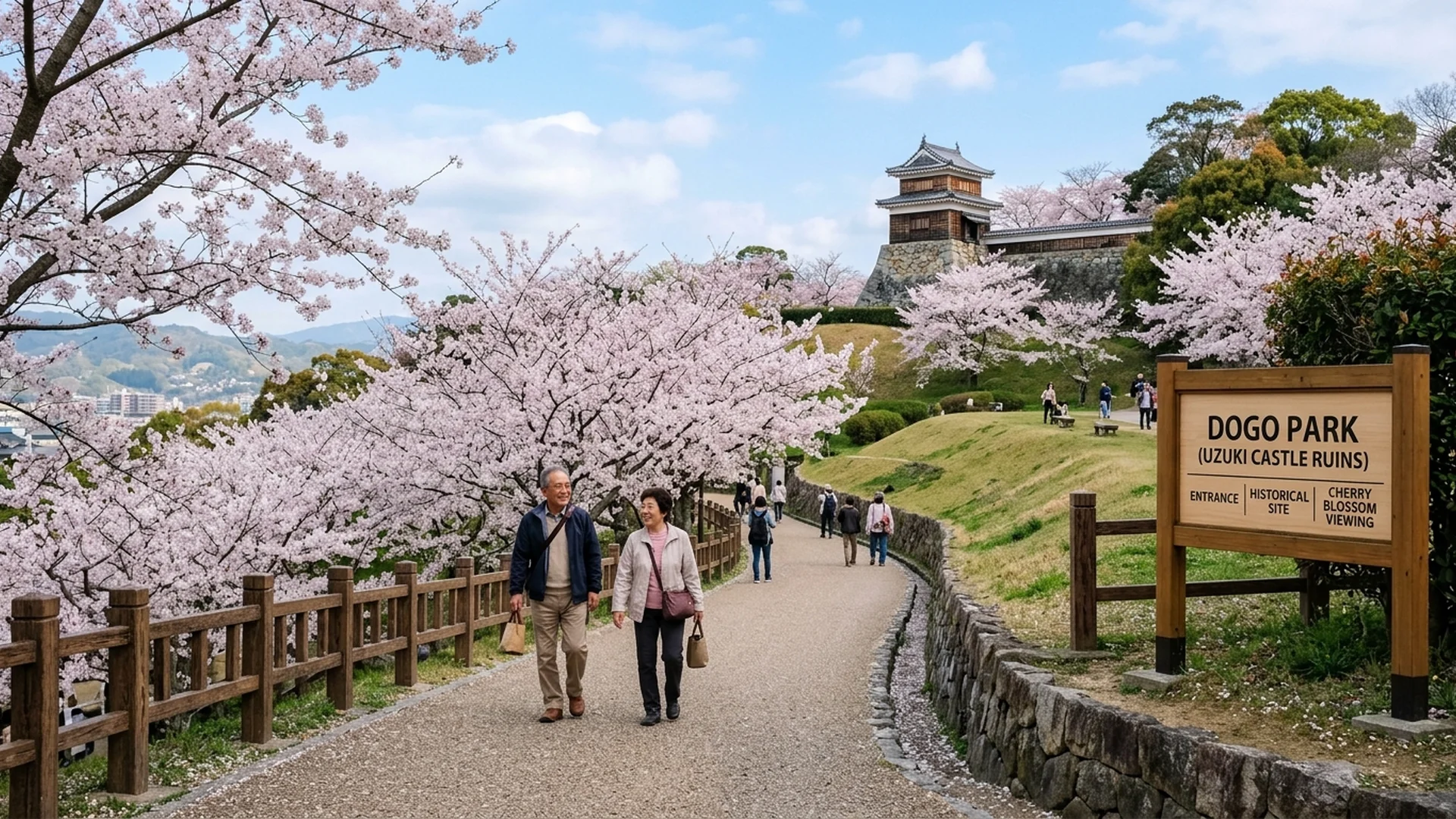
Amidst the rushing currents of the contemporary world, there exists a quiet corner in Matsuyama, Ehime Prefecture, where time slows its steady march. Dogo Park is far more than a conventional green expanse for afternoon leisure; this hallowed ground conceals the invaluable remnants of the Kono clan, the formidable feudal lords who once governed the ancient province of Iyo.
Crossing the threshold of the historic moat, the ambient clamor of the city dissolves, replaced instantly by the sigh of wind through ancient pines and the deep, glassy stillness of water reflecting the canopy above. Here lies a wondrous convergence: the contemplative solitude of the Sengoku era resting seamlessly against the vitality of Dogo Onsen, a restorative hot spring sanctuary revered for millennia. It is a place that invites discerning travelers to quietly decode centuries of history while bathing the senses in restorative nature.
Echoes of the Sengoku Era: Journeying Back at Yuzuki Castle Ruins
Beneath the manicured lawns and stately boughs of Dogo Park lie the foundations of Yuzuki Castle, officially designated as a historic landmark and celebrated among Japan’s one hundred finest castles. Established during the fourteenth century by the influential Kono clan of Shikoku, the fortress diverges from the towering stone Keeps of later eras. Instead, its brilliance lies in an ingenious defensive architecture of concentric moats and steeply graded earthen ramparts that harness the natural topography. A morning walk along these ancient trenches and earthen mounds offers an authentic encounter with the military strategy and medieval prosperity of feudal antiquity.
The Seasonal Wheel: From Spring Petals to Autumnal Solitude
Dogo Park functions as a living canvas, its palette shifting profoundly with the turning of the year. In spring, the grounds transform into a delicate wash of pale pink as over a hundred cherry trees burst into blossom along the historic moats, drawing locals and mindful travelers alike to sit beneath their canopy in tranquil communion. As autumn arrives, the foliage transitions into rich embers of copper, amber, and gold. Mirroring perfectly upon the calm waters, this autumnal transition fosters an atmosphere primed for introspection and deep appreciation of Shikoku’s understated natural splendor.
Cultural Legacies: The Museum and Life Along the Moat
Beyond its natural landscape and castle earthworks, the park houses the Yuzuki Castle Ruins Museum, a refined repository showcasing archaeological finds, medieval artifacts, and everyday implements that vividly illuminate life in the Middle Ages. Furthermore, the surrounding landscape design thoughtfully evokes the architectural vernacular of samurai dwellings and historic moat systems. For those captivated by history, it offers a rare opportunity to study firsthand the spatial organization and domestic strategies of Japan’s historical ruling class.