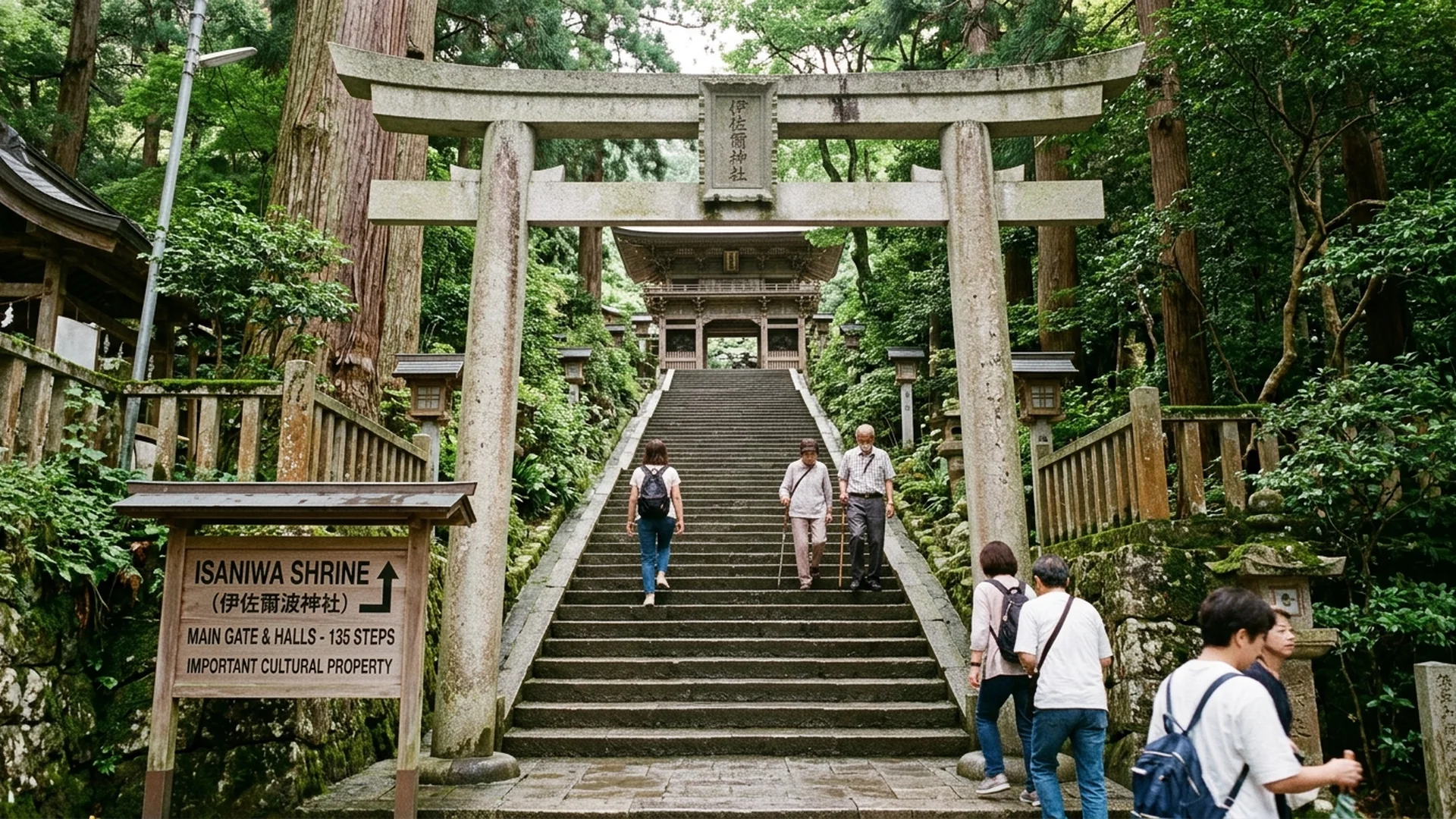
As the morning mist lifts over the weathered timber roofs of the historic Dogo Onsen district, an enduring aura of antiquity lingers along the quiet hillside above. Here, one hundred and thirty-five stone steps sweep upward, beckoning travelers away from the gentle bustle below toward a profound repository of cultural heritage. Isaniwa Shrine is far more than a conventional sanctuary of worship; it stands as a sublime architectural archive of Shinto craftsmanship, exceptionally rare within the modern landscape of Shikoku Island.
To cross the threshold into this elevated realm is to embark on a quiet passage backward through time, into an era where woodcraft and spiritual devotion were inextricably fused. As one of only three surviving architectural examples of the revered Hachiman-zukuri style in all of Japan, Isaniwa Shrine reveals its splendor through vermilion pillars set against a deep emerald backdrop, intricate structural framing, and subtle traces of ancestral wisdom tucked quietly along its covered corridors, offering discerning visitors a rare encounter with a designated national treasure.
Hachiman-zukuri Architecture: A Rare Architectural Legacy Surviving in Only Three Domains
The architectural heartbeat of Isaniwa Shrine lies within its defining Hachiman-zukuri framework, an ancient and exceedingly sophisticated style of Shinto design. The primary sanctuary, or Honden, is composed of two parallel structures joined harmoniously beneath a unified, sweeping roofline, directly mirroring the layout of Kyoto’s famed Iwashimizu Hachimangu.
Upon passing through the brilliant vermilion tower gate, the sacred precinct reveals the immaculate precision of classical imperial carpentry. The columns enveloping the main hall shimmer subtly with application of genuine gold leaf, complemented by intricate wood carvings of flora and fauna embellishing the curved ‘Ebi-koryo’ tie-beams and the frog-leg ‘Kaerumata’ brackets. Every element testifies to a golden age of artistry preserved in pristine condition, earning the complex its esteemed status as an Important Cultural Property of Japan.
From Imperial Legend to the Patronage of the Matsudaira Clan
The ancestral roots of Isaniwa Shrine run deep into the chronicles of ancient antiquity. According to local lore, the sanctuary traces its spiritual lineage to Emperor Chuai, Empress Jingu, and the deity Ojin, who once journeyed to bathe in the restorative waters of Dogo Onsen. The shrine’s presence was officially documented as early as the Heian period within the Engi Shiki legal and ritual codes.
During the 14th century, the noble Kono clan relocated the shrine to its present elevated site upon the hillside. Subsequently, the Matsudaira clan—the feudal lords governing the domain of Iyo during the Edo period—bestowed comprehensive restorations that brought the complex to its current zenith of architectural grace. To ascend this sacred ground is to wander quietly through layers of political history, fierce devotion, and the enduring bond between the people of Matsuyama and their guardian deities.
The Covered Corridors and the Esoteric Wisdom of Sangaku
Beyond the grand scale of the primary sanctuary, the encircling covered galleries harbor an intellectual legacy that consistently captivates thoughtful travelers: the Sangaku mathematical tablets. These are hand-painted wooden panels inscribed with complex geometric problems and theorems, created by scholars and common citizens alike during the Edo and Meiji eras, then dedicated to the deities as both offerings of gratitude and intellectual puzzles for fellow visitors to contemplate.
To pause and study these weathered wooden tablets amidst the whisper of mountain breezes across the antique verandas is to discover an unexpected facet of Japanese sacred spaces. They reveal that shrines served not solely as venues for spiritual rites, but as vibrant centers of learning and quiet intellectual discourse for ordinary citizens, seamlessly wedding the rigorous elegance of mathematics with sacred art.