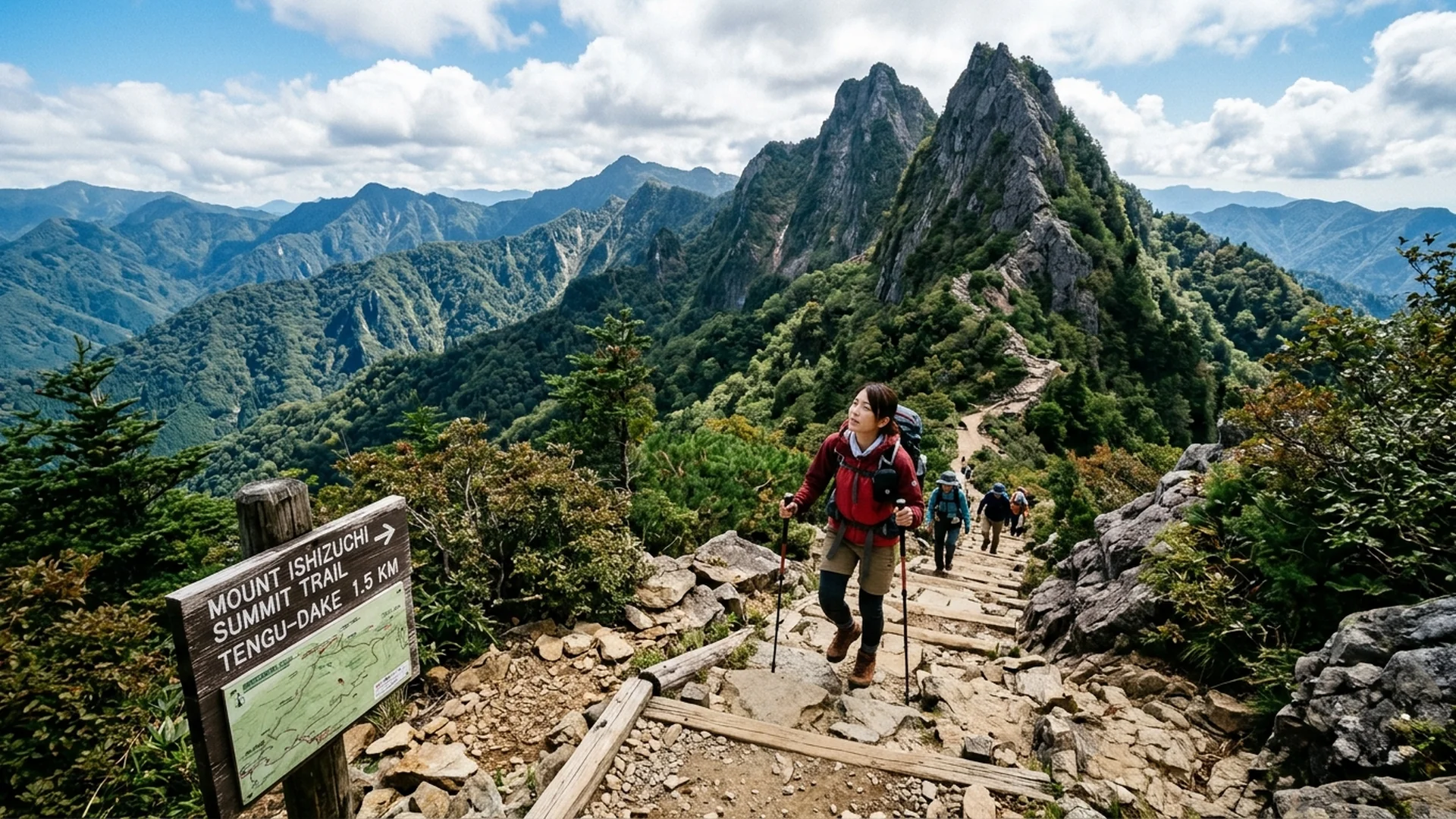
As the morning mists gently lift, a formidable wall of dark grey stone emerges, piercing the azure sky. This is Mount Ishizuchi, the loftiest pinnacle on Shikoku Island and throughout western Japan at 1,982 meters. Far more than a mere coordinate on a topographic map, it is a sanctified natural cathedral steeped in a millennium of spiritual history. As one of Japan’s seven sacred mountains, it has long drawn devoted practitioners of Shugendo—the ancient syncretic path of mountain asceticism—who sought spiritual refinement through the austere challenges of the wilderness.
To journey to Ishizuchi is to engage in a silent dialogue between the profound stillness of primeval forests and the exhilarating thrill of gravity-defying cliffs. The route seamlessly weaves the modern comfort of an aerial tramway with the raw, elemental challenge of sheer precipices. Here, travelers are rewarded with sweeping panoramas stretching across the Iyo Nada sea and rolling seas of mist, all while encountering the enduring, quiet pulse of Japan’s ancient spiritual heritage lingering above the canopy.
The Legacy of Shugendo: Whispers from Precipices and Sacred Iron Chains
Along the upper reaches of Mount Ishizuchi, the air thins noticeably, ushering in an atmosphere of solemn reverence. This mountain has long served as a rigorous training ground for Yamabushi ascetics—practitioners of Shugendo who immerse themselves in the raw, elemental forces of nature through a profound synthesis of esoteric Buddhism and Shinto traditions.
The most celebrated and pulse-quickening test of a traveler’s mettle here is the Kusari-ba, a series of historic iron-chain climbing routes spanning varying degrees of difficulty. From the initial 33-meter ascent to the final, dizzying vertical stretch approaching a 68-degree incline, scaling these chains is far more than a physical exercise in mountaineering. It is a deeply symbolic ritual of spiritual purification, designed to strip away ego and transcend fear. For those preferring a more measured approach, the park thoughtfully maintains a secure, gracefully winding walking path along the cliffside that offers an equally rewarding perspective.
From the Ishizuchi Ropeway to Tengudake: An Alpine Sanctuary
The ascent begins effortlessly aboard the Ishizuchi Ropeway, among the longest aerial tramways in the Shikoku region, carrying passengers soaring past 1,300 meters above sea level within a matter of minutes. Below unfolds an ancient forest whose canopy undergoes a dramatic seasonal transformation, shifting from emerald summer greens to a rich, blazing tapestry of crimson and gold in autumn.
Upon disembarking and continuing on foot past the serene precincts of the Ishizuchi Shrine at Jojusha, the trail navigates the ridge of Sengetsu before reaching the true pinnacle: Tengudake at 1,982 meters, characterized by its narrow, dramatic stone ridge. Standing upon this summit reveals a boundless sea of clouds rolling toward the Seto Inland Sea. On exceptionally clear days, the sweeping vistas extend effortlessly across the entire southern expanse of the Shikoku mountain range.
The UFO Line and Ehime’s Wilderness: A Dreamlike Sky Road
Beyond the footpaths leading to the summit, the surrounding terrain of Mount Ishizuchi connects to one of Japan’s most cinematic alpine byways: the UFO Line, formally known as the Kamegamori Ridge Route. Suspended at elevations between 1,300 and 1,700 meters above sea level, this asphalt ribbon contours gracefully along undulating mountaintops, creating the sublime illusion of driving directly through the clouds.
Journeying along this ridge feels akin to moving through a classical ink wash painting. In autumn, golden alpine grasses blanket the rolling crests, contrasting sharply with the deep indigo of the sky above and evoking a rare sense of liberating solitude. It is a sanctuary where discerning travelers naturally pause, turning off the engine simply to absorb the profound quietude and crisp, alpine air of Shikoku’s roof.