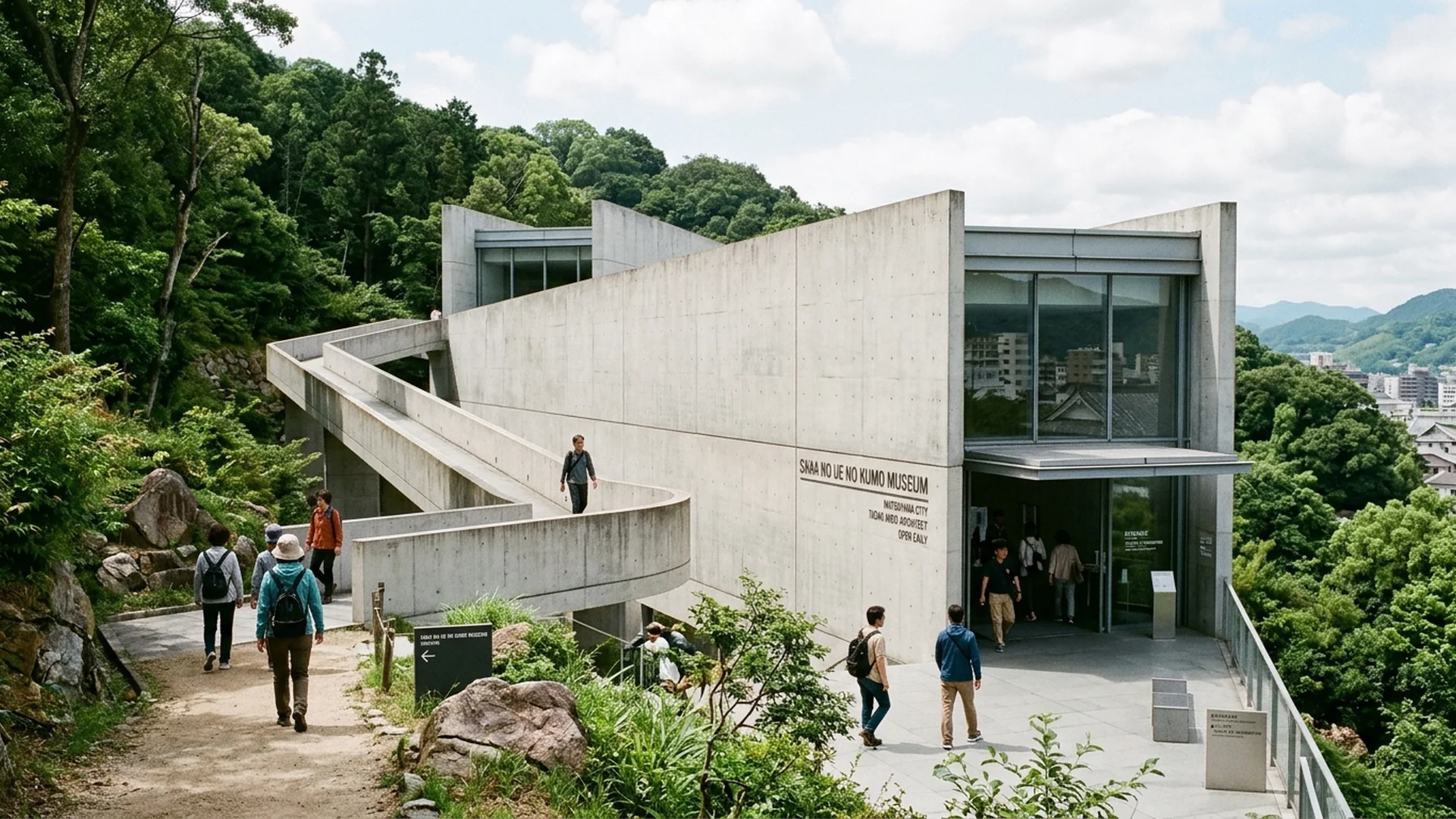
As the late afternoon sun casts elongated shadows across cold, raw concrete surfaces, the sharp triangular geometry of this understated gray edifice reflects the warmth of passing time at the heart of Matsuyama in Ehime Prefecture. Here stands the Saka no Ue no Kumo Museum, a sanctuary where global avant-garde architecture converges with the rich historical tapestry of Japan’s Meiji era. Step into a space brought to life by the visionary philosophy of Tadao Ando, the master architect who transforms structural concrete into poetry.
More than a mere repository of artifacts, the museum is conceived as an architectural pilgrimage. Its dynamic forms echo the ambitious ascent depicted in Ryotaro Shiba’s seminal historical novel, inviting discerning global travelers to contemplate a pivotal epoch of modernization through the lens of pure geometry, natural light, and serene spatial voids.
Geometry of Light and Shadow: The Triangular Architecture of Tadao Ando
Tadao Ando does not merely design buildings to house exhibitions; he crafts ‘spaces for internal journeys.’ The building’s unconventional triangular footprint—defying standard orthogonal grids—mirrors the steep inclines of life’s path and the steadfast drive toward the heavens. Sweeping internal ramps connect the floors, engineered specifically to channel natural daylight through expansive glass panels. The resulting interplay of shifting shadows, which evolves with the sun’s trajectory across the hours, evokes profound stillness. It invites the visitor to pause, reflect, and ascend metaphorically toward the clouds, echoing the poetic namesake of the institution.
Meiji Intellectual Legacy: The Literary Roots of ‘Saka no Ue no Kumo’
The museum’s moniker and ideological foundation are drawn from Ryotaro Shiba’s monumental historical novel, which chronicles the tenacity of Meiji-era Japan through the true lives of three luminaries hailing from Matsuyama. These figures include Yoshifuru Akiyama, who pioneered modern cavalry tactics; Sanada Akiyama, instrumental in shaping the Imperial Japanese Navy; and Masaoka Shiki, the revolutionary poet who modernized haiku and tanka for a changing world. The exhibitions inside preserve the aspirations, unwavering dreams, and profound dedication of a generation that continually looked forward, pressing onward like clouds drifting across distant summits.
Aesthetic Refinement and Deep Rest in Matsuyama
Beyond its engagement with art and history, the museum offers a deeply restorative spatial experience. The serene Library Lounge gathers a curated collection of significant volumes and multidisciplinary writings, inviting guests to gaze through sweeping glass walls framing the surrounding urban landscape. Visitors can sip tea or coffee served in authentic ‘Tobe-ware’ ceramics—traditional indigo-patterned porcelain originating from Ehime Prefecture. This thoughtful touch unites contemporary minimalist design with enduring regional heritage in quiet, effortless harmony.