Travelers frequently consign Mito to a mere transit station on the swift railway architecture heading toward the Tohoku region. Yet, if one slows their pace and allows time to unfurl at an unhurried cadence, this capital of Ibaraki Prefecture gradually reveals profound layers of civilization. Here, the ancestral spirit of the Tokugawa samurai clan still drifts across the gentle breezes of Lake Senba, and ancient Eastern philosophy is articulated with subtle mastery through earth, stone, and falling leaves. Journeying to Mito transcends conventional sightseeing; it is an awakening of the senses to a philosophy of slow luxury, seamlessly bridging centuries-old imperial heritage with contemporary artistic vision.
Crossing into the territorial boundaries of Mito, one does not merely tread upon modern concrete. We are walking across one of the most culturally potent pages in Japanese history. The hypnotic allure of this city rests beneath quietude, verdant canopies, and architectural forms that reflect the far-sighted wisdom of feudal lords past. This sanctuary is where the rigorous discipline of Bushido converges with the delicate refinements of classical Japanese aesthetics, offering a gracious welcome to the discerning global traveler seeking meaning far beyond transient tourism.
The Philosophy of Yin and Yang: Seasonal Poetry at Kairakuen Garden
When discussing the masterworks of landscape design in Mito, Kairakuen Garden stands indisputably at the forefront. Esteemed as one of Japan’s three most exquisite landscape gardens—alongside Kenroku-en in Kanazawa and Korakuen in Okayama—Kairakuen possesses a distinct identity rooted in its founding ethos. Rather than serving as a private pleasure ground for feudal lords, the very name ‘Kairaku,’ signifying ‘sharing happiness with others,’ reflects the progressive vision of Lord Tokugawa Nariaki when he established the sanctuary in 1842.
The architectural landscape of Kairakuen is rich with philosophical symbolism drawn from Chinese and Japanese thought, particularly the delicate equilibrium between ‘Yin’ and ‘Yang.’ The refined Kobuntei pavilion, standing in quiet elegance within the grounds, represents subtlety and grace (Yin), contrasting with the dense, robust groves of Moso bamboo and dark, towering cedars (Yang). When spring arrives, the gardens transform into an impressionistic canvas painted with the blossoms of over 3,000 plum trees of diverse lineages. These ancient branches not only perfume the mountain air with delicate fragrance but also stand as living metaphors for endurance through winter’s chill to fully blossom into the splendor of life.
Interlocking Eras: The Honor of Kodokan and Mito Castle
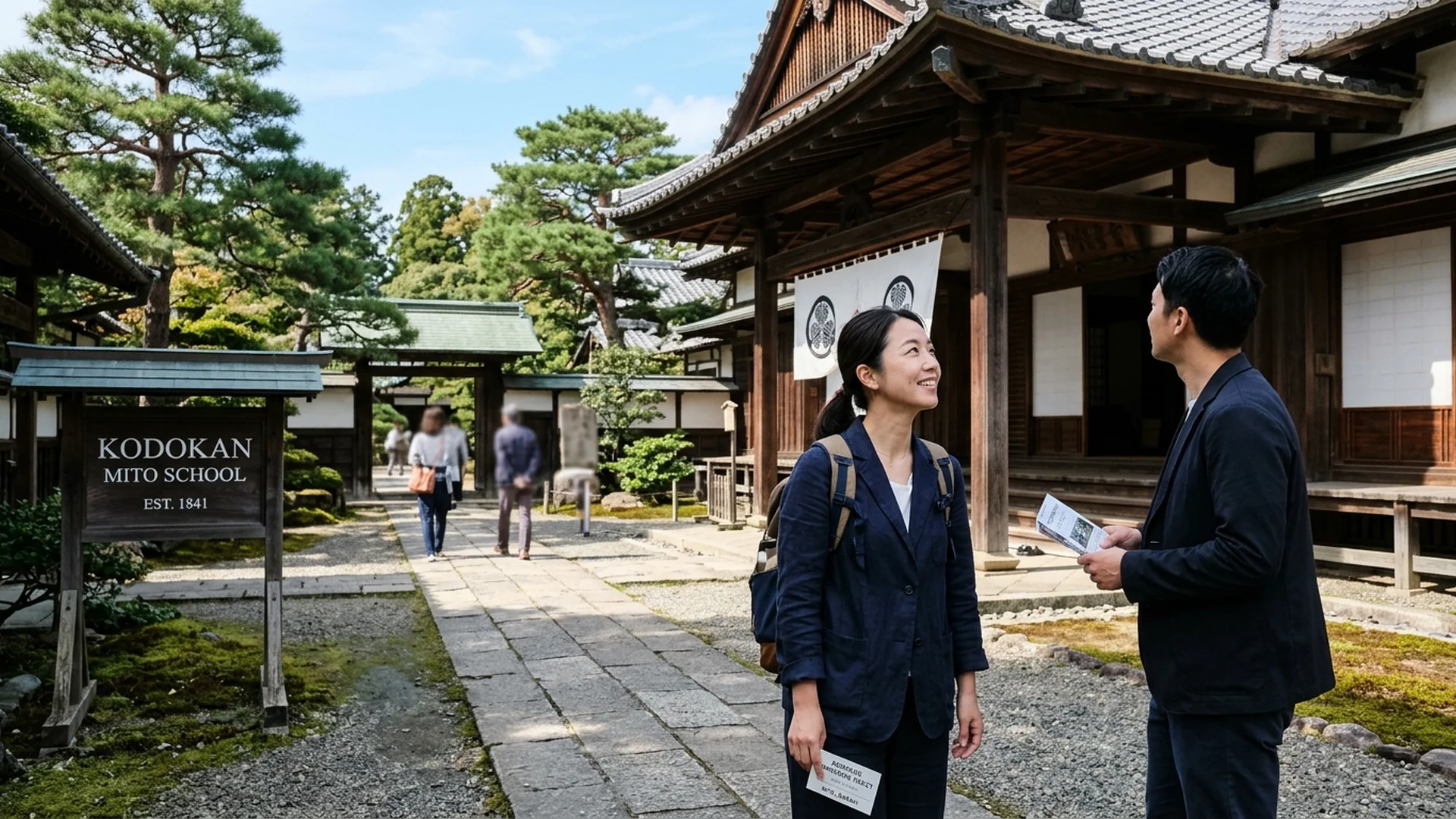
The formidable legacy of the Mito Tokugawa—a powerful cadet branch of the ruling shogunate—is preserved through imposing educational and administrative architecture. Kodokan, situated at the heart of Mito, served as the preeminent domain academy in Edo-period Japan. This institution was far more than a simple school of Confucian texts or martial arts; it functioned as an ideological furnace, forging scholars and reformers who steered the course of the Meiji Restoration. The atmosphere within these ancient classrooms retains an aura of solemn gravity, where heavy timber columns and weathered wooden plaques whisper of an unwavering dedication to national cultivation through education.
Not far away lies the historic domain of Mito Castle. Although the central keep succumbed to the ravages of time and conflict, the Ninomaru Gate has been meticulously restored using traditional carpentry techniques, restoring its former dignity. Stroll past ancient stone ramparts and tranquil moats during the amber hours of the afternoon, and one can easily imagine walking as a loyal samurai guardian, enveloped in the quietude that peacefully coexists with modern Ibaraki.
Contemporary Art and Poetic Aesthetics Around Lake Senba
Mito is by no means a city frozen in amber; its true fascination lies in its bold synthesis of cutting-edge modernity and deep cultural roots. This synthesis finds its expression in Art Tower Mito, a striking 100-meter-tall contemporary art tower composed of interlocking triangular spirals, designed by the renowned architect Arata Isozaki. Functioning as an international cultural nucleus housing a theater, a world-class concert hall, and avant-garde galleries, it continually draws fine-art aficionados from across the globe.
The aesthetic journey of Mito extends naturally to the shores of Lake Senba. This tranquil, naturally rectangular lake anchoring the city center serves as the verdant lung and open salon for local residents. A three-kilometer path tracing the perimeter of the water offers some of the most sublime sunset vistas in the region. Drifting white swans and migrating waterfowl glide smoothly across the surface, mirroring the quiet skyline—a flawless synthesis of natural serenity and urban vitality.