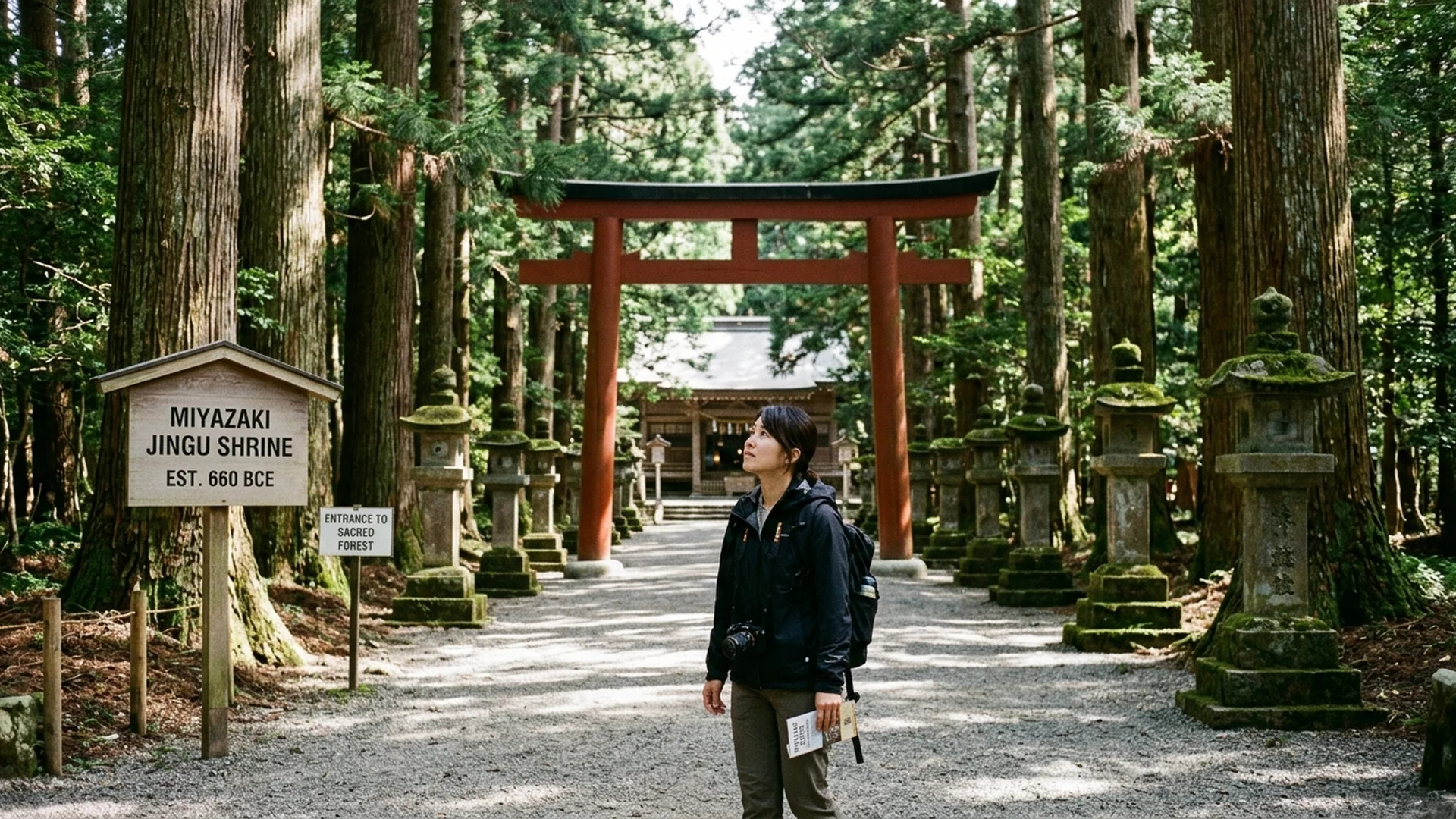
As the first morning light filters through towering cedar canopies, a delicate mist lingers above the sacred woodland at the heart of Miyazaki. The gentle crunch of gravel beneath foot and the faint, earthy fragrance of natural timber signal a quiet transition into another dimension of time. Miyazaki Jingu is far more than a conventional Shinto sanctuary; it is the profound starting point of imperial mythology and ancestral roots in Japan, where millennia of history meld seamlessly with profound natural stillness.
Amidst the rapid pace of the modern world, this verdant sanctuary preserves the pristine purity of an ancient spiritual realm. The surrounding forest teems with native cedar trees that have grown unhindered for centuries. Every step deeper into the hallowed grounds mirrors a return to an era when humanity maintained an intimate communion with deities and the earth itself, guided by the enduring legend of the nation’s founding sovereign.
The Imperial Dawn: Emperor Jimmu’s Footprints Across Kyushu
Miyazaki has long been revered as a ‘kokufu’ or ancestral cradle of myth and legend. According to ancient chronicles such as the Kojiki and Nihon Shoki, Emperor Jimmu—historically styled Kamiyamato Iwarebiko no Mikoto—was born and raised in this very region before leading a historic maritime expedition from the shores of Kyushu to establish the Japanese imperial realm in the Kanto plain. Miyazaki Jingu was established to commemorate his legacy, tracing its spiritual origins to antiquity and undergoing careful restorations across the eras. A pilgrimage to this site transcends mere architectural appreciation; it is an immersive exploration into the foundational beliefs that have shaped the Japanese identity for millennia.
Sano Sugi Architecture: The Aesthetics of Simplicity by Ito Chuta
The architectural language of Miyazaki Jingu profoundly reflects traditional Japanese aesthetic philosophy. The main sanctuary, or Honden, is crafted from exceptional local Sano Sugi cedar, celebrated for its exquisite grain and enduring resilience. Notably, the timber remains unpainted, allowing the natural surfaces to weather gracefully alongside the elements. Subsequent design and restoration works led by Ito Chuta, one of Japan’s most influential architects, masterfully harmonized the grandeur of Shinto architecture with profound humility toward the surrounding environment. Massive cedar pillars rise to support thick bark-roofed gables, projecting a quiet, solemn elegance.
Dimensions of Faith: Torii Tunnels and Sacred Woodlands
Beyond the main shrines, the sacred grounds harbor expressions of diverse spiritual devotion, most notably the Gosho Inari Shrine, nestled deep within a dense thicket of greenery. The highlight here is a pathway framed by dozens of radiant vermilion torii gates winding through the woodland, creating a striking visual contrast between scarlet pillars and emerald foliage. Traversing this tunnel of gates feels akin to crossing a threshold between the mortal realm and the heavens. The surrounding atmosphere resonates with a profound quietude, broken only by wind rustling through pine needles and the distant calls of forest birds, inviting deep contemplation.