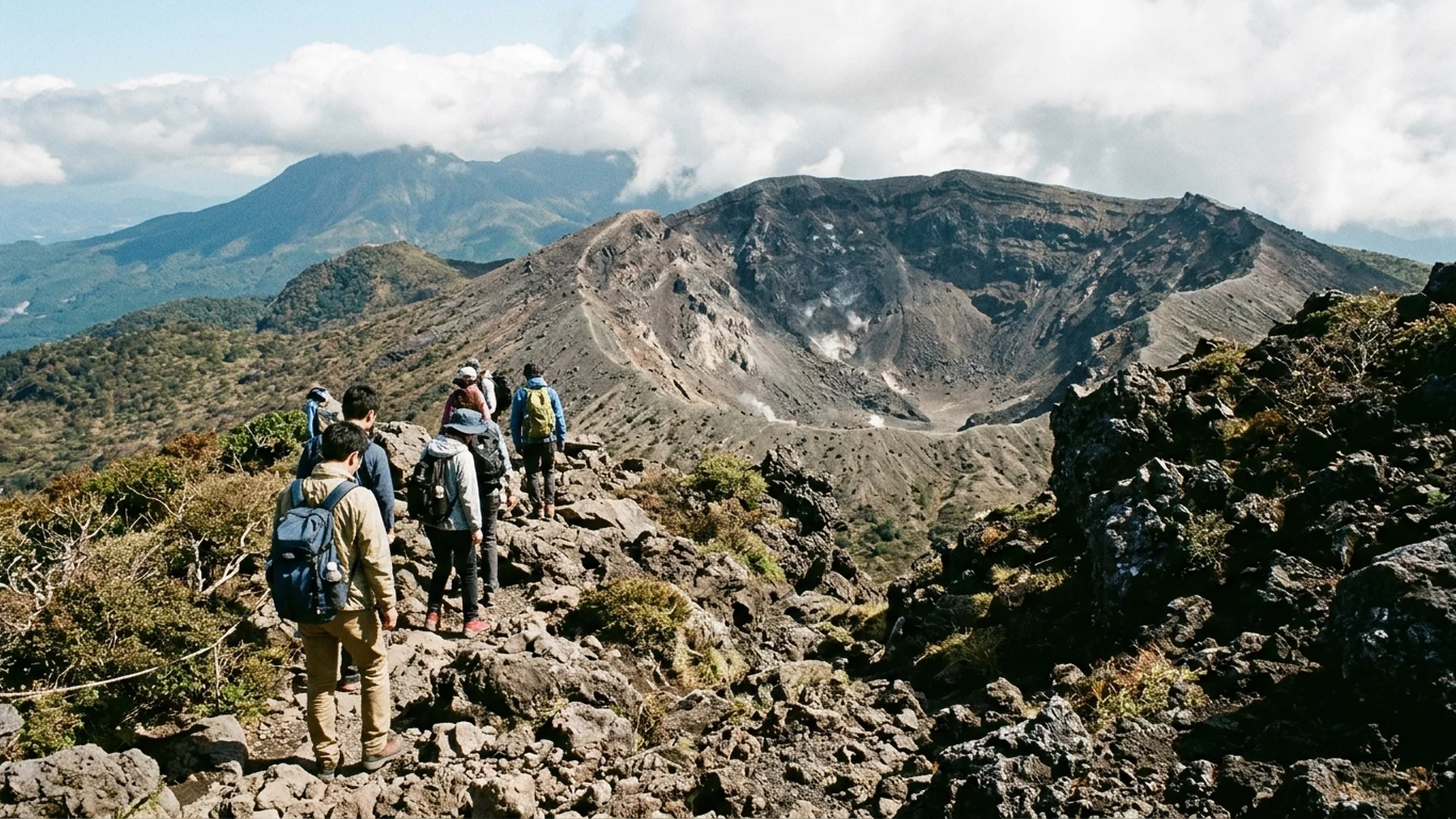
When crisp winter mists descend upon the cascading ridges of southern Kyushu, distant echoes of the heavenly descent of deity Ninigi-no-Mikoto still drift through ancient, untouched forests. Established in 1934 as one of Japan’s earliest protected preserves, Kirishima-Kinkowan National Park functions far beyond a standard wilderness area. It is a living geological archive where centuries of tectonic transformation intertwine with deep spiritual devotion to a formidable, breathtaking landscape.
To visit Kirishima-Kinkowan is to transcend ordinary geography, stepping directly into the pulsing thermal breath of the earth. From emerald crater lakes resting high in the clouds to the azure expanse of Kinkowan Bay—dominated by the ever-smoking silhouette of Sakurajima—every panorama reveals raw natural majesty. Paired with the refined hospitality of secluded luxury hot spring ryokans hidden amongst pristine woodlands, this southern sanctuary delivers the unhurried depth sought by discerning global travelers.
Two Realms of Contrast: Between the Kirishima Heights and Kinkowan Bay
The extraordinary character of Kirishima-Kinkowan National Park lies in its harmonious juxtaposition of contrasting topographies. The first zone, the Kirishima Mountain Range, encompasses over twenty interconnected volcanic peaks. Rising 1,574 meters above sea level, the highest summit—Takachiho-no-mine—is revered in mythology as the sacred site where the heavenly spear, Amano-hakaiboko, was planted to forge the foundation of Japan. Traversing the upland trails leads explorers to Lake Onami, the highest crater lake in the country, whose tranquil waters mirror the seasonal metamorphosis of the surrounding canopy.
Crossing into the Kinkowan Bay zone, the scenery shifts toward sweeping coastal majesty dominated by Sakurajima, an active stratovolcano rising proudly in the center of Kagoshima Bay. Whether cruising across the bay or admiring the vista from the Osumi Peninsula—particularly at Cape Sata, the southernmost tip of Kyushu—visitors are reminded of the titanic geological forces that have shaped regional culture for centuries.
Kirishima Jingu: Architecture of Devotion Beneath Millennial Cedars
Deep within the serene forests of the Kirishima highlands rests Kirishima Jingu, one of Kyushu’s most sacred and visually arresting architectural masterpieces. The shrine complex is distinguished by its striking vermilion palette, which provides a vivid contrast against the emerald fronds and eight-hundred-year-old sugi cedar trees guarding the perimeter. The approach, laid with immaculate white gravel, establishes an atmosphere of profound reverence.
Constructed to honor deity Ninigi-no-Mikoto, grandson of the sun goddess Amaterasu, the shrine architecture exemplifies Edo-period craftsmanship through intricate lacquerwork and gilded woodwork. Stepping onto these hallowed grounds offers more than aesthetic appreciation; it invites travelers to quiet the mind, reflect inward, and absorb the pristine energy generated by centuries of uninterrupted spiritual practice.
The Art of Repose: Premium Onsen Ryokans and Satsuma Culinary Heritage
The cornerstone of any pilgrimage to Kirishima is immersion in its world-class thermal spring culture. Fed by mineral-rich subterranean aquifers, premier properties within the Kirishima Onsen Village are thoughtfully integrated into their natural surroundings. Guests soak in pure, sulfurous springwater within private open-air rotenburo baths, enveloped by forest vistas and birdsong for profound physical and mental restoration.
When evening arrives, culinary artistry takes center stage through multi-course kaiseki dinners crafted from historic Satsuma ingredients. Highlights include Kagoshima Kuroge Wagyu beef grilled over fragrant leaves, meltingly tender Kurobuta black pork, seasonal mountain vegetables, and fresh catches from Kinkowan Bay, thoughtfully paired with local sweet potato shochu to celebrate the bounty of southern Kyushu.