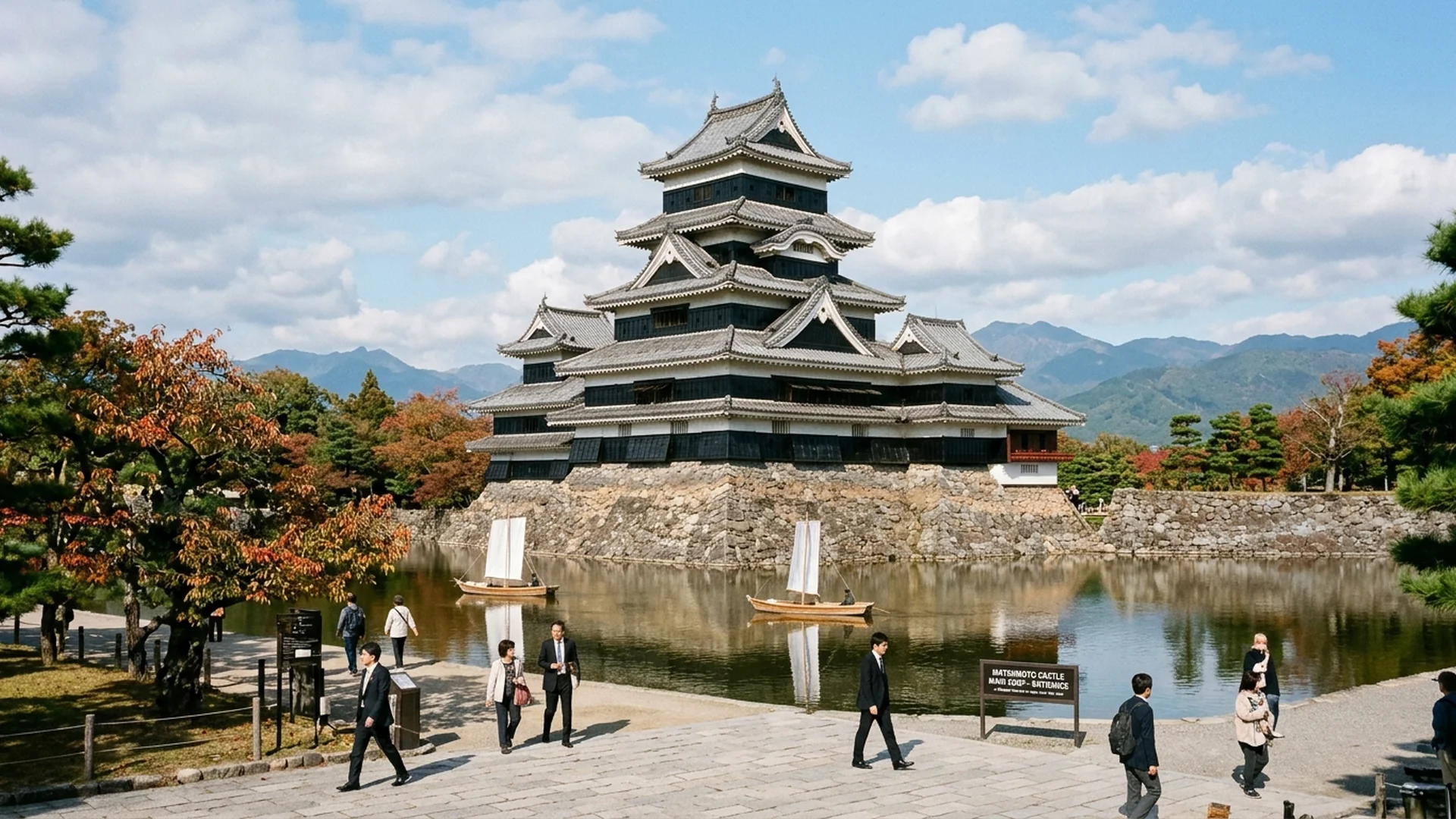
As morning mists lift above the dramatic expanse of the Northern Alps, an obsidian fortress emerges with arresting clarity against a pristine backdrop of snow-capped peaks. This is Matsumoto Castle, revered by connoisseurs and historians alike as ‘Karasu-jo’—the Crow Castle. Standing resiliently for over four centuries, it remains one of Japan’s most precious original wooden keeps, remarkably untouched by the ravages of war or devastating fires.
To cross its threshold is to step backward into the contemplative quiet of the samurai era, discovering a masterpiece where formidable military engineering meets sublime aesthetic restraint. For the discerning global traveler seeking profound cultural resonance, studying the ancient joinery and absorbing the tranquil reflections of the swan-frequented moat offers an unforgettable immersion into Japan’s aristocratic soul.
The Architecture of the ‘Crow Castle’ and Defensive Mastery
Erected during the turbulent transition from the Sengoku period to the dawn of the Edo shogunate, Matsumoto Castle evolved from the foundational fortifications of Fukashi. Its most commanding visual hallmark is the striking facade of contrasting white plaster and deep black-lacquered boards—an artistic choice that simultaneously projected psychological authority and offered robust weatherproofing and fire resistance.
Within the six-tier, five-story main keep (Tenshu), visitors navigate a labyrinth of steep, narrow wooden staircases deliberately engineered to impede advancing intruders. Arrow slits (Yazama) and stone-dropping chutes (Ishiotoshi) remain impeccably preserved, inviting thoughtful reflection on the meticulous tactical strategies employed by feudal lords during centuries past.
Aesthetics of Leisure: The Moon-Viewing Tower and Refined Design
What truly distinguishes Matsumoto Castle from its architectural peers is the inclusion of the ‘Tsukimi Yagura’ or Moon-Viewing Turret, added in the 17th century during a rare era of sustained peace. Designed with open-air verandas rather than fortified solid walls, this pavilion captures the sophisticated sensibilities of rulers who finally had the leisure to compose poetry and watch reflections of the harvest moon ripple across the moat.
As golden hour light washes over the timber facade, the surrounding waters transform into an expansive mirror, capturing the looming silhouette of the dark keep against a twilight sky. It is a fleeting, deeply serene moment cherished by landscape photographers and contemplative travelers alike.
Moat-Side Elegance: Venturing into Nakamachi and Local Gastronomy
The cultural immersion of Matsumoto extends far beyond the castle walls into meticulously preserved surrounding districts. Nakamachi Street, in particular, enchants visitors with its traditional ‘Kura’ storehouses—distinguished by distinctive black-and-white grid tile patterns—which have been gracefully repurposed into artisanal boutiques, contemporary galleries, and inviting specialty cafes.
Culinary exploration in this alpine basin is anchored by legendary hand-crafted soba noodles, cultivated by the crisp climate and mineral-rich mountain waters. Paired with Shinshu beef grilled over fragrant Hoba leaves, these authentic regional flavors provide a deeply satisfying counterpoint to a day of architectural discovery.