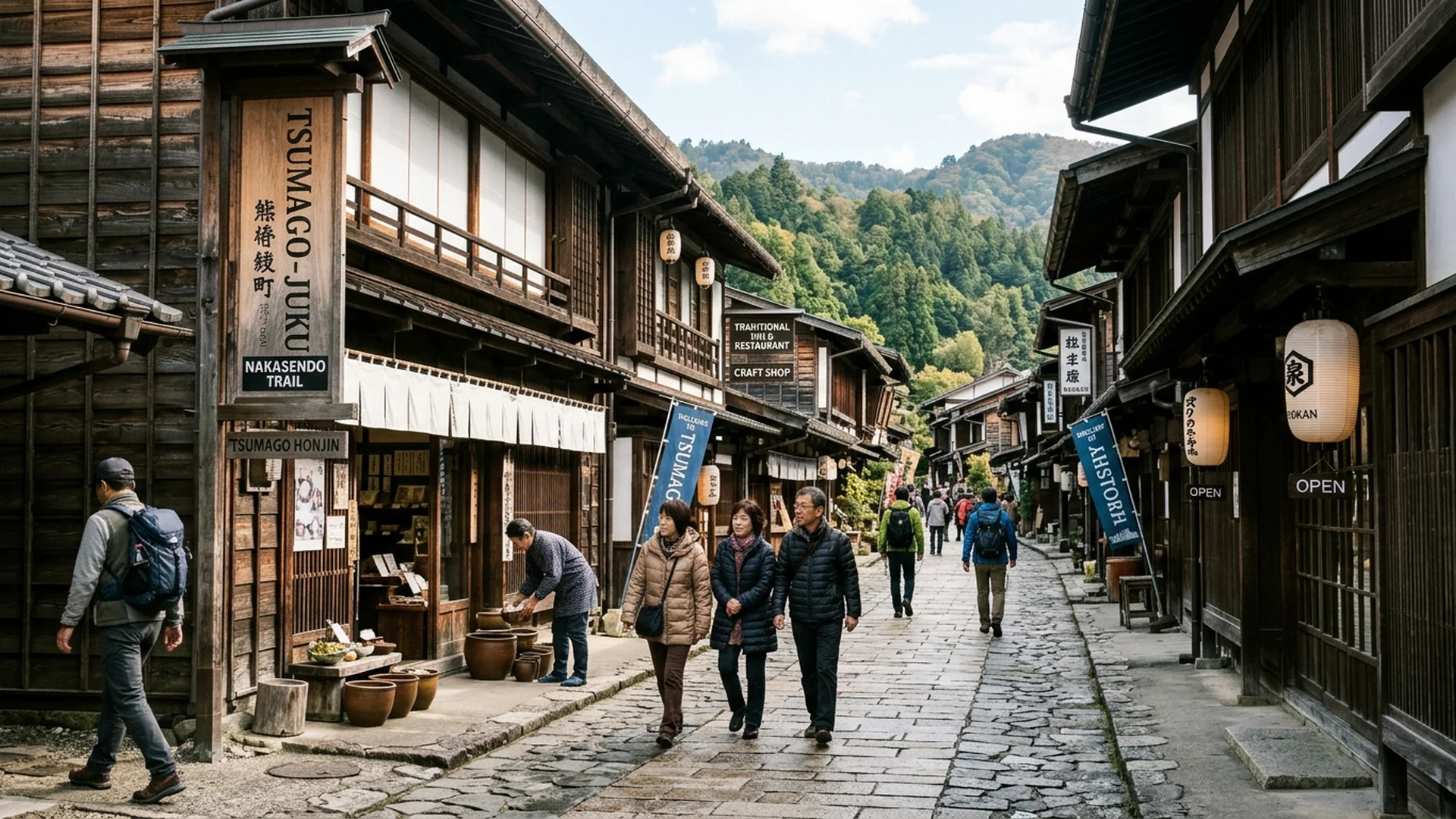
Cross the threshold past ancient pine groves and the undulating green folds of Nagano’s Kiso Valley, and the relentless ticking of the modern world simply dissolves. Tsumago-juku reveals itself not merely as a destination, but as a living manuscript of Japan’s Edo period, preserved with an almost sacred devotion. Here, telephone poles and asphalt give way to smooth stone footpaths, dark cedar eaves, and the quiet, comforting scent of charcoal hearths drifting through the evening air.
This preservation is no accident of geography; it is the result of a fierce, community-wide pact forged decades ago to shield the village from the tide of unbridled modernization. For the discerning global traveler seeking unhurried immersion, Tsumago-juku offers an authentic encounter with a Japan of quiet contemplation, profound craftsmanship, and an enduring respect for the past.
Architecture of the Spirit: The Three Ironclad Rules and Seamless Preservation
During the Edo period, the Nakasendo served as one of the vital arterial highways connecting Edo (modern-day Tokyo) with Kyoto, with Tsumago-juku functioning as the 42nd of the route’s 69 designated post stations. Yet, the march of post-war modernization nearly erased the settlement from maps. In the 1960s, local residents awakened to the irreplaceable value of their architectural heritage and instituted an unprecedented covenant for urban planning: “Do not sell, do not rent, and do not destroy.” The resulting landscape is a triumph of collective will—a continuous streetscape of dark timber lattice-work, clay-tiled roofs, and hidden subterranean utility lines that banish visual clutter. Walking these cobbled lanes feels precisely like stepping inside a living monochrome print from centuries past.
Waki-Honjin Okuya and the Refinement of Kiso Master Carpentry
At the historical heart of Tsumago-juku stands the Waki-Honjin Okuya, an architectural masterpiece that once accommodated high-ranking samurai and visiting nobility. Reconstructed in 1877 using superlative Hinoki (Japanese cypress) harvested from the surrounding Kiso mountains, the building exemplifies the pinnacle of local woodworking artistry. The interior reveals breathtaking subtleties, notably circular windows engineered to cast shifting bars of natural sunlight across interior cedar pillars throughout the day. To walk upon these polished wooden floorboards is to listen to the soft, rhythmic creak of history, inviting quiet contemplation of the weary travelers who once sought sanctuary behind these heavy wooden doors.
Footsteps Across the Centuries: The Magome to Tsumago Trail
True communion with the Kiso Valley requires traveling on foot along the historic Magome-to-Tsumago Trail. This 8-kilometer path winds gently through whispering pine forests, terraced rice paddies, and secluded farming hamlets. Along the way, bronze bells hang at intervals, inviting travelers to ring them gently to echo through the valley—a charming traditional precaution against local wildlife. For the discerning traveler, convenient baggage-forwarding services between the two towns allow for a completely unencumbered journey, leaving one free to capture the shifting seasonal beauty of the mountains, whether draped in fiery autumn copper or the lush, verdant canopy of early summer.