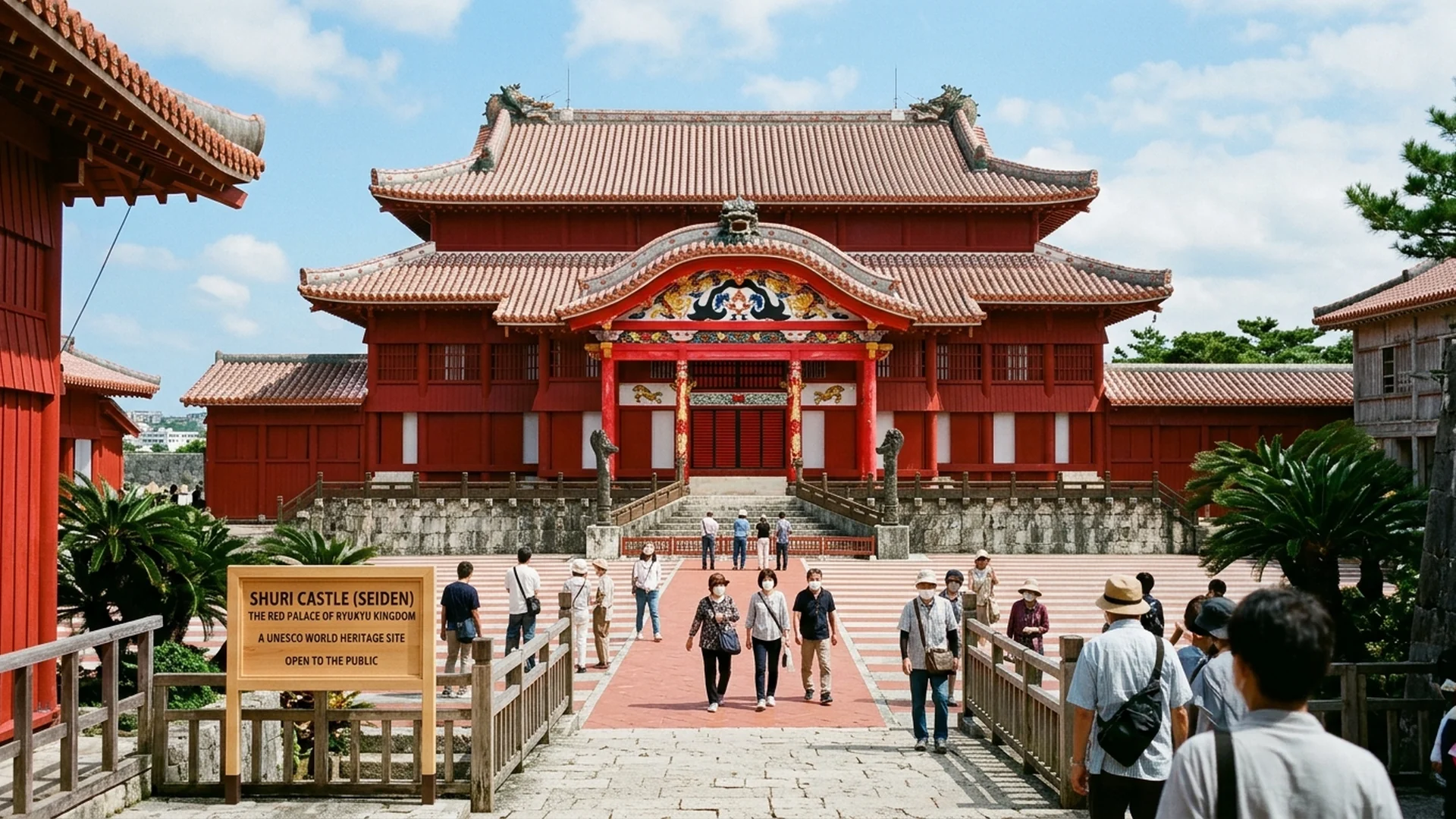
When stepping past the familiar vermilion gates, the standard mental image of austere Japanese feudal castles—defined by dark timber tones and slate-black tile roofs—dissolves completely. Here, brilliant shades of cinnabar red strike a sharp contrast against elaborate golden dragon motifs. This is Shuri Castle, the beating heart of the historic Ryukyu Kingdom. More than a mere military fortification, it served as the political, commercial, and spiritual epicenter of Okinawa, a sovereign realm that once bridged the civilizations of China, Japan, and Southeast Asia into a harmonious mosaic.
Amidst Pacific maritime breezes carrying salt spray and centuries of memory against curved stone ramparts, Shuri Castle stands as a profound testament to human resilience. Having weathered the tempests of history and repeatedly rising from the ashes, a journey here transcends casual sightseeing. It offers a rare opportunity to witness an epic chapter of restoration, where a glorious past comes back to life before our very eyes.
Gusuku Architecture and Vermilion Grandeur: The Unique Identity of the Ryukyu Realm
If castles on mainland Japan represent the archetype of the samurai, Shuri Castle embodies the spirit of an expansive, outward-looking seafaring nation. Its architecture is utterly distinct, built upon the ‘Gusuku’ style—a sophisticated fusion of robust, curved stone wall construction influenced by Chinese Manchu and Japanese aesthetics. The main hall, known as the Seiden, radiates a powerful vermilion hue traditionally derived from natural cinnabar compounds. This vibrant red served purposes far beyond mere visual splendor; it signified sovereign authority, high status, and protective auspiciousness rooted in Eastern cosmological beliefs. Intricate dragon carvings along wooden beams and portico pillars echo the close tributary and maritime trade relations maintained with the Ming and Qing dynasties, ultimately earning the site UNESCO World Heritage status in the year 2000 under the designation of Gusuku Sites and Related Properties of the Kingdom of Ryukyu.
From Shureimon Gate to Royal Splendor: Living Traces of the Past
The ascent into the royal precinct begins at Shureimon Gate, an elegant wooden portal bearing a Chinese inscription that translates to ‘The Land of Propriety.’ Having survived numerous historical conflicts, this iconic gate was once immortalized on Japan’s 2,000-yen banknote. Passing through its archway leads travelers upward through a sequence of inner defensive portals, including Kankaumon and Hoshinmon gates, each historically designed to filter visiting dignitaries according to strict protocol. The intricately layered curved stone walls, assembled entirely without mortar yet possessing remarkable seismic flexibility, showcase the extraordinary ingenuity of traditional Ryukyuan stonemasons.
A New Chapter in History: The Resurrection of the Seiden Palace
A profound tragedy struck in 2019 when a devastating fire consumed the main Seiden hall and numerous irreplaceable cultural treasures. Yet this immense loss ignited an unwavering determination among the people of Okinawa and the Japanese government to reclaim this vital spiritual symbol. The ongoing reconstruction effort goes far beyond mere rebuilding; it is an authentic revival of ancestral craft wisdom. Local artisans have meticulously studied historical archives, sourced premium pine timber, and reinstated traditional cinnabar painting techniques. By opening designated viewing galleries overlooking the active restoration work, the site offers an inspiring, value-driven travel experience rarely found elsewhere in the world—a testament to cultural heritage that refuses to yield to time.