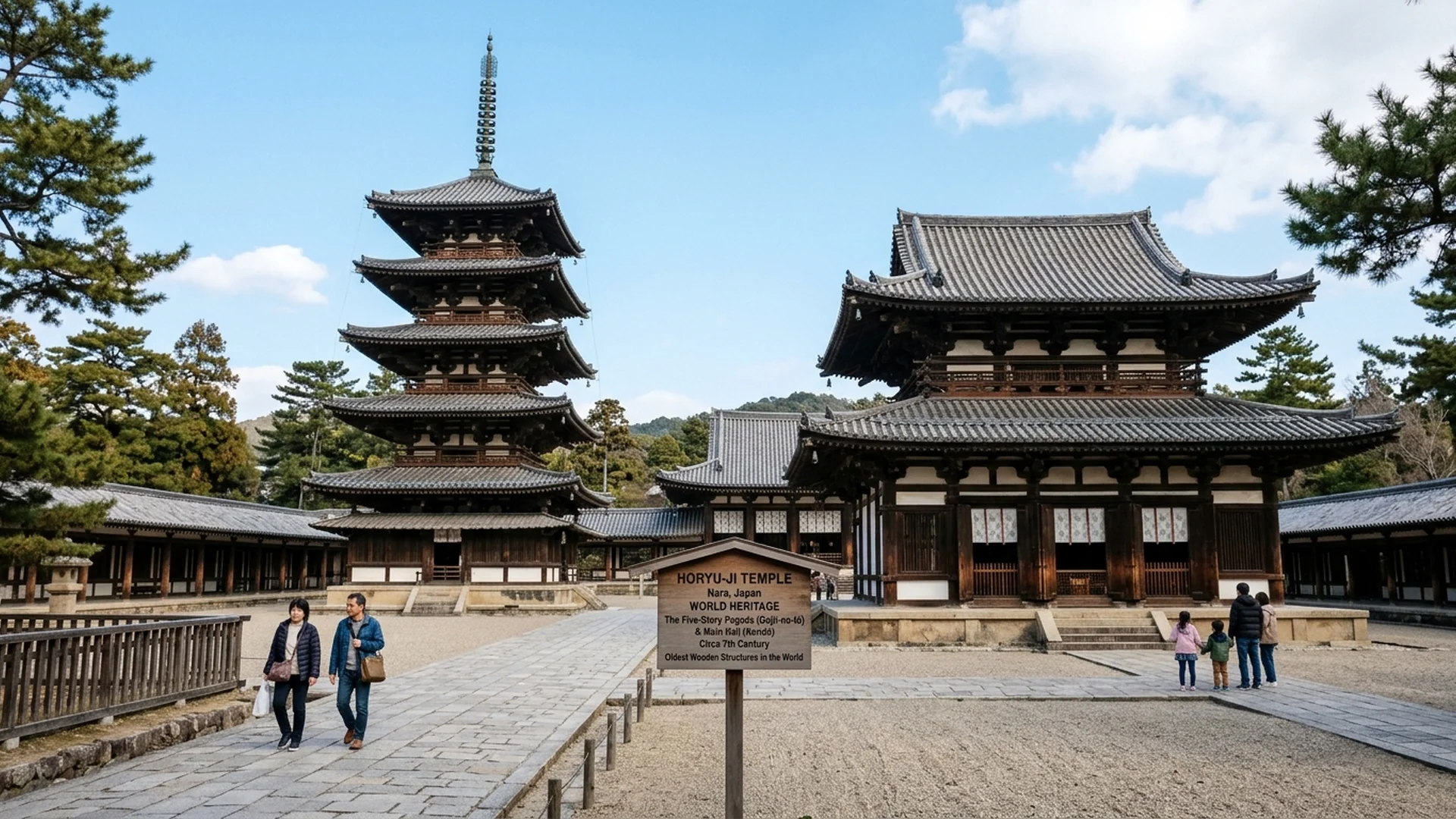
Amidst the quiet, mist-veiled landscapes of Nara prefecture stands a monumental sanctuary that has defied the passage of over thirteen centuries. Horyu-ji Temple is far more than a mere place of Buddhist worship; it is a living reliquary preserving the pure aesthetic and spiritual devotion of the Asuka Period, rightfully designated as Japan’s very first UNESCO World Heritage site in 1993.
Crossing the formidable threshold of the Nandaimon gate and entering the sacred precinct, one is immediately enveloped in the scent of antiquity. Massive Hinoki cypress columns, harvested and shaped through ancient generational wisdom, stand in proud, silent dignity. This is a monumental open-air classroom where mindful global travelers come to witness the profound beauty hidden within the world’s most enduring timber structures.
The Genesis of Faith and Japan’s First World Heritage
The chronicle of Horyu-ji is deeply intertwined with Prince Shotoku, one of the most revered figures in Japanese history, who laid the foundational stones of Japanese Buddhism and governance during the Asuka period. Around 607 AD, the Prince commissioned the sanctuary as a dedication to Yakushi Nyorai, the Medicine Buddha, in earnest prayer for his ailing father’s recovery. Though it has weathered historical trials and fires, the vast majority of the original structural integrity has been miraculously preserved and restored. This immense historical gravitas prompted UNESCO to enshrine Horyu-ji and its neighboring monastic treasures as the vanguard of Japan’s heritage preservation.
Decoding a 1,300-Year Timber Miracle: Nail-Less Architecture and the Five-Story Pagoda
Architects and structural engineers from across the globe remain captivated by the Five-Story Pagoda (Goju-no-To) and the Main Hall (Kondo), both constructed entirely from Hinoki cypress. Ancient artisans devised an ingenious system known as interlocking woodwork, which permits the entire timber skeleton to flex and dissipate seismic energy during earthquakes. Furthermore, Hinoki timber possesses natural resinous qualities that repel moisture and ensure extraordinary longevity. Master builders carefully selected trees aligned with the natural wind patterns of mountain slopes, allowing the structures to gracefully withstand millennia of environmental forces without a single metallic fastener.
A Treasury of Buddhist Art: Exploring the Western Precinct and the Hall of Dreams
The temple grounds are distinctly organized into two primary compounds. The Western Precinct (Saiin Garan) houses the Main Hall and the Five-Story Pagoda, sheltering priceless national treasure statues dating to the dawn of Japanese Buddhism. Meanwhile, the tranquil Eastern Precinct (Toin Garan) is anchored by Yumedono, the Hall of Dreams. This iconic octagonal pavilion was erected as a memorial sanctuary honoring Prince Shotoku, enveloping visitors in a profound atmosphere of meditative stillness and historical reverence.