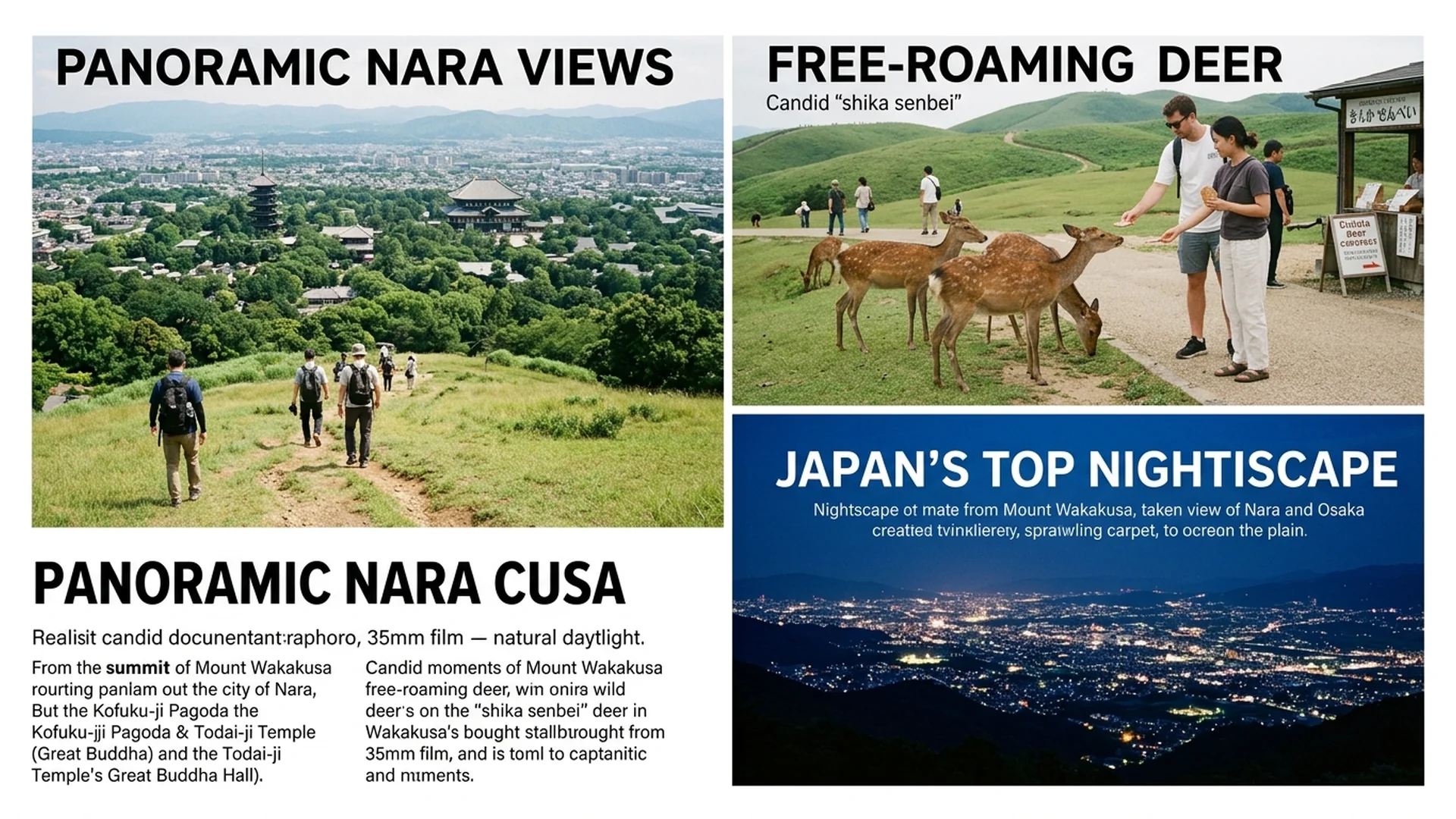
Beyond the murmured crowds pressing against the temple gates of Todai-ji within Nara Park lies a sculptural peak of undulating emerald velvet, sweeping quietly toward the heavens. Mount Wakakusa, affectionately known to locals as Wakakusayama, is far more than a mere geographical mound; it serves as a contemplative high-altitude terrace that elevates the ancient imperial capital’s narrative far beyond conventional itineraries.
Stepping upward onto its slopes feels less like a hike and more like a gentle crossing through time. One leaves the resonant history of the valley floor for the vast, unhurried stillness of three terraced tiers, where the crisp mountain air welcomes travelers alongside herds of wild deer grazing in untamed serenity. Here lies the harmonious intersection of ancient royal heritage and breathtaking topography, celebrated widely as one of the most transcendent nocturnal viewpoints in the Japanese archipelago.
Topography of Silence: The Tiered Slopes and the Path Above World Heritage
Mount Wakakusa presents a distinctive physical profile defined by three natural steps stacked seamlessly upon one another. Beginning the ascent from the base, the pathway gently gradients across vast open meadows that transform in hue through the shifting seasons, shifting from lush summer emeralds to the golden amber of autumn. Upon reaching the second and third tiers, the surrounding horizon expands exponentially, culminating at the 342-meter summit where the world opens into an unbroken, 360-degree panorama. Far below, ancient forests, sweeping temple eaves, and the historic urban layout of Nara reflect centuries of imperial lineage originating from the Nara Period. For discerning travelers seeking effortless contemplation, seasonal roadways and transport options ensure seamless access to the uppermost viewing platforms.
The Realm of Untamed Deer: Raw Natural Beauty Apart from the Park
While Nara’s deer populations are iconic across the city, encountering them upon the slopes of Mount Wakakusa imparts an entirely distinct emotional resonance. The resident herds here retain a more primal, instinctual independence, moving gracefully across the expansive grassy meadows against a backdrop of open skies. To observe these creatures under the soft afternoon light, entirely detached from the auditory bustle of the city below, invites profound mental stillness. It grants nature-focused travelers an exclusive, highly private vantage point to record memories far removed from the primary tourist thoroughfares.
Nocturnal Dimensions and the Legend of Fire: From Million-Dollar Views to Yamayaki
As the sun dips below the distant western ridges, Mount Wakakusa transforms into a natural amphitheater where nature and human heritage conspire in artistic brilliance. The nightscape visible from the summit is officially designated among the New Three Major Night Views of Japan, wherein the delicate twinkling of city lights and historic monuments below glimmers like rare gemstones upon absolute black velvet. Beyond its ordinary nocturnal majesty, the mountain hosts the centuries-old Yamayaki festival every January. Roaring orange and crimson flames deliberately consume the dried winter grasses to ready the earth for spring, accompanied by brilliant fireworks blooming in the cold winter sky—an arresting spectacle that draws thoughtful travelers from across the globe.