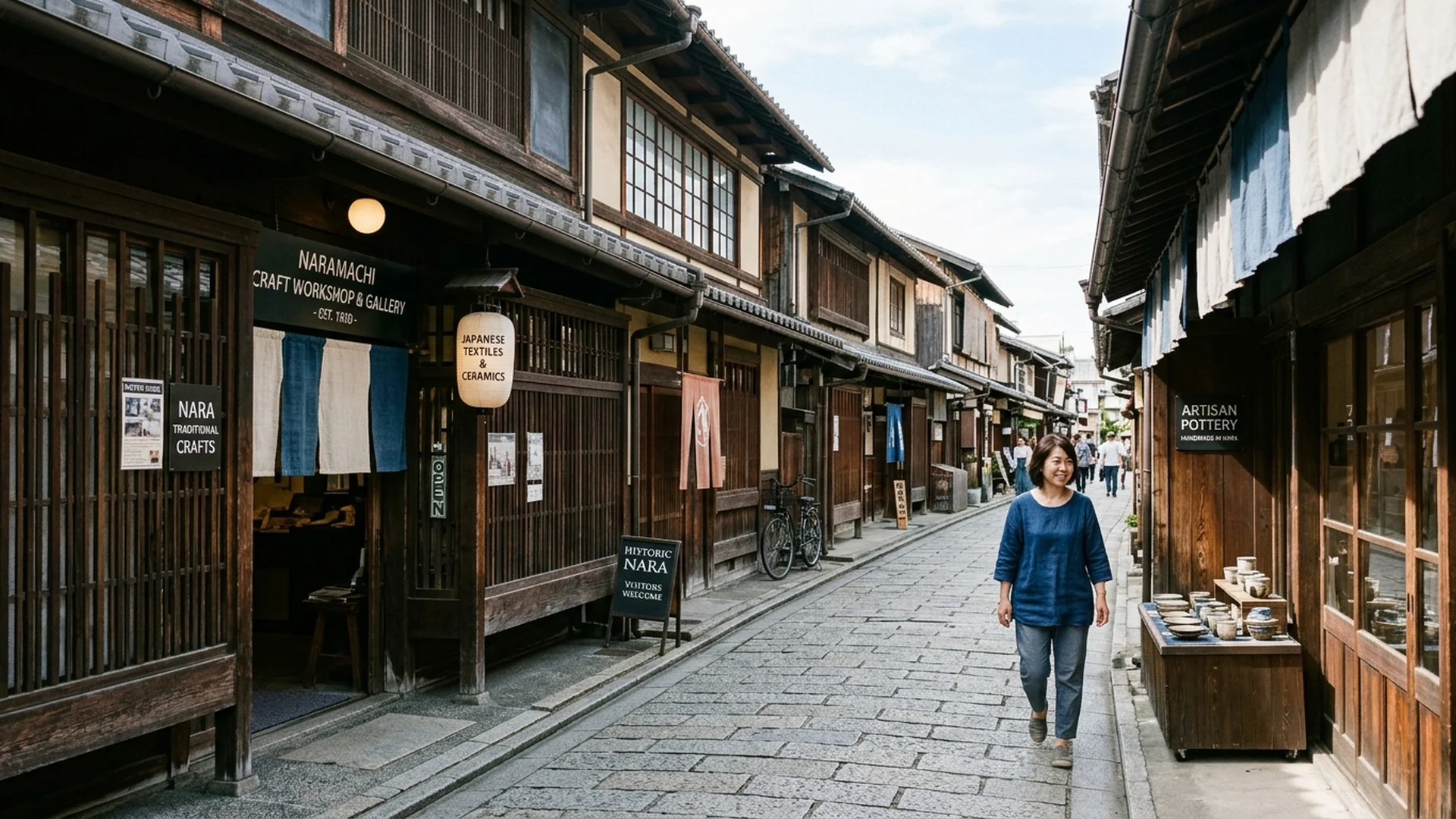
When travelers envision Nara, the enduring image is almost always that of the sika deer wandering beneath ancient canopies across the sprawling expanse of Nara Park. Yet for those willing to step beyond the animated commotion of the primary landmarks and let their footsteps wander southeast of Gango-ji temple, an entirely different, profoundly still dimension reveals itself. This is Naramachi, a historic district with roots stretching back through the Heian period and as deep as the ancient Asuka era.
Here, time appears to have relaxed its hurried march. Cobblestone pathways and facades of dark timber and whitewashed plaster stretch into the distance, evoking the sensation of turning the pages of a living history book. Naramachi is far from a curated outdoor museum; it is a breathing community where traditional architectural wisdom, heritage handicrafts, and a deliberate, unhurried way of life are woven seamlessly together. It remains the quintessential destination for the discerning traveler yearning to absorb the true spirit of ancient Japan without haste or distraction.
Decoding Machiya Wisdom: The Townhouse Architecture of Naramachi
The beating heart of Naramachi’s profound architectural charm is the machiya—traditional wooden townhouses lining the narrow streets. Their defining characteristic is a notably narrow frontage, a historical artifact of property taxation based on street width, stretching remarkably deep into the block, earning them the affectionate moniker of eel beds. The interiors are brilliantly partitioned, anchored by a central open-air courtyard known as a tsuboniwa. This garden well invites natural light and gentle breezes deep into the structure while forging an intimate connection between the inhabitants and nature. Stepping inside Naramachi Koshi-no-Ie, a meticulously reconstructed traditional residence, illuminates the domestic rhythms of historical merchants, the subtle artistry of shoji paper screens, and the sophisticated joinery that elevates timber construction without a single nail.
Millennial Traces at Gango-ji and the Allure of the Red Monkey Talisman
No exploration of Naramachi is complete without visiting Gango-ji, among the earliest Buddhist foundations in Japan, relocated from the ancient capital of Asuka in the eighth century. Though much of the sprawling complex has weathered the centuries, ancient roof tiles and select structural beams remain intact from the archaic era. The temple grounds exude a profound stillness, inviting quiet contemplation among masterpieces of early Buddhist craftsmanship. Beyond the temple walls, attentive observers will notice curious red rag dolls resembling small monkeys dangling from surrounding eaves. Known as migarazu, or proxy monkeys, these folk talismans are believed by locals to absorb adversity and ward off misfortune in place of the household residents—a charming cultural nuance reflecting enduring folk beliefs.
Contemporary Aesthetics: Artisanal Studios and Persimmon Leaf Sushi in Historic Alleys
The true grace of Naramachi lies in its seamless synthesis of heritage architecture and contemporary refinement. Numerous historic timber residences have been thoughtfully restored to house ceramic studios, traditional incense ateliers, and specialty coffee sanctuaries where the rich aroma of roasted beans drifts across tatami flooring. On the culinary front, travelers must sample kakinoha-zushi, the region’s traditional preserved delicacy featuring mackerel or salmon pressed over seasoned rice and wrapped in persimmon leaves, whose natural antibacterial properties impart an unforgettable, subtle fragrance found nowhere else.