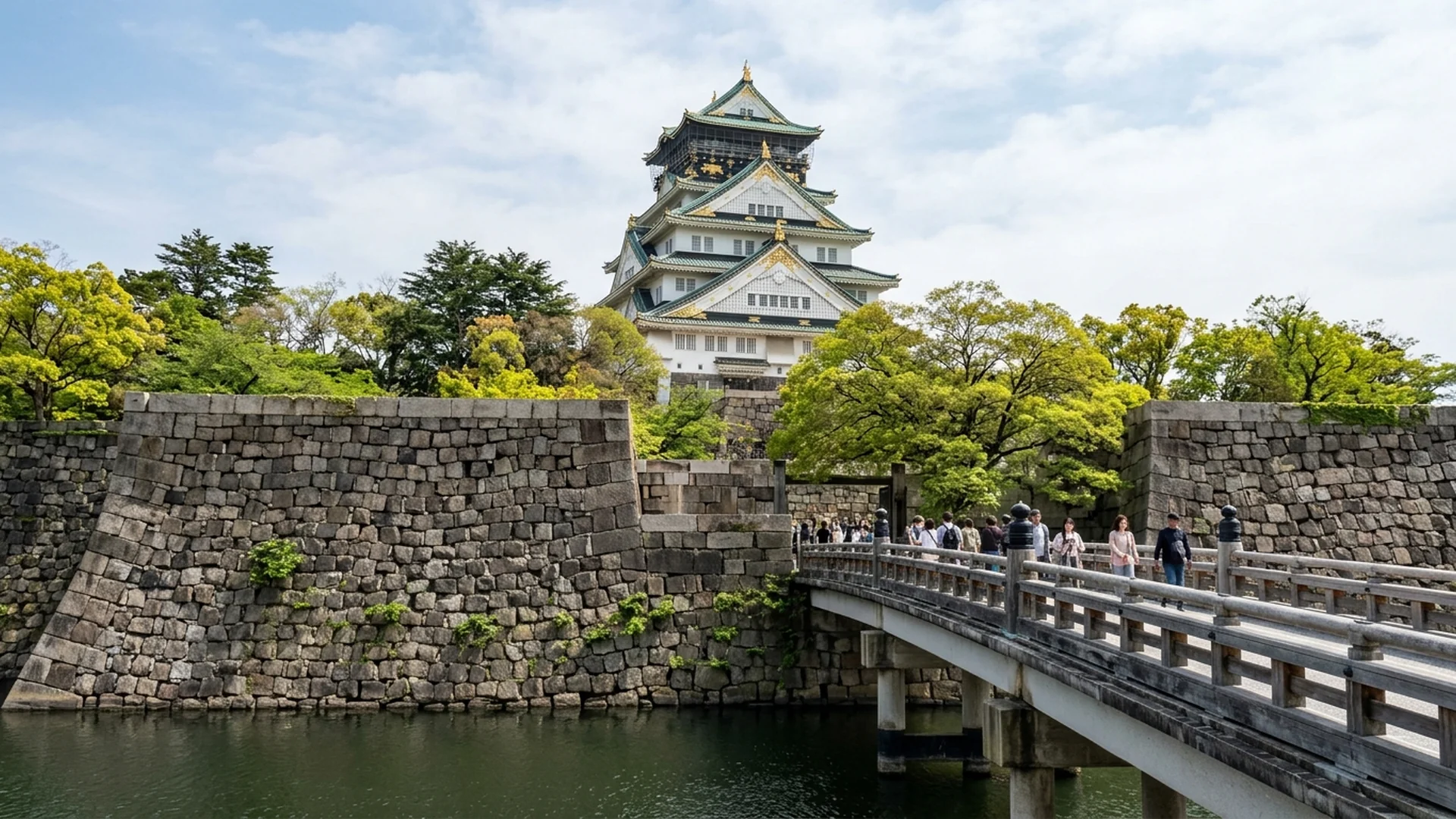
When conjuring Osaka Castle, travelers often envision a gleaming green-and-gold keep rising above a bustling sea of cameras and tour groups. Yet beneath this familiar landmark lies a powerful tapestry of Sengoku-era history, a pivotal theater of power struggles that reshaped the Japanese realm, and monumental megalithic architecture that has defied the centuries. To approach this sanctuary with discerning depth is to turn a master key, unlocking an era where daimyos and samurai forged destinies through brilliant strategy and indomitable spirit.
This journal invites you to transcend conventional tourism and immerse yourself in an unhurried, contemplative exploration. From tracing the ambitious architectural visions of Regent Toyotomi Hideyoshi to savoring the refined mastery of Nishinomaru Garden, we reveal the precise timing and secret vantage points that allow you to experience Osaka Castle in absolute peace and unforgettable elegance.
1. Roots of Power: From Crimson Battleground to Architectural Peace
The history of Osaka Castle is far more than a chronicle of stone and mortar; it is a ledger stained with the dramatic shifts of feudal dominance. Long before the citadel rose, this ground held Ishiyama Hongan-ji, the formidable monastic stronghold that withstood the forces of Oda Nobunaga for a decade. Recognizing the supreme tactical advantage of the terrain, Toyotomi Hideyoshi chose this very site in 1583 to erect a magnificent castle that would broadcast his boundless authority and wealth to the realm.
Though the original keep was reduced to ashes during the Summer Siege of Osaka in 1615, and subsequent structures rebuilt during the Edo period fell victim to lightning and the ravages of the Second World War, the indomitable spirit of the Toyotomi era remains woven into the foundation. Today’s modern reinforced-concrete reconstruction stands in seamless dialogue with the surviving ancient stone ramparts, creating a harmonious dialogue between modern structural engineering and ancient seismic resilience.
2. Decoding the Architecture and Marvelous Megalithic Walls
A truly rewarding exploration of Osaka Castle begins with the colossal stone ramparts (Ishigaki) enclosing the inner and outer moats. Sourced from various mountains across the Kansai region, these gargantuan boulders were fitted together without a single drop of mortar, relying entirely on sophisticated traditional engineering to absorb seismic tremors. Among them, the legendary Tako-goro-ishi—or Octopus Stone near the Otemon Gate—stands as a breathtaking testament to the master stonemasons of antiquity.
Ascending into the Main Keep reveals a contemporary historical museum chronicling Hideyoshi’s legacy and military strategy through state-of-the-art curation. Upon reaching the uppermost observation deck, visitors are greeted by a striking juxtaposition: a 360-degree panorama where the soaring skyscrapers of modern Osaka meet the tranquil, emerald waters of the ancient moats, perfectly framing the passage of time.
3. Nishinomaru Garden: A Sanctuary of Quiet Contemplation and Refined Aesthetics
If the sun-drenched courtyards before the keep represent the vibrancy of the modern world, the Nishinomaru Garden on the western citadel is a realm of utter tranquility, wholly insulated from urban clamor. Once serving as the private quarters for esteemed lords and consorts during the Toyotomi era, the grounds are now meticulously manicured, featuring sprawling lawns and over six hundred Somei-Yoshino cherry trees.
Come spring, the garden transforms into a delicate, luminous pink canopy that mirrors the golden ornamentation of the distant keep. When autumn arrives, blazing maples and golden ginkgo trees ignite against the slate-grey stone walls and crystalline moats. To stroll through Nishinomaru in the pristine stillness of early morning, long before the arrival of tour groups, is an exceptionally privileged experience that restores the soul.