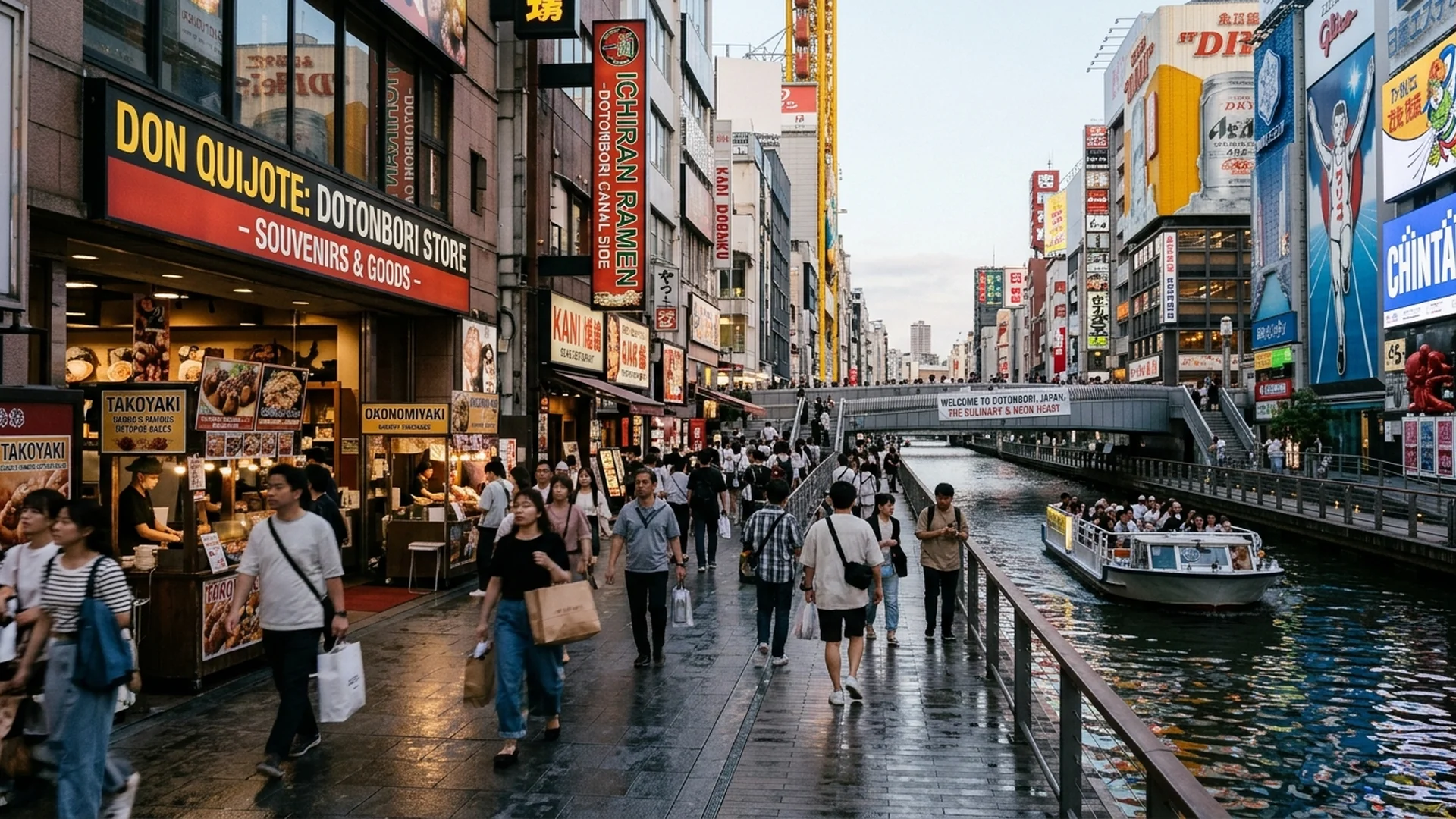
As twilight dissolves over the sprawling expanse of Kansai’s largest metropolis, the night sky above Osaka awakens in a brilliant symphony of neon hues, casting luminous reflections upon the historic waters of the canal. The air fills with the gentle hiss of iron griddles, the clamor of cheerful conversation, and the rich, savory aroma of simmering broths. This is Dotonbori—the pulsating emotional core of Osaka. Far more than a mere backdrop for a photograph beneath the iconic Glico Running Man at Ebisubashi Bridge, this legendary district serves as the magnificent open-air drawing room for a city devoted entirely to the philosophy of Kuidaore, or eating until one drops.
To truly understand Dotonbori is to look past the superficial bustle of modern tourism and immerse oneself in the deep currents of its past. The narrative begins in 1612, when the visionary merchant Nariyasu Doton undertook the monumental task of channeling the waters to connect the Tosaobori and Kizubori rivers, fostering commerce and eventually transforming the riverbanks into the most vibrant kabuki theater district of the Edo period. Echoes of this theatrical heritage still whisper through the narrow alleys that intersect the main thoroughfare, standing in fascinating contrast to towering modern facades adorned with gargantuan kinetic sculptures—from giant mechanical crabs to breathing golden dragons. Together, these elements form a living museum that invites the discerning traveler to partake in a rich sensory tapestry.
From 17th-Century Canal to Timeless Sanctuary of Entertainment
The chronicle of Dotonbori originates in the ambitious vision of wealthy entrepreneur Nariyasu Doton, who dedicated his private fortune to excavating the waterway in 1612. Though he perished on the battlefield before witnessing the project’s completion, successive municipal authorities recognized the distinct potential of the surrounding land. They decreed the relocation of traditional kabuki theaters and playhouses to the southern banks, firmly establishing Dotonbori as the premier entertainment quarter of Osaka.
Although the centuries have turned and the historic theaters have gradually yielded to contemporary architecture and retail emporiums, the spirit of dramatic revelry remains undiminished. It has simply been reimagined through astonishing architectural signage. These outsized sculptural displays function not merely as commercial advertisements, but as kinetic pop-art installations that embody the humor, ingenuity, and infectious warmth characteristic of the Osakian temperament.
Decoding ‘Kuidaore’: From Iconic Street Fare to Refined Omakase
The expression ‘Kuidaore’ is frequently translated with casual levity as ‘eating oneself to bankruptcy,’ yet for the residents of Osaka, it represents a profound aesthetic of living fully through the senses. Dotonbori is the sacred arena where this culinary philosophy reaches its zenith, offering an unbroken continuum of flavor that ranges from expertly crisped, molten-centered takoyaki served by generational vendors to savory, bubbling okonomiyaki.
Yet the true depth of the district’s culinary landscape reveals itself away from the main thoroughfares. Stepping into the quiet alleyways reveals a hidden realm of exceptional Japanese gastronomy. Here, discerning gourmands discover sanctuaries specializing in prime Wagyu beef prepared as delicate shabu-shabu, alongside intimate sushi counters where master chefs pair pristine seafood from Osaka Bay with immaculate rice and timeless technique.
The Nocturnal Symphony of Neon and the Tonbori River Cruise
When night falls, Dotonbori assumes its most arresting persona, transforming into one of the world’s most dynamic galleries of kinetic light. Cascading neon projections from legendary facades ripple across the surface of the canal, creating an immersive atmosphere reminiscent of classic cyberpunk cinema. Observing the ceaseless choreography of humanity upon Ebisubashi Bridge—where travelers from every corner of the globe converge—offers an endlessly fascinating sociological study.
For those seeking a more contemplative vantage point above the animated pedestrian walkways, the Tonbori River Cruise offers an exceptionally refined alternative. Gliding slowly along the canal in the cool evening air reveals architectural details of historic stone bridges otherwise overlooked from the pavement, accompanied by the gentle cadence of local commentary that brings centuries of hidden river lore to life.