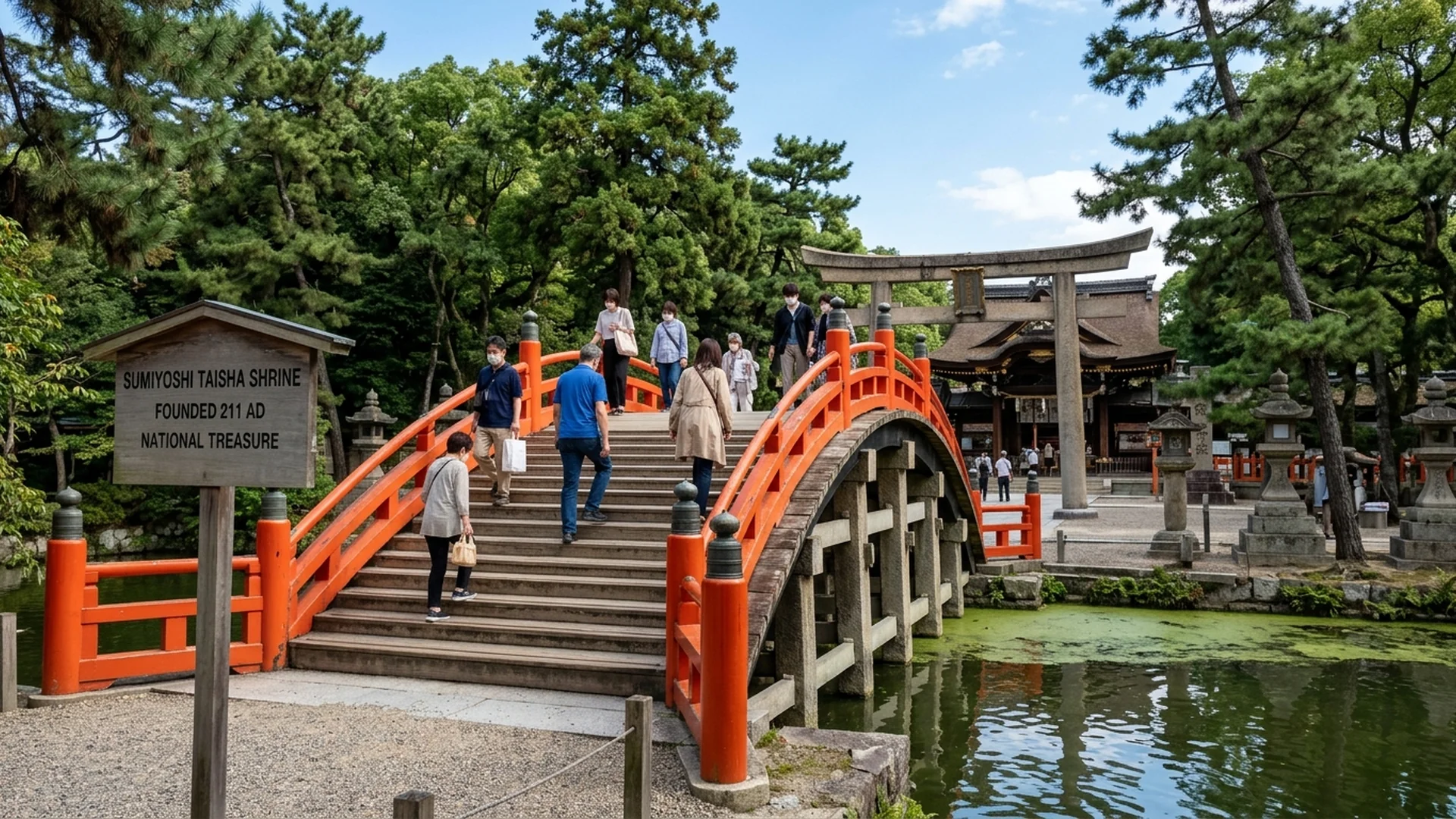
Amidst the relentless, neon-lit pulse of modern Osaka lies a spiritual pocket seemingly frozen in tranquil suspension for over eighteen centuries. Sumiyoshi Taisha is far more than a mere religious site; it stands as the profound ancestral taproot and head shrine presiding over more than 2,300 Sumiyoshi sanctuaries across the Japanese archipelago.
Crossing the weathered stone torii gate into the deep, ancient canopy of sacred camphor trees is an immersive descent into pre-Buddhist Japan. This hallowed ground, dedicated to the guardian deities of the seas and voyagers, whispers its timeless narratives through pristine architectural forms that have miraculously weathered the tempests of Japanese history.
Sumiyoshi-zukuri Architecture: Pure Shinto Heritage Before the Buddhist Dawn
The architectural heartbeat that captivates architectural historians and connoisseurs worldwide is the ‘Sumiyoshi-zukuri’ style, revered as one of the most archaic expressions of pure Shinto building traditions in Japan. The four principal sanctuaries are arranged in a precise linear procession facing westward beneath the protective canopy of a sacred grove. Their defining characteristics include straight, uncurved cypress-bark roofs completely devoid of the continental Buddhist eaves that proliferated in later centuries. Crowned by pristine chigi (crossing roof finials) and katsuogi (short horizontal logs), the structures radiate an unadorned, muscular simplicity deeply tethered to the natural world without the intrusion of garish pigments.
The Sorihashi Bridge: A Vermilion Arc to the Divine Realm
Perhaps the most iconic visual signature of Osaka’s sacred landscape is the Sorihashi bridge—a brilliant crimson arch mirrored in the clear waters below. Soaring to a steep gradient of roughly 48 degrees, this dramatic curvature transcends mere aesthetics, serving as a profound spiritual conduit. Ancient folklore dictates that crossing this precipitous span purifies the soul, washing away transgressions and worldly defilements before stepping into the divine precincts. When one pauses at the apex and gazes down, the reflection in the tranquil waters below completes a flawless circle, evoking a masterwork of Zen brushwork that mirrors cosmic equilibrium.
Deities of the Sea and Voyage: A Living Mythos
The Sumiyoshi Sanjin, the three primordial maritime deities enshrined here, were invoked to safeguard navigation, commerce, and treacherous ocean crossings. In bygone eras, the shoreline pressed much closer to these grounds before centuries of land reclamation pushed the coast further away. Yet, profound devotion to these protective gods has never waned. During antiquity, imperial envoys dispatched on perilous diplomatic missions to Tang Dynasty China invariably paused here to perform solemn propitiation rites for safe passage. Similarly, renowned poets like Matsuo Basho made sacred pilgrimages to these hallowed stones, immortalizing the eternal grace of the sanctuary in verse.