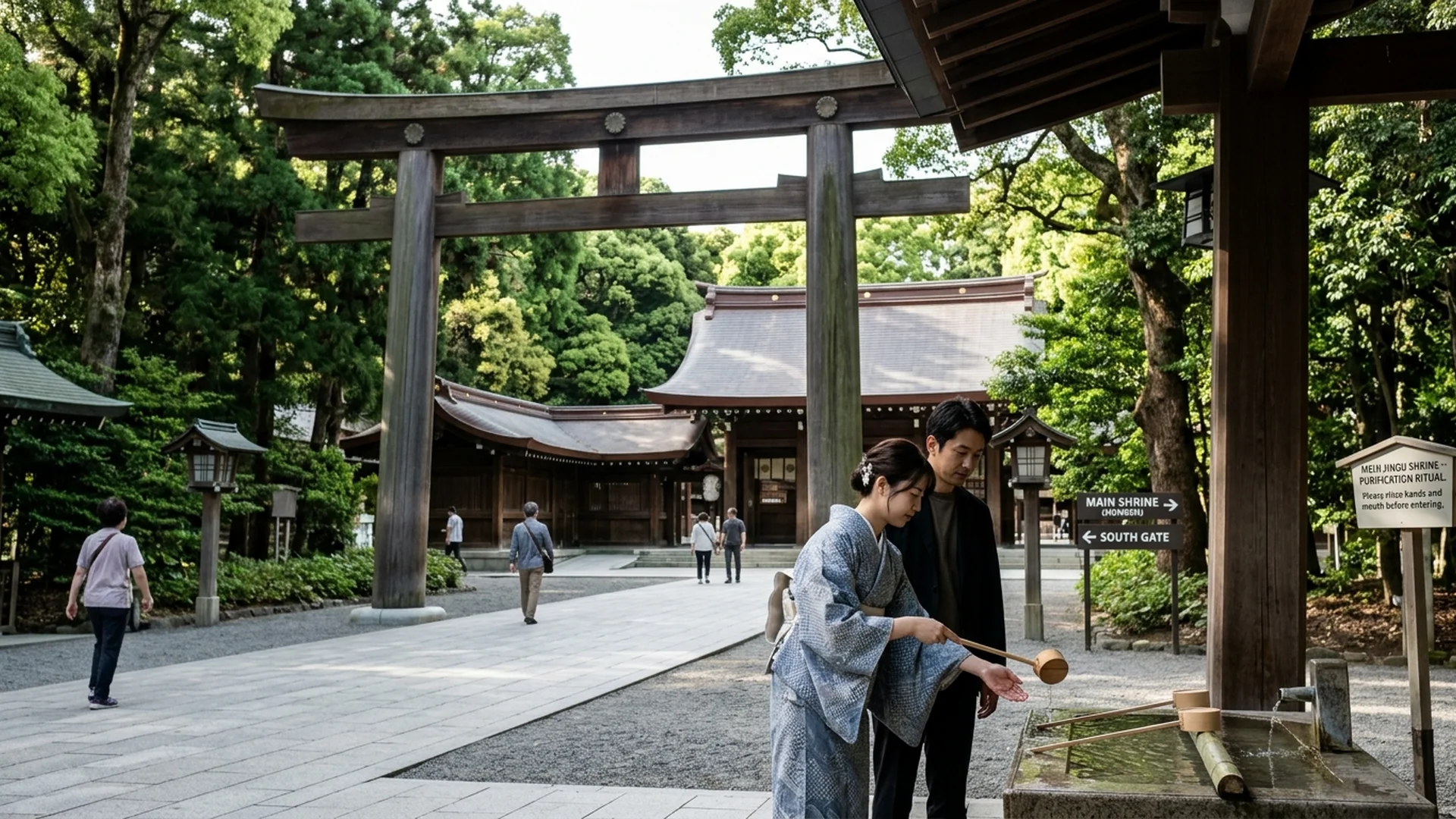
Amidst the relentless pulse of modern Tokyo, where the neon currents of Harajuku and Shibuya flow in seamless acceleration, lies a sprawling canopy of green that acts as a spiritual timepiece. The moment you step past the monumental cypress torii gate, the clamor of the metropolis dissolves entirely, replaced by the soft crunch of gravel beneathfoot and the subtle, earthen fragrance of decaying leaves in an ancient forest.
This is Meiji Jingu Shrine, a hallowed sanctuary dedicated to the deified spirits of Emperor Meiji and Empress Shōken. Yet, it is far more than a monument of imperial reverence; it is an extraordinary artificial forest collaboratively shaped by human hands and nature a century ago. Today, it serves as a natural drawing room that invites millions to discover profound stillness in the heart of the world’s most dynamic city.
The Centenary Miracle Forest: Human Artifice Transformed into Primeval Nature
The story of Meiji Jingu began in 1920, consecrated to honor the emperor who ushered Japan into modernity. More remarkable than the architecture itself is the living forest that enfolds it. Landscape architects and botanists of the era devised an audacious 150-year vision, curating over 100,000 trees sourced from across the Japanese archipelago. They planted them in a systematic symbiosis designed to let the woodland naturally mature into a dense, evergreen climax forest requiring no future replanting. Today, this sanctuary thrives as a miniature wilderness in central Tokyo, offering refuge to rare bird species and native insects—a lasting testament to visionary foresight and deep reverence for the natural world.
Architecture of Devotion: Hinoki Timber and Rows of Sacred Sake Barrels
Walking deeper into the precincts reveals the majestic nagare-zukuri style architecture, constructed using the finest hinoki (Japanese cypress) harvested from imperial estate forests. The primary approach torii gate stands tall as the nation’s largest Myōjin-style wooden gateway, hewn from a 1,500-year-old cypress tree originating in Taiwan.
Another iconic vantage point illustrating the harmony between ancestral faith and cultural openness is the kazaridaru, or orderly rows of decorative sake barrels (Kazaridaru). Offered by breweries nationwide to honor the deities, they stand directly opposite a collection of French wine barrels (ワイン樽), symbolizing Emperor Meiji’s progressive embrace of Western exchange to modernize the nation.
Sacred Rites and Etiquette: Experiencing Authentic Shinto Traditions
A pilgrimage to Meiji Jingu is incomplete without honoring traditional customs. Visitors should walk along the gravel pathways while keeping to the sides, as the central path is reserved for the deities. Upon reaching the Temizuya water pavilion, use the wooden ladle to purify your left hand, then your right, cup water into your palm to gently rinse your mouth, and tilt the ladle vertically to wash the handle for the next visitor.
At the main hall (Honden), standard devotional practice involves casting a coin into the offering box—traditionally a five-yen coin, as its pronunciation sounds like go-en, signifying a favorable karmic connection. Bow deeply at a ninety-degree angle twice, clap your hands firmly twice to summon the attention of the deities, clasp your hands in silent prayer, and conclude with one final, deep bow. Additionally, visitors may pen wishes on wooden ema votive plaques or draw an omikuji oracle. Unlike conventional fortunes predicting good or bad luck, Meiji Jingu omikuji offer classical waka poems composed by Emperor Meiji and Empress Shōken, intended as poetic reflections for personal contemplation.