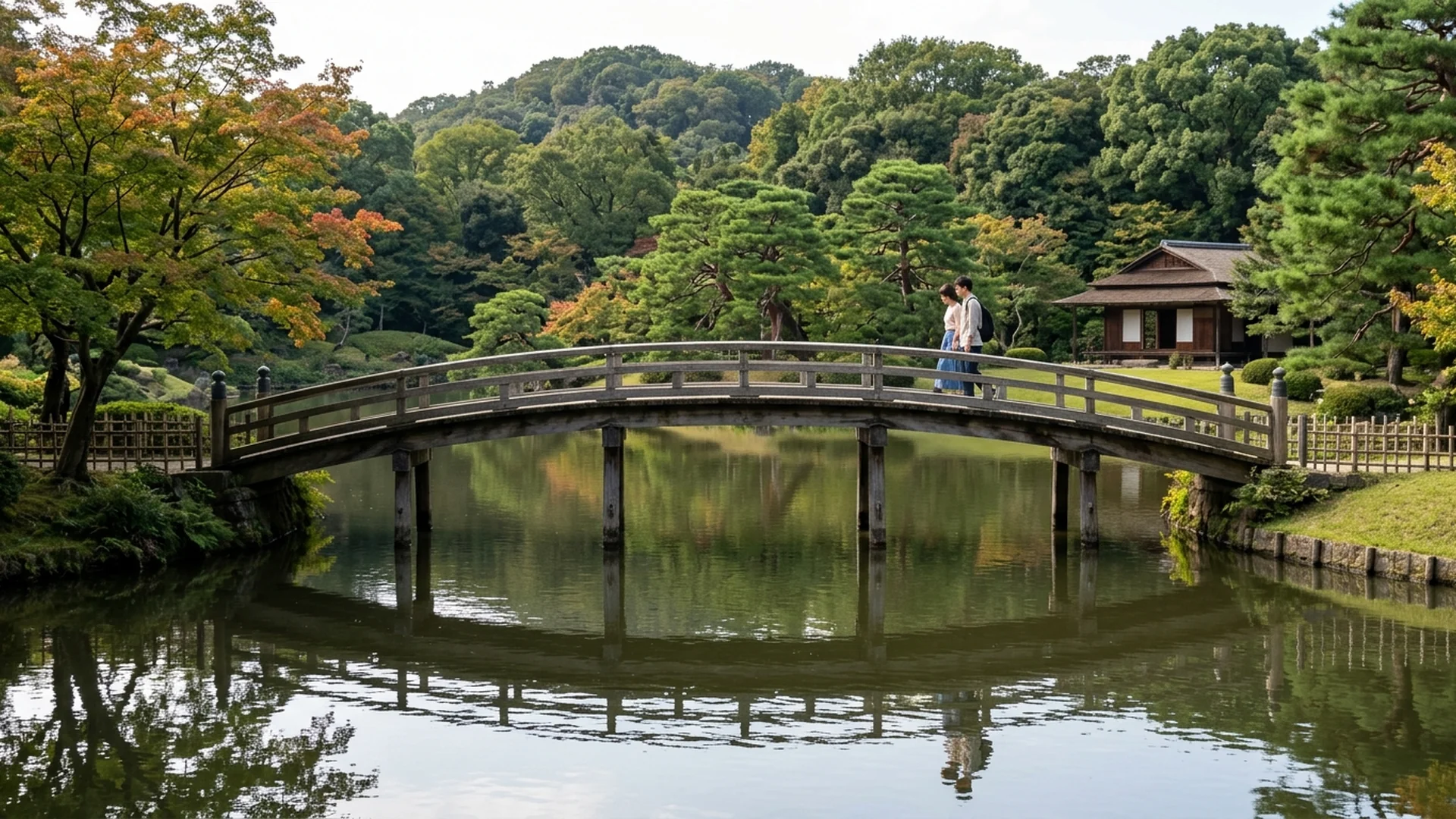
Amidst the relentless kinetic energy of modern Tokyo lies a sanctuary where time unspools with unhurried grace. Here, ancient stone pathways and weeping canopy shadows insulate an enclave of profound stillness from the twenty-first century. Rikugien Garden is far more than a manicured municipal park; it is an exalted Special Place of Scenic Beauty, representing the absolute apex of feudal daimyo aesthetics and literary landscaping from Japan’s Edo period.
Crossing the threshold into the garden is akin to turning the translucent pages of a classical anthology. Every weathered boulder, sinuous stream, and verdant islet upon the central pond was meticulously orchestrated to mirror eighty-eight sublime vistas drawn from classical Chinese and Japanese Waka poetry. Commissioned in the seventeenth century by Yanagisawa Yoshiyasu, a trusted confidant of Shogun Tokugawa Tsunayoshi, this estate remains a living museum where high literature and botanical architecture exist in perfect equilibrium.
Whether you arrive when cascading shidarezakura cherry blossoms greet the tentative dawn of spring, or during late autumn when fiery maples cast their ember reflections across ink-dark waters at dusk, Rikugien offers an intellectually and visually stirring pilgrimage. It invites the discerning traveler to touch the beating heart of wabi-sabi—the quiet reverence for transience and austere, unadorned beauty.
Decoding Edo Philosophy: When Poetry Becomes Earth and Water
The nomenclature ‘Rikugien’ finds its linguistic roots in the six foundational principles of Chinese Waka poetry, known as Rokugi in Japanese. Yanagisawa Yoshiyasu devoted seven long years—from 1695 to 1702—to materializing this visionary sanctuary, employing the kaiyushiki style of stroll garden centered around a vast contemplative pond, or sensui. The landscape shifts dramatically with every unhurried footfall, unfolding new compositional revelations.
At the spiritual anchor of the estate stands Fujimiyama, an artificial hill sculpted from the earth excavated to form the central lake. Ascending its mist-kissed summit in the early morning hour reveals an impeccably balanced miniature horizon, evoking the serene brushwork of classical ink-wash scrolls. This obsessive devotion to spatial harmony mirrors the refined escapism of the ruling elite, who sought refuge from political intrigue within realms of pure literary imagination.
Dual Seasonal Splendor: From Weeping Sakura to Fiery Autumn Tunnels
Throughout the solar cycle, Rikugien shifts its botanical raiment in response to nature’s unyielding cadence, anchored by two legendary spectacles that draw cognoscenti from across the globe.
In early spring, stretching from late March into April, a magnificent weeping shidarezakura cherry tree near the primary entrance unfurls cascading boughs heavy with pale pink blossoms. Stirred by gentle vernal breezes, the falling petals drift like perfumed snow across the pathways, arresting the gaze of every passerby.
As autumn yields to winter from November through December, Rikugien transforms into a smoldering canvas of chromatic brilliance. Over four hundred maples, alongside towering ginkgo specimens, blaze in hues of vermilion, burnt sienna, and lustrous gold. During the celebrated Autumn Illumination evenings, discreetly positioned amber lighting casts long shadows across the foliage and mirrors incandescent patterns upon the obsidian lake surface, evoking an ethereal dreamscape.
The Art of Tea: Savoring Matcha Amidst Architectural Heritage
An immersion within Rikugien remains incomplete without pausing at the historic teahouses scattered discreetly along the shoreline, such as the storied Fukiage-chaya and Tsutsuji-no-chaya structures, constructed from raw, natural timbers that blend harmoniously into the surrounding pine groves.
Seating oneself upon woven tatami mats while casting one’s gaze through wide-open wooden apertures—each acting as a living picture frame capturing shimmering ripples and wind-swept leaves—constitutes an act of mindfulness in motion. Paired with a delicate, seasonally themed wagashi confection and a bowl of frothy, bitter-rich ceremonial matcha, this ritual offers a rare sanctuary of contemplative presence in our hyper-accelerated modern epoch.