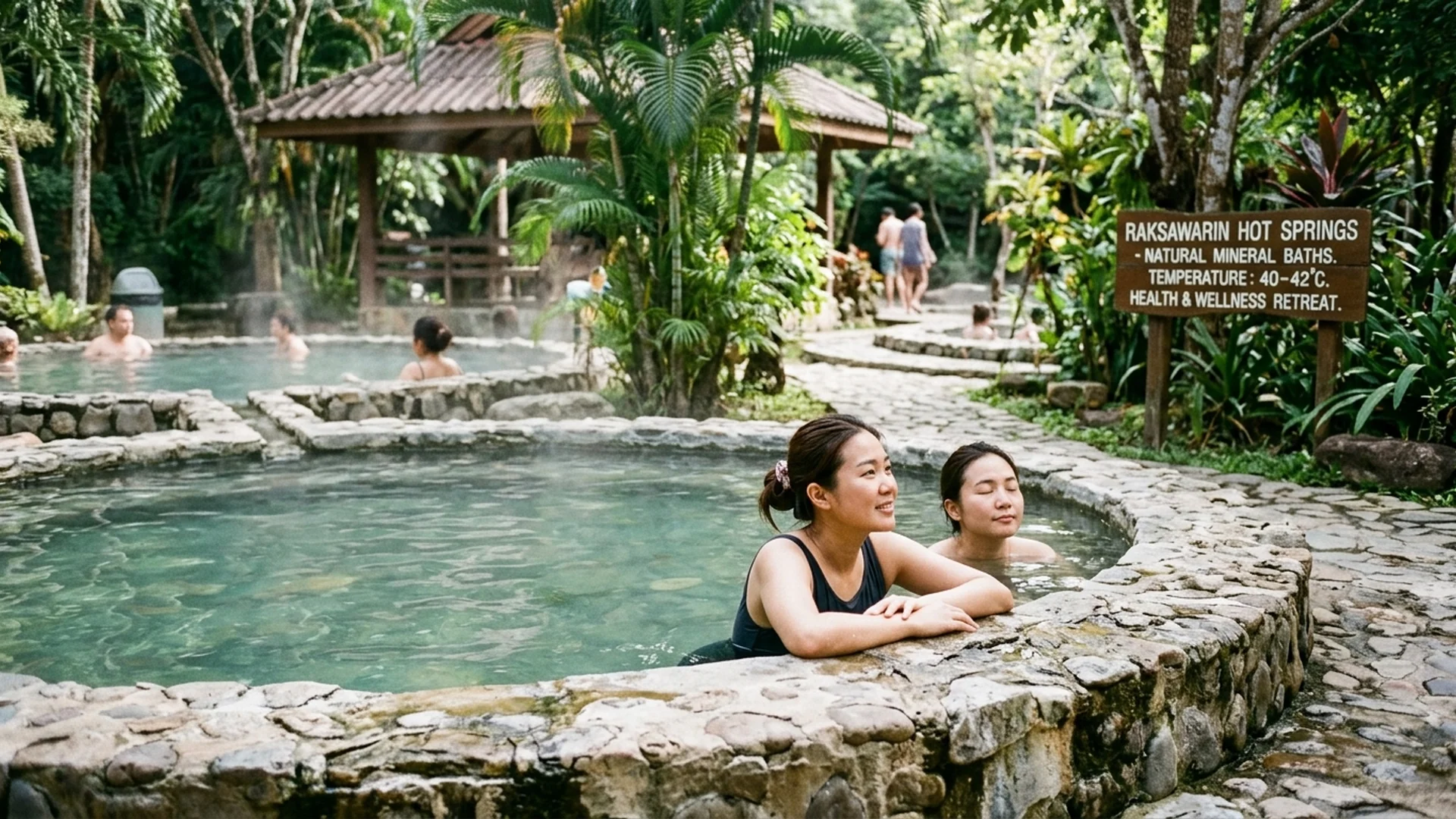
As the morning mist lingers low over pristine rainforests and gentle warmth rises from the earth’s deep core, travelers enter a realm of refined natural healing. Modern luxury travel transcends mere geographical relocation; it is an inward journey, seeking the delicate equilibrium of body and soul through the primordial elements of the earth. Subterranean hot mineral springs are millennia-old archives, filtering precious minerals through ancient volcanic and metamorphic rock formations.
In Thailand, geological diversity has gifted the kingdom with uniquely distinct mineral springs across its varied regions—from the rain-kissed valleys of Ranong and the rugged peaks of the north to the tranquil horizons of the Andaman coast. Bathing in these mineral waters is far more than a leisure pursuit; it is a time-honored hydrotherapy ritual internationally recognized for dissolving fatigue, releasing deep-seated toxins, and restoring vitality to every cellular fiber.
The Minerals of Ranong: Pristine Rainforest Waters Untouched by Sulfur
When discerning wellness travelers speak of natural thermal springs in Thailand, Ranong invariably emerges as an unrivaled jewel. The extraordinary characteristic of these natural springs lies in their exceptional chemical purity, completely devoid of the pungent sulfur aroma typical of geothermal waters elsewhere. These crystal-clear waters teem with essential minerals such as calcium, magnesium, and metasilicic acid, renowned for bestowing silkiness upon the skin, decelerating cellular aging, and soothing frayed neural pathways.
Combined with the atmospheric rhythm of a land kissed by endless rain and brilliant sunshine, where warm vapor drifts against cool forest canopies, descending into a natural stone basin or private onsen becomes an experience of timeless stillness. The quietude of Ranong allows restless thoughts to settle, growing as clear and transparent as the mineral waters themselves.
Cross-Regional Hydrotherapy: From Lanna Mists to Andaman Luxury
Beyond Ranong, Thailand offers a constellation of fascinating mineral water destinations. In northern sanctuaries like Chiang Mai and Chiang Rai, subterranean thermal springs bubble forth amidst mist-shrouded mountain valleys. The sharp thermal contrast between crisp alpine air and intensely warm mineral waters powerfully activates the body’s metabolism and immune defenses.
Meanwhile, in the upper southern reaches of Phang Nga and Krabi, hydrotherapy ascends to sophisticated new heights. World-class resorts architecturalizing harmony with nature have crafted natural mineral onsens that seamlessly weave holistic wellness modalities with ancient Thai therapeutic massage and local botanical aromatherapeutic oils, creating an exquisite aesthetic of rest tailored for the mindful modern traveler.
The Art and Ritual of Onsen Immersion: Natural Physiological Balance
Immersing oneself in thermal mineral waters is not merely a matter of sitting in warm liquid; it is an orchestrated sequence refined by alternative medicine and hydrotherapy to maximize physiological benefit without thermal shock.
The ritual commences with thorough ritual cleansing. Guests then gently cleanse their feet and splash water across the torso to acclimate the skin’s temperature to the warmth, a traditional practice known as Kakeyu. Upon entering the pool, one should begin with half-body immersion for five to ten minutes, allowing the cardiovascular system to adapt to vascular dilation before submerging to chest level for no more than fifteen minutes. Upon exiting, sipping warm water restores hydration while quiet repose in a well-ventilated lounge completes the cycle. This sequence may be repeated two to three times according to individual constitution.