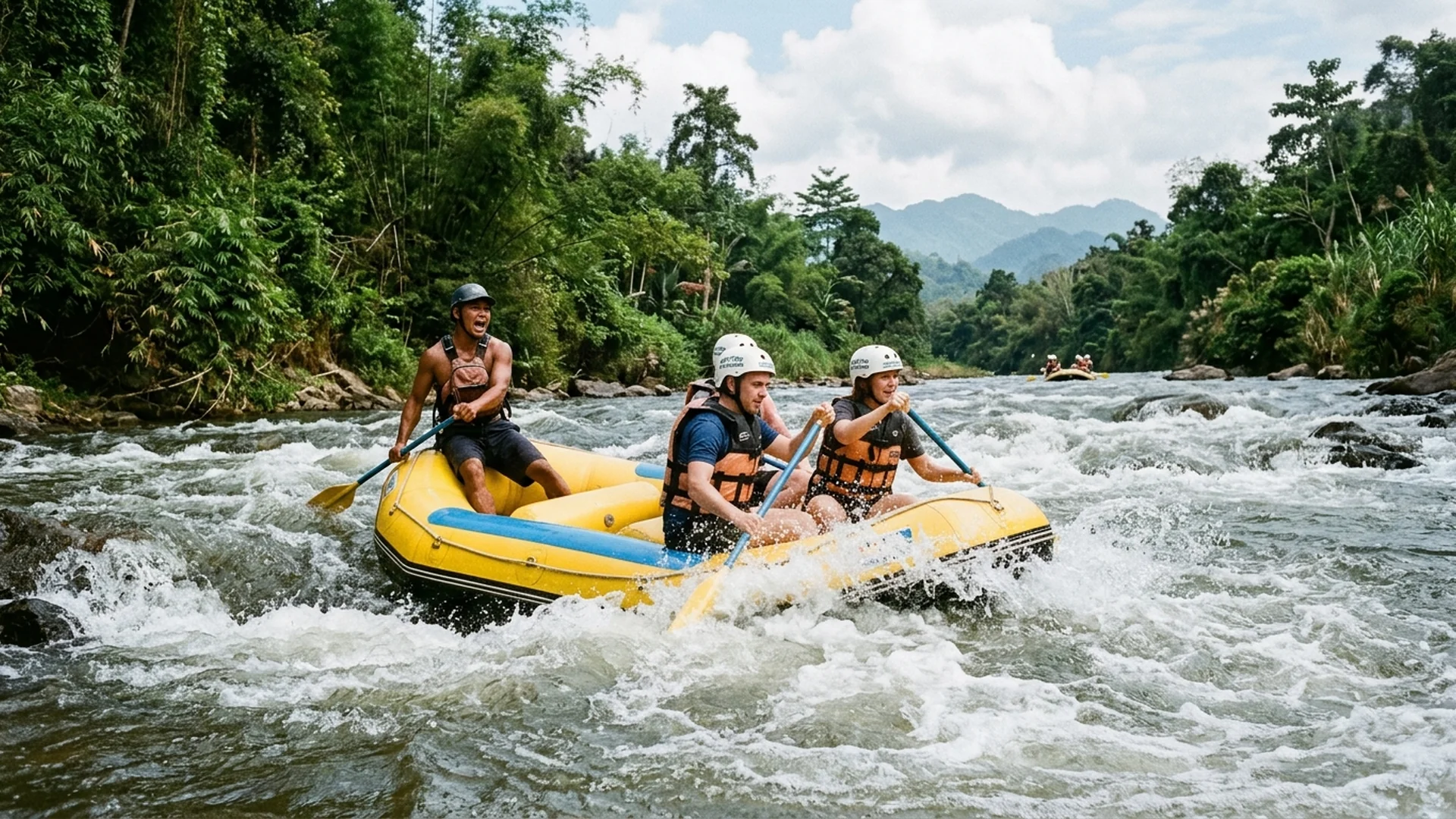
When seasonal rains cascade over the western mountain ranges and northern highlands, the tranquil waterways of the dry months transform into powerful charcoal-colored beasts. The resonant roar of churning rapids echoes through the deep valleys, summoning adventurous souls to test their mettle against the elements. Whitewater rafting in Thailand is far more than a fleeting aquatic sport; it is an immersive, spiritual pilgrimage that demands an intimate reading of the water, absolute synchronization among paddlers, and a profound reverence for the raw majesty of nature.
At the heart of any river expedition lies a mastery of the International Scale of River Difficulty, ranging from the placid ripples of Class I to the ferocious, unforgiving power of Class V. Thailand is exceptionally blessed with diverse topography, fostering world-class river routes that global paddlers dream of conquering. This editorial guide decodes three legendary river expeditions—the Khek River in Phitsanulok, the Pai River in Mae Hong Son, and the Wa River in Nan—alongside comprehensive preparation protocols and uncompromising safety standards.
Decoding River Difficulty (Classes I–V): Navigating the Churning Tides
In the global rafting community, river difficulty is categorized into six distinct classes (Class I through VI) to allow adventurers to evaluate their capabilities with absolute precision:
- Class I (Very Easy): Swift-moving current with small, regular waves and minimal obstacles. Ideal for basic paddling instruction and scenic observation.
- Class II (Moderate): Faster currents with straightforward rapids, clear channels, and visible obstructions requiring basic maneuvering skills.
- Class III (Challenging): Marked by moderate, irregular waves, medium-sized hydraulics, and narrower chutes. Requires alert paddlers who respond instantly to the helm.
- Class IV (Difficult): Powerful, churning currents with submerged boulders and violent drops that can easily destabilize a raft. Demands advanced technical skill and exceptional team synergy.
- Class V (Extremely Difficult): The ultimate test for seasoned veterans, characterized by violent hydraulics, steep drops, and continuous, complex rapid networks. Rescue is exceptionally difficult, reserved exclusively for professional river runners.
Understanding these classifications ensures that expedition planners never underestimate local conditions, as swollen seasonal waters can swiftly transform a gentle stream into a profound psychological and physical test.
1. The Khek River (Phitsanulok): A Symphony of Speed and Seventeen Raging Rapids
For concentrated, high-octane excitement, the Khek River—the upper Wang Thong River cascading down from the Phetchabun mountain range past Thung Salaeng Luang National Park—stands without peer. Celebrated as a premier national rafting arena, the route spans approximately eight kilometers yet packs between 17 and 18 distinct rapids into its exhilarating course.
The allure of the Khek River lies in its seasonal transformations. During the peak monsoon months, the water transforms into a rich amber hue laden with mineral sediment. The journey begins gently at Class I (Tha Kham rapid) to allow crews to establish their rhythm before escalating rapidly into Classes III through V. Crews confront iconic rapids such as Sai, Sang, Sopharam, and Yao, where currents violently sweep toward boulder walls and fling rafts into an intoxicating dance. Because the river flows parallel to Highway 12, access and emergency extraction are remarkably efficient, drawing continuous streams of eager adventurers.
2. The Pai River (Mae Hong Son): A Mythic Passage Through Mist-Shrouded Valleys
If the Khek River is a symphony of speed, the Pai River in the mist-veiled province of Mae Hong Son is an ancient epic poem unspooling across complex, interlocking mountain ranges. Rafting the Pai offers far more than the technical challenge of Class II to IV rapids; it delivers a protracted immersion through pristine rainforests and untouched ecological sanctuaries.
The expedition typically launches from Pai district and winds southward toward Mae Hong Son town. Along the route, travelers encounter silent limestone cliffs, cascading natural waterfalls feeding the main artery, and fleeting glimpses of traditional riverside indigenous life. The defining challenge of the Pai River lies in its meandering length and remote stretches, with itineraries ranging from half-day runs to multi-day wilderness camping expeditions designed for travelers seeking profound seclusion.
3. The Wa River (Nan): Thailand’s Longest and Most Formidable River Odyssey
This is the ultimate crucible for those who claim the title of dedicated adventurer. Originating in the Phi Pan Nam mountain range in Bo Kluea district, the Wa River flows through Doi Phu Kala, Khun Nan, and Mae Charim National Parks before merging with the Nan River, accumulating the longest continuous rapid network in Thailand.
Divided into crucial segments—most notably the Middle Wa (from Ban Sop Mang to Mae Charim) and the Upper Wa—these routes are typically orchestrated as immersive two-day, one-night or three-day, two-night expeditions. Adventurers face unrelenting Class III to V (and occasional V+) rapids, including Luang, Prap Sian, and Nam Paeng, characterized by violent recirculation zones, massive boulders, and punishing channels. Success here demands more than mechanical paddling; it requires total psychological fusion with the team and absolute obedience to the seasoned river guide at the stern.