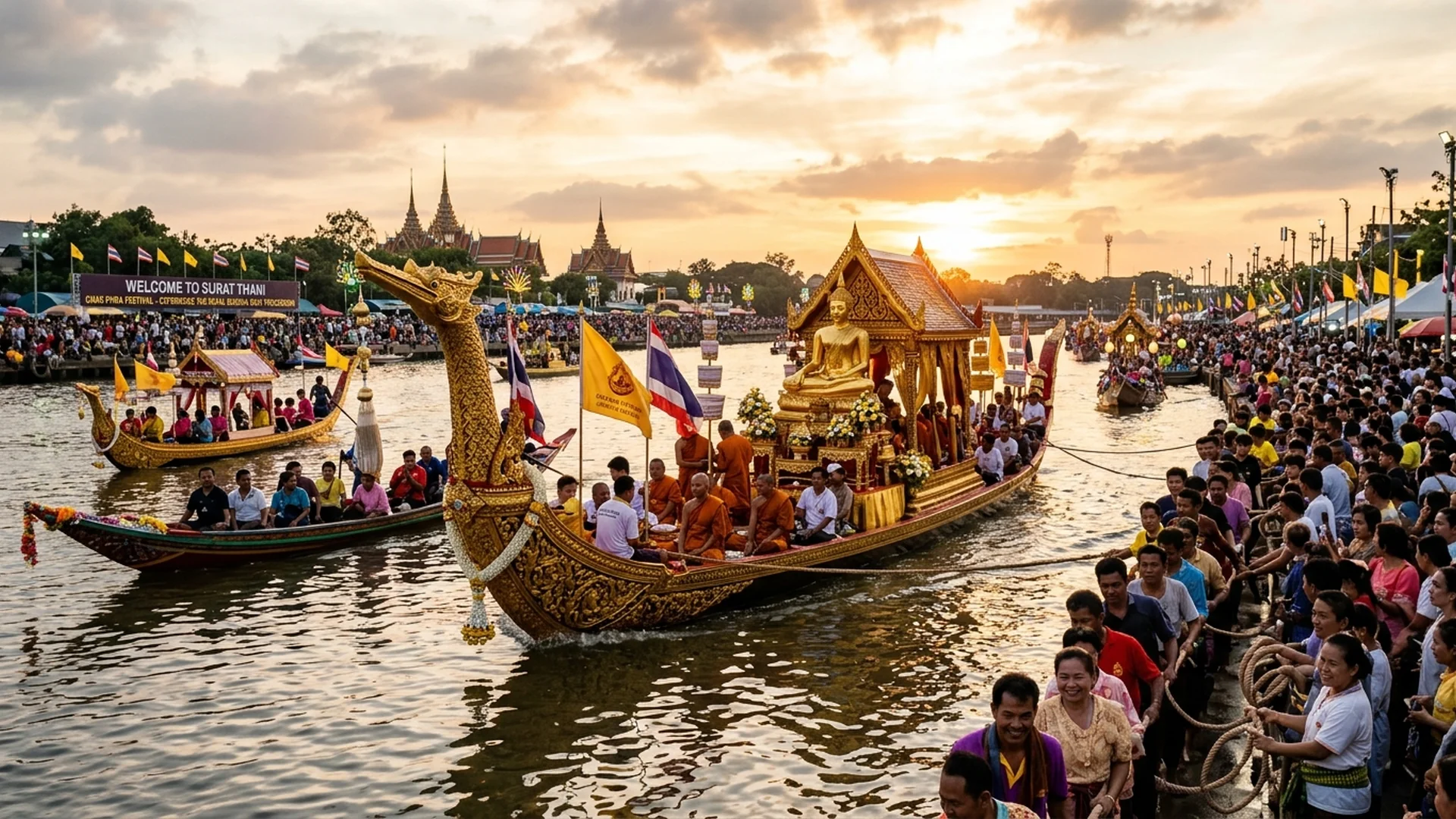
When the first crisp breath of seasonal change sweeps across the southern realm of Thailand, the expansive waters of the Tapi River in Surat Thani awaken with a quiet, shimmering vitality. Amidst the rhythmic beating of traditional drum pulses and the harmonious, resonant chants of villagers pulling sacred floats along the banks, the air fills with an ancient cadence. This is the sacred threshold of the End of the Buddhist Lent, drawing tens of thousands of devoted pilgrims together in a centuries-old cultural inheritance.
The Chak Phra—or the ceremonial dragging of the sacred Buddha image—transcends a mere religious observance commemorating the Buddha’s descent from the Tushita heaven after preaching to his mother. It stands as a profound testament to community solidarity, the ingenious artistry of rural craftsmen, and an unbroken symbiotic bond between human existence and the living waters. Together, these elements transform this southern city into a radiant metropolis of living faith.
From Celestial Realms to Earthly Waters: The Roots of Devotion
According to Theravada Buddhist cosmology, the conclusion of the Vassa rains retreat marks the auspicious day the Buddha descended back to the mortal realm at Sankassa, welcomed by joyous deities and human followers alike. This celestial event inspired southern communities to craft an elaborate ritual reenacting the divine welcoming, known as Chak Phra or Phra Lak.
Within the unique cultural landscape of Surat Thani, this tradition diverges wonderfully from other regions through its dual expression: the ‘land floats’ (Ruea Phra Bok), whose chassis are ingeniously adapted into wheeled carriages draped in ornate pavilions, and the ‘river floats’ (Ruea Phra Nam), gliding serenely upon the Tapi River. Transporting these sacred vessels serves not merely as the movement of holy relics, but as a spiritual anchor uniting the entire community around the revered standing Buddha images that grace each floating sanctuary.
Masterpieces of the Watershed: The Duality of Land and River Floats
The visual triumph of the festival lies in the astonishing devotion poured into decorating the Phanom Phra vessels. Artisan guilds from participating sanctuaries collaborate for weeks, constructing tiered pavilion roofs (Busabok) characterized by multi-gabled eaves tapering toward delicate spires that catch the autumn sunlight. The framework is wrapped in intricate Thai ornamentation—kanok scrolls, floral gables, and mythical swan tails—crowned by the ephemeral mastery of banana-pith carving (Ta-ni banana stalks skillfully whittled into astonishingly delicate, lace-like reliefs).
As a hundred land floats wind gracefully through municipal avenues, mirrored by their fluvial counterparts adrift on the sweeping currents of the Tapi, the synchronized ringing of bronze bells and resonant gongs creates a hypnotic symphony of faith. This auditory and visual tapestry conjures an ephemeral architectural wonderland rarely witnessed elsewhere in the kingdom.
Dimensions of Culture: Roadside Shrines and Waterway Rivalries
Beyond the formal processions, the festival preserves intimate domestic traditions such as the creation of roadside Pha Pa (forest-monk alms) bushes. On the eve of the main procession, families construct miniature woodland sanctuaries populated by mythical Himmapan creatures or scenes from the Jataka tales, decorated with incense, lanterns, and hanging currency offerings for nocturnal monastic collection. This charming custom highlights an understated domestic piety.
Simultaneously, the waters fronting the Tapi River embankment churn with fierce athletic passion during the Royal Trophy long-boat races. Skilled crews from distant watersheds pit muscle and strategy against the rushing tide, while spectators along the stone quays cheer amidst the rich, comforting aromas of southern homestyle cuisine and traditional coconut dumplings, heightening the festival’s contemplative yet vibrant pulse.