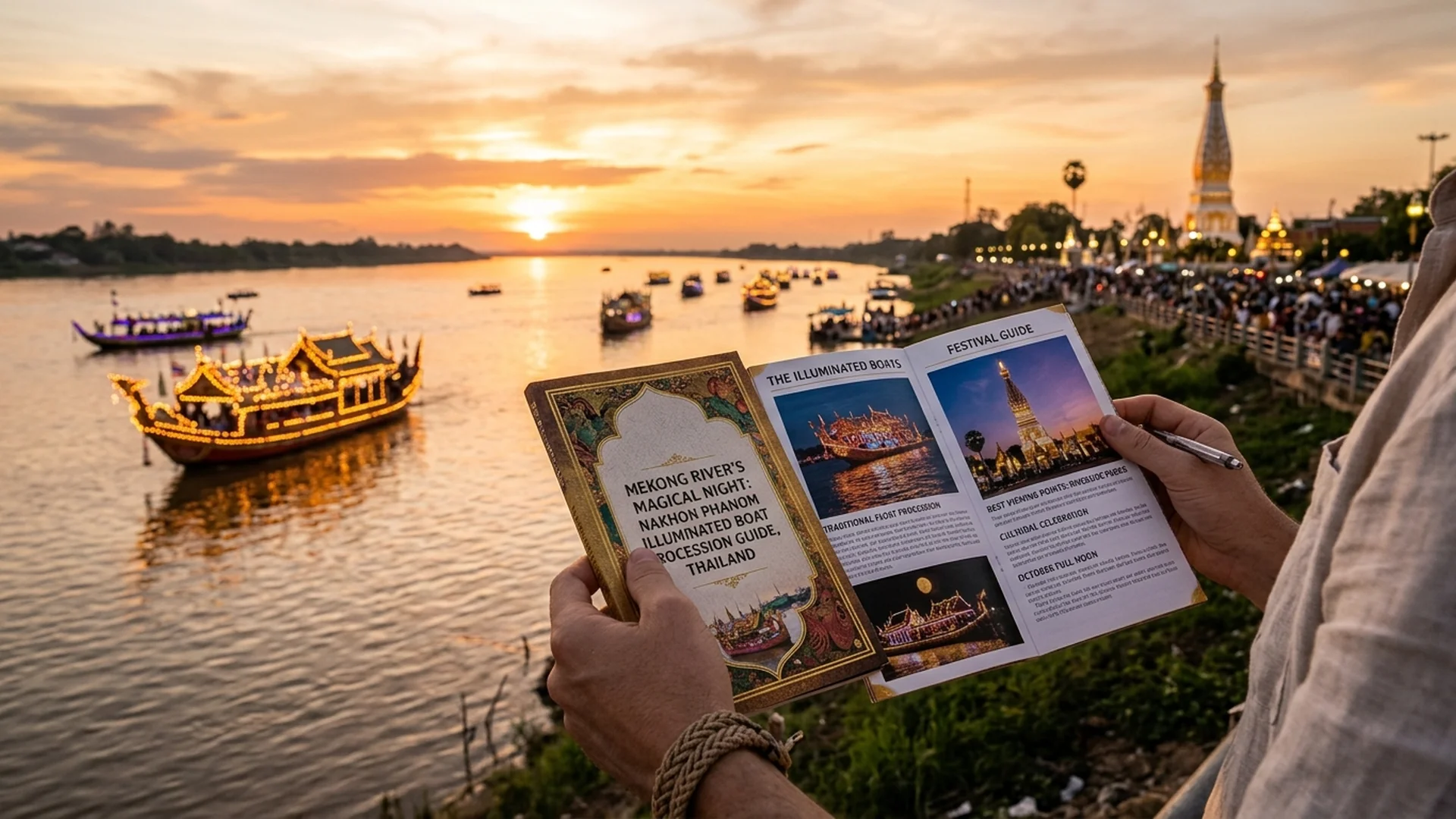
As the sun dips below the rugged silhouettes of the Laotian mountains, the Mekong River at Nakhon Phanom transforms from a glistening golden ribbon into an obsidian canvas waiting to be brushed with fire. On the night of the full moon—the fifteenth day of the eleventh lunar month, marking Aw Phansa—colossal floating architectural marvels glide gently along the swift currents. These breathtaking masterworks are meticulously woven from hundreds of thousands of flickering oil lamps, representing the pinnacle of vernacular folk artistry born from the unyielding devotion of communities on both sides of the Mekong.
Amidst the crisp evening air of early winter, the soft lapping of water mingles with distant Buddhist chants and traditional melodies. The gentle heat radiating from roaring flames dances across the vast expanse of the Mekong, creating an architectural and spiritual spectacle unlike any other on earth. For the discerning cultural traveler, this centuries-old tradition transcends mere ritual; it is an epic of ephemeral architecture that harmonizes ancient engineering, folk mathematics, and communal harmony.
Journeying to Nakhon Phanom in a luxury paradigm offers far more than a fleeting glance from crowded riverbanks. It invites travelers to embrace the slow-life rhythm aboard an exclusive vessel on the Mekong, savoring refined local gastronomy as colossal, hundred-meter-wide fireboats drift silently into view, connecting the soul of the great river with sacred heritage sites across the storied town.
An Epic of Fire: Bamboo Architecture and the Art of the Fireboat Artisans
Behind the fleeting spectacle upon the Mekong lies weeks of sweat, skill, and ancestral wisdom. Long before the festival begins, master artisans and villagers from all twelve districts of Nakhon Phanom gather along the riverbanks to harvest massive bamboo stalks, lashing them securely with recycled strips of motorcycle inner tubes. They assemble these skeletal foundations into colossal floating structures, some stretching over 100 meters long and towering as high as a ten-story building.
The defining element that sets Nakhon Phanom’s fireboats apart from modern electric illumination is the deliberate choice of handmade oil lamps fashioned from discarded metal cans or eggshells, filled with diesel-alcohol fuel and fitted with cotton wicks. Up to thirty thousand such lamps are meticulously installed onto the bamboo framework according to intricate sacred geometries, tracing the divine forms of Nagas, the sacred That Phanom stupa, swans, and Jataka tales from Buddhist scripture.
By night, as local craftsmen bravely scale the bamboo scaffolding to ignite each lamp by hand, the evening breeze breathes life into the flames. This creates a poetic rhythm of light dancing harmoniously with the dark waters—a radiant spectacle warmed by genuine human pulse and unshakeable faith.
The Eleventh Lunar Month: Carvings of Faith, Nagas, and the Mekong Waters
Rooted in the profound cosmology of the ethnic Lao-Isan people along the Mekong, the tradition of Lai Ruea Fai is deeply entwined with Buddhist philosophy and riverine reverence. According to legend, the night of Aw Phansa marks the sacred occasion when the Buddha descended from the Tavatimsa heaven after preaching the Dhamma to his mother. Mortals and celestials alike gathered to offer magnificent homages, establishing the tradition of floating illuminated vessels to venerate the Buddha’s footprint left upon the banks of the Nammada River in ancient India at the behest of the serpent kings.
Furthermore, the Mekong River has long served as the lifeblood of mainland Southeast Asia. The act of lighting and setting adrift these luminous vessels serves as a profound expression of gratitude and atonement toward Phra Mae Khongkha, the river goddess, for sustaining daily life, while invoking the protection of Phra Uppakut, the venerable arhat dwelling in the oceanic depths.
As each fireboat is released into the current, the blazing flames symbolically consume worldly grief, illness, and misfortune, allowing them to vanish into the dark expanse of the great river, leaving behind inner clarity, spiritual renewal, and awakened hope.
An Elevated Riverine Symphony: Experiencing the Fireboats from the Water and Above
Experiencing the Illuminated Boat Procession with tranquility and refinement requires thoughtful planning. For high-net-worth travelers, the ultimate vantage point is aboard an exclusive dining vessel or luxury river craft that anchors mid-stream before dusk. Here, guests witness the golden hour paint the Mekong and the rolling hills of Khammouane in Laos with warm amber light before twilight gives way to night.
From this serene aquatic sanctuary, the colossal fireboats pass in intimate proximity, revealing the staggering scale of their bamboo construction, the crackling symphony of tens of thousands of flames, and the gentle radiant warmth they cast upon the breeze. All the while, guests savor meticulously curated Isan-Thai haute cuisine.
For those who prefer a panoramic vista, staying in a boutique heritage hotel or utilizing a rooftop lounge along Sunthon Wichit Road offers a bird’s-eye perspective. From this elevated view, the entire bend of the Mekong unfurls like a luminous thread, accompanied by bursts of celebratory fireworks mirroring the celestial expanse above.
Pilgrimage Around Nakhon Phanom: Veneration at the Eight Day-of-Birth Stupas
Nakhon Phanom offers far more than nocturnal festival pageantry; it is a profound sanctuary of sacred Buddhist reliquaries. Integrating a pilgrimage to the eight auspicious day-of-birth stupas scattered across the province elevates any seasonal journey into a transformative spiritual retreat.
The journey begins at the legendary That Phanom in That Phanom district, the spiritual heartland for devotees on both sides of the river and the sacred shrine for those born on Sunday. It continues to That Phanom’s spiritual siblings: That Phanom Ruenu in Renu Nakhon (Monday), adorned in soft pink stucco; That Phanom Si Khun in Na Kae (Tuesday); That Phanom Maha Chai in Pla Pak (Wednesday daytime); That Phanom Marukhanakhon (Wednesday evening); That Phanom Prasit in Na Wa (Thursday); That Phanom Tha Uthen along the northern Mekong (Friday); and That Phanom Nakhon at Wat Mahathat in the city center (Saturday).
Driving leisurely through tranquil rural landscapes, stopping for artisanal drip coffee brewed from local beans, and performing ritual water-pouring ceremonies at each sanctuary restores vital energy and inner stillness before returning to the town to witness the evening’s luminous pageantry.