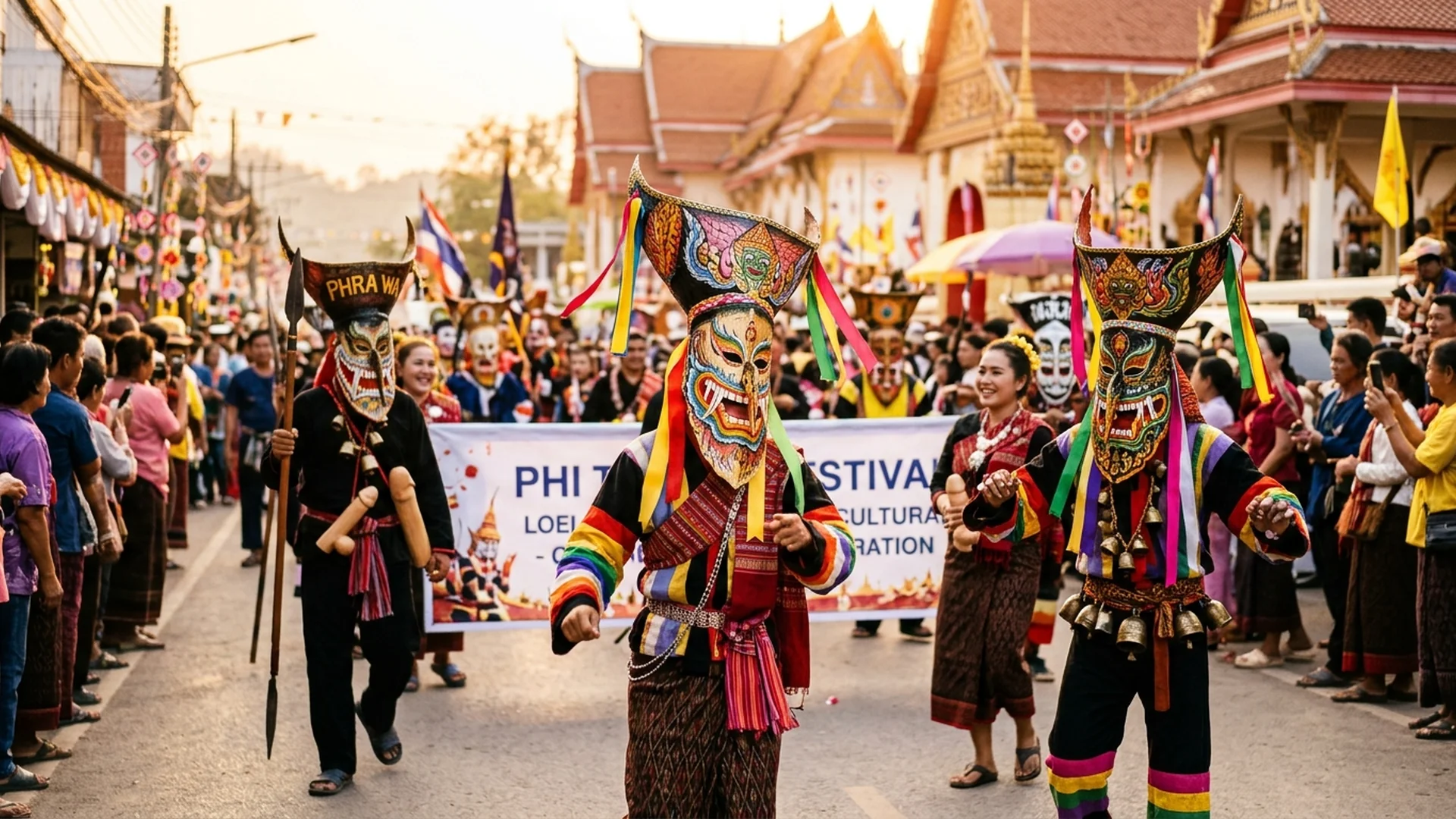
Amidst the dawn mists veiling the emerald valleys of Dansai District in Loei Province, the resonant clinking of brass bells and bamboo rattles echoes across the Man River. This rhythmic chorus heralds the commencement of the Phi Ta Khon festival—not merely a riotous carnival of color, but an ancient, hallowed ritual bridging ancestral spirit worship and Theravada Buddhist devotion.
Deeply rooted in the sacred Bun Luang or Vessantara Jataka celebrations, this spiritual tradition reenacts the joyous return of Prince Vessantara to his capital, an event so exultant that forest spirits and wild beasts followed—or ‘Phi Ta’—humanity in profound homage. Journey across these cultural dimensions, where unadorned faith transforms into world-class bamboo and coconut husk mask artistry.
A Three-Day Tapestry of Faith: The Chronology of Bun Luang
Participating in the Bun Luang tradition in Dansai transcends mere observation; it is stepping through a portal of time across a meticulously choreographed three-day sequence. Daybreak breaks at 4:00 AM on the first day, when village elders and ritual assistants process to the banks of the Man River. Here, they perform the Upakut invocation, drawing a sacred river stone from the depths to enshrine it at the Upakut shrine of Wat Phon Chai, punctuated by ceremonial gunfire in four directions to invoke peace. This is immediately followed by the Baci soul-welcoming ceremony for ‘Chao Pho Kuan’ and ‘Chao Nang Tiam,’ the revered hereditary spiritual custodians of the local deities and the sacred Phra That Si Song Rak stupa.
The second day unfolds as a kinetic explosion of life and polychromatic wonder during the grand Vessantara homecoming procession. Swarms of exuberant Phi Ta Khon dancers wind through the streets to rhythmic folk melodies, circling the Wat Phon Chai ordination hall three times before launching bamboo rockets to implore Phya Thaen for rain. The evening culminates in the symbolic casting of the masks into the Man River to wash away sorrow and affliction. The final day settles into quiet contemplation within the temple sanctuary, centered on listening to the 13 chapters of the Great Birth Sermon amidst the community’s devout offerings.
Decoding the Mask: Woven Architecture and Coconut Husk Canvases
The Phi Ta Khon mask stands as a triumph of vernacular ingenuity, masterfully fusing indigenous natural materials. The crown framework is fashioned from a ‘huad,’ a traditional woven bamboo sticky-rice steamer, inverted to form an elongated, flared headpiece. The visage itself is carved from dried coconut husks, featuring a dramatic protruding nose carved from soft wood and pierced eyeholes. Hand-stitched garments fashioned from colorful textile scraps complete the vibrant silhouette.
The distinction between ‘Phi Ta Khon Yai’ and ‘Phi Ta Khon Lek’ lies in their sacred hierarchy and ritual function. Created only in male-female pairs towering a head above ordinary mortals, the Greater Spirits (Yai) are crafted exclusively by those sanctioned by Chao Pho Kuan to embody powerful ancestral entities. Conversely, the Lesser Spirits (Lek) provide an outlet for boundless creative expression among villagers and youth, who adorn their coconut husk visages with intricate Thai motifs and whimsical vines, celebrating humor and natural abundance.
The Artistry of Dansai Slā: From Craft Heritage to Bamboo Workshops
For discerning travelers seeking profound cultural immersion, direct engagement with local master craftsmen—known as ‘slā’—in Dansai offers rare insight into the true essence of this folk art. Village ateliers and heritage preservation centers invite visitors to try their hand at painting miniature bamboo masks, learning traditional techniques from historic natural clay pigments to contemporary palettes.
Conversations with these master artisans reveal that every brushstroke applied to the coconut husk is more than aesthetic embellishment; it is an intuitive rite designed to dispel negativity and instill positive spiritual energy. Participating in this creative process elevates the journey from a passive tour to an intimate connection with an artistic lineage passed down through generations.
The Art of Slow Travel: Riverside Sanctuaries and the Quiet Charm of Loei
After surrendering to the vibrant energy and kinetic devotion of the festival, retreating to the quiet sanctuaries along the Man River offers a pristine balance. The riverbanks, cradled by the undulating emerald contours of Loei’s mountain ranges, embody an unhurried, minimalist elegance reminiscent of Kinfolk Living.
Sipping steaming tea amid morning river mists, savoring subtle Isan-Loei highland gastronomy crafted from hyper-local ingredients, and watching the lazy current of the Man River combine to reset the traveler’s internal rhythm, elevating a cultural excursion into a deeply restorative spiritual retreat.