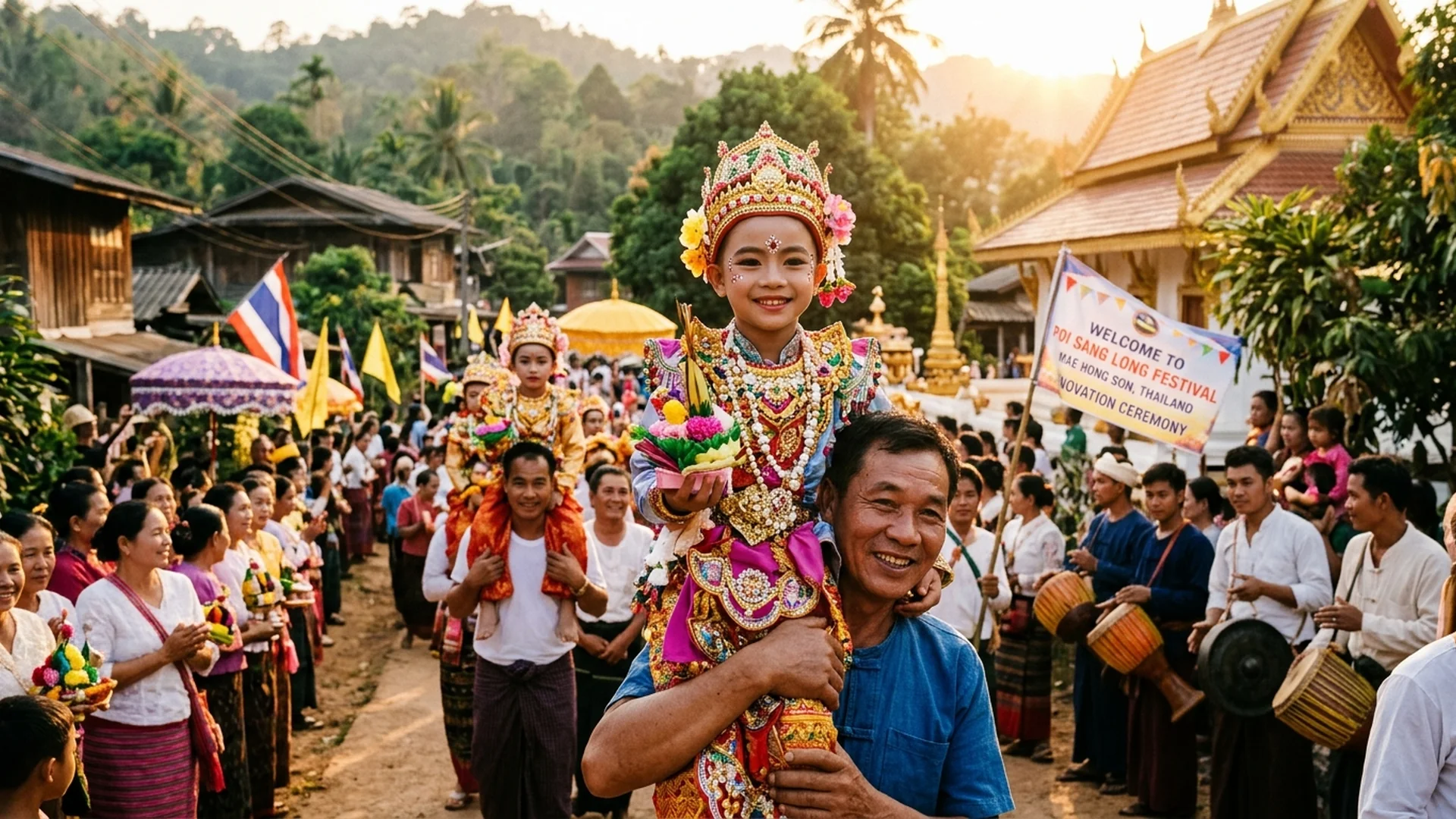
Amidst the gentle morning mists that shroud the mist-veiled valleys of Mae Hong Son, the resonant chime of brass gongs, the rhythmic thrum of drums, and the crisp clashing of cymbals drift across the rugged Tai Yai landscape. This is the herald of the Poi Sang Long festival—the most splendid and culturally profound novitiate ordination ceremony in the western reaches of the ancient Lanna realm. Here, scores of innocent young boys undergo a transcendent metamorphosis, arrayed like celestial princes drawn from classical epic literature. Their brows are crowned with glittering diadems, their garments woven from brilliant silk and embroidered with threads of spun gold.
Most striking of all, these young princes do not walk upon the earthly realm. Instead, they are borne aloft upon the shoulders of the ‘Tapha’—dedicated guardians who carry their sacred burdens with profound reverence and familial devotion. It is an enduring, powerful image that lays bare the unbreakable bond between Theravada Buddhism, living art, and the unyielding spiritual resolve of the Tai Yai people, passed down through unbroken generations.
Yet, the enchantment of Poi Sang Long extends far beyond its dazzling visual splendor. It is steeped in profound philosophy, symbolizing the renunciation of worldly attachments and mirroring the early life of Prince Siddhartha before his Great Departure. This editorial transcreation invites you to journey deep into Tai Yai civilization, decoding the symbolism behind priceless garments, tracing the sacred rhythm of a four-day consecration, and mastering the art of mindful observation with the sensitivity of a documentary master.
Decoding the Metamorphosis: When Ordinary Boys Become Royal Sang Long
At the beating heart of the Poi Sang Long tradition lies a profound spiritual conviction: guiding one’s sons or young relatives into monastic novitiate generates supreme spiritual merit, paving a path of grace for parents and ancestors alike. Yet, before crossing the threshold into the sacred monastic robe, these youths must undergo a breathtaking transformation into ‘Sang Long’. The term ‘Sang’ denotes a novice monk, while ‘Long’ signifies a king or nobleman, fusing together to translate as ‘noble lords preparing for monkhood’.
The vestments of the Sang Long are masterclasses in indigenous Tai Yai craftsmanship. The attire begins with luminous silk trousers, paired with tailored mandarin-collared jackets intricately embroidered with metallic threads of silver and gold. Their crowns are exquisitely wrapped silk turbans adorned with fresh blossoms and shimmering faux gemstones. Their faces are delicately touched with cosmetics to evoke the luminous, otherworldly visage of princes from ancient mythology. Many of these heirloom ornaments are generously shared or passed down through generations within the community, offering a tangible testament to collective village solidarity where every family contributes to the splendor of the initiates’ defining day.
Equally unforgettable is the steadfast rule prohibiting the Sang Long from allowing their feet to touch the soil throughout the primary ritual days. Stepping forward as ‘Tapha’—traditionally teenage boys or robust male relatives—they hoist and cradle the young initiates upon their shoulders for every leg of the ceremonial processions. This physical labor is never viewed as mere exertion; rather, it is embraced as an act of immense devotion, symbolizing the community’s supreme reverence for those on the precipice of monkhood.
The Four Sacred Days: From Investiture to the Grand Procession
The architecture of the Poi Sang Long festival follows an impeccably choreographed ritual calendar, typically unfolding across four full days, each designated with distinct ceremonial titles and spiritual responsibilities:
- Day One (The Investiture & Cleansing): The dawn begins at the monastery, where the young boys undergo ritual head-shaving and eyebrow-removal before dressing in their full regal regalia. By afternoon, they embark on the ‘Glai Sang Long’ procession, visiting sacred temples across Mae Hong Son to pay homage to principal Buddha images and invoke the blessings of guardian deities.
- Day Two (The Grand Procession of Offerings): Widely regarded as the most visually arresting day, this features an exuberant parade of monastic requisites and the Sang Long winding through the thoroughfares of Mae Hong Son. The procession pulses with traditional Tai Yai ensembles, sword dances, mythical bird dances (‘To’), and graceful fingernail dances. Perched high upon their guardians’ shoulders, the Sang Long greet onlookers with innocent smiles amidst joyous fanfare.
- Day Three (The Day of Seeking Forgiveness): This day centers on circumambulating the town to formally petition for forgiveness and offer absolute devotion to the preceptor abbot. Solemn evening prayers prepare the minds of the initiates for their imminent transition into ascetic life.
- DayFour (The Ordination into Monastic Life): The culmination of the journey arrives with the formal novice ordination ceremony. The opulent garments and glittering crowns are respectfully laid aside, replaced by the serene saffron robes of Buddhist monasticism. The rites conclude with communal almsgiving and a celebratory feast honoring the supporting families.
A Photographer’s Lens & Cultural Etiquette: Documenting with Reverence
For discerning travelers and photography enthusiasts, Poi Sang Long offers an extraordinary visual tapestry rich in mood, hue, and narrative depth. However, capturing these sacred rites demands heightened cultural sensitivity, patience, and absolute discretion.
Visual storytelling should prioritize emotional resonance over mere documentary cataloging. The low, raking light of early morning and late afternoon—the coveted golden hour—dances across silk fabrics and painted faces, etching a poignant dimensionality into every frame. Utilizing a telephoto lens allows you to capture intimate expressions, profound moments of parental devotion, or the quiet focus of an initiate without intruding upon the sacred space of the ceremony.
Above all, maintaining respectful boundaries is paramount. The ritual processions follow ancient, unbroken pathways; stepping directly into the path of the parade for a photograph is strictly discouraged. Flash photography should be avoided during solemn indoor shrine rituals. Visitors are likewise expected to wear modest, respectful attire that covers shoulders and knees, honoring the sanctity of both the temples and the hosting communities.