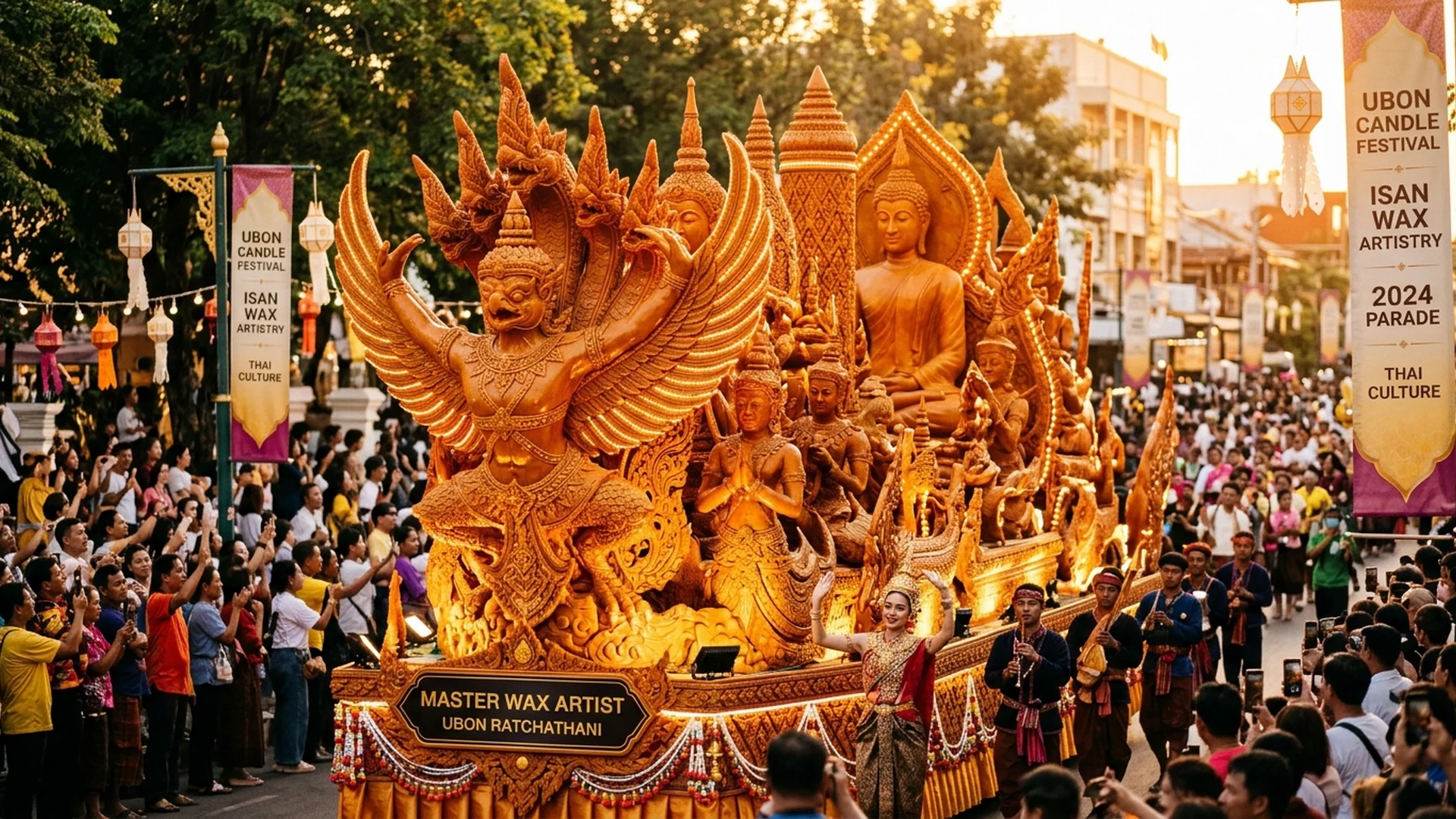
When the first amber light of July illuminates the southern Isan plateau, the subtle fragrance of pure beeswax and the soft, rhythmic tapping of brass chisels awaken a centuries-old hymn of faith in Ubon Ratchathani. Here, the observance of Buddhist Lent transcends simple religious ritual, transforming into a silent yet monumental arena for master wax artisans. These craftsmen elevate humble pillars of wax into high sculptural masterpieces brimming with spiritual meaning. The grand candle procession is far more than a dazzling visual spectacle for global observers; it is a living chronicle of history forged through perspiration, boundless imagination, and the unwavering devotion of the Thai Buddhist faithful, destined to captivate every seeker of authentic beauty.
Rooted deeply in regional heritage, the festival represents an extraordinary synthesis of communal spirit and peerless patience. As contemporary travelers increasingly seek meaningful, unhurried cultural immersion, the Ubon Candle Festival offers a rare window into a world where sacred geometry and artistic mastery converge in absolute harmony.
Legacy of Faith: Decoding the Sculptural Mastery of Ubon Artisans
Beneath the towering stature of each sacred candle pillar lies an intensely complex architectural process demanding uncompromising focus. Candle-making artistry in Ubon Ratchathani broadly separates into two distinct schools: the molded technique, where refined beeswax is pressed into elaborate traditional Thai molds and meticulously applied piece by piece to create uniform surface patterns, and the carved technique, which stands as the crowning jewel of regional ingenuity. Expert artisans first cast colossal monolithic wax cylinders, then apply precision blades directly into the dense medium, carving inward by inches to reveal multilayered narratives of Buddhist Jataka tales, celestial beings, and intricate floral motifs. Every single incision carries immense risk; a solitary miscalculation can compromise the medium, necessitating a complete restart from the very beginning. This is a beauty defined by its delicate vulnerability, yet it resonates with formidable cultural power.
The Rhythm of Light and Shadow: Processional Routes and Golden Hours
Appreciating the full aesthetic breadth of the Ubon Candle Festival demands deliberate, thoughtful scheduling. On the eve of Buddhist Lent around Thung Si Mueang Park, the competition candle floats are exhibited in an enchanting nocturnal setting where dramatic lighting accentuates the translucent wax reliefs, making them appear vibrantly alive against the encroaching darkness. This quiet twilight hour affords photographers and art connoisseurs the luxury of examining intricate details without haste. By the following morning, the grand procession surges down the main avenues, accompanied by traditional Isan folk dances that celebrate regional life with measured grace. Securing an orderly, curated viewing area allows travelers to absorb the sheer scale and sculptural grandeur of the illuminated floats without obstruction or distraction.
Behind the Sanctuary Doors: Temple Compounds and the Guild of Artisans
To truly comprehend the spiritual pulse of this celebration, one must venture into the historic temple compounds—known locally as Khum Wat—such as Wat Phurapharam, Wat Si Pradu, or Wat Thung Si Mueang during the weeks leading up to Lent. These sacred enclosures serve as organic ateliers where veteran masters and aspiring apprentices labor side by side in companionable silence. The gentle scent of natural beeswax mingles with quiet conversation and distant folk melodies. Engaging in dialogue with these custodians of heritage reveals that a single candle pillar is never born of solitary labor; rather, it is the collective offering of an entire community devoted entirely to spiritual veneration.