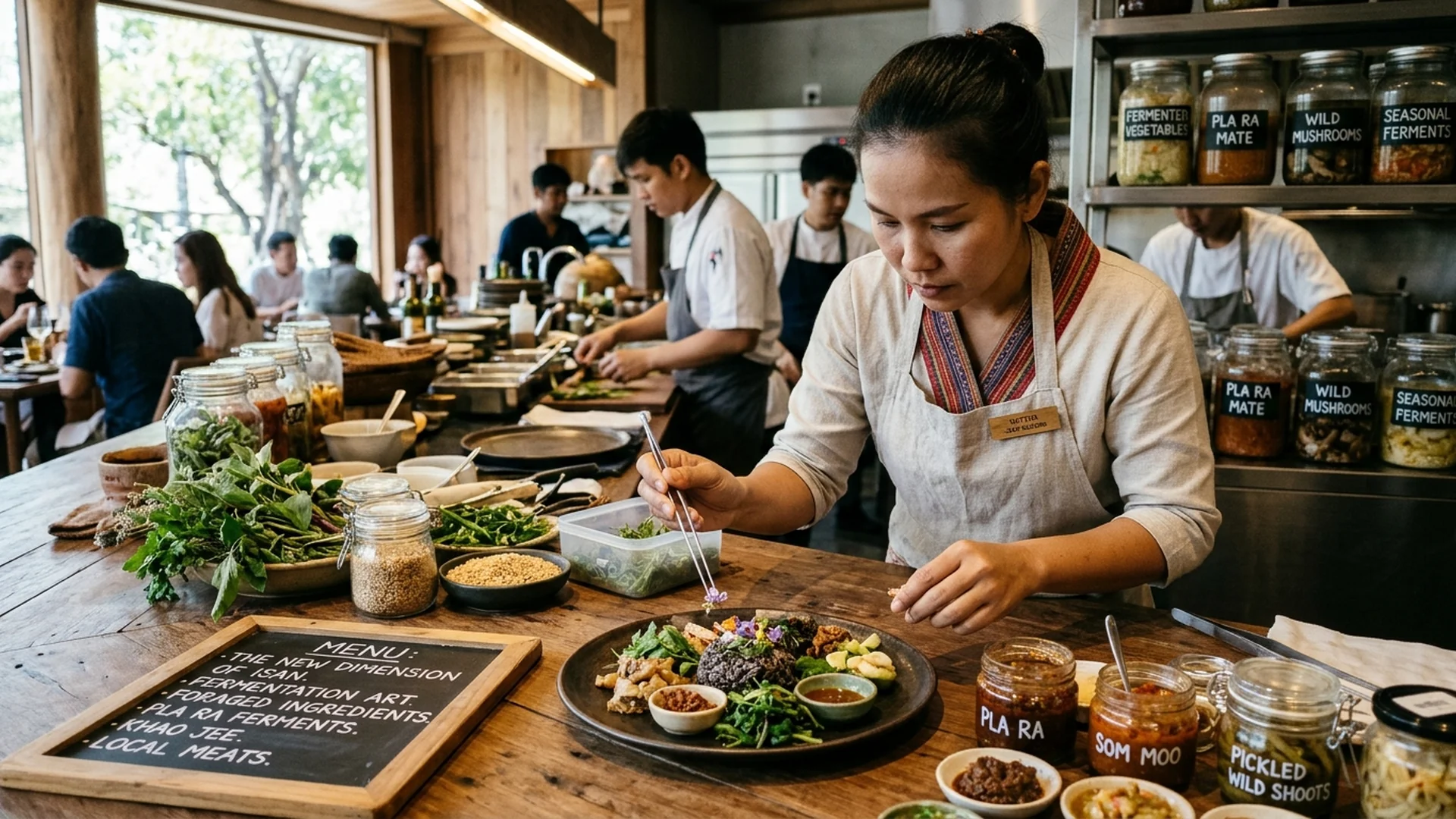
Across the sweeping arid plains and sparse open woodlands of Thailand’s northeastern Isan plateau, ancestral strategies of survival and harmonious coexistence with nature have forged a culinary heritage of profound complexity. Far beyond conventional assumptions of fiery street fare or simple rustic dishes, Isan cooking is underpinned by a subtle philosophy of ecological reliance, patient fermentation arts, and a meticulous reverence for seasonal woodland foraging.
Today, a vanguard of contemporary chefs and culinary innovators is propelling Isan gastronomy beyond historical boundaries, reinterpreting its traditions on white tablecloths. By extracting the very essence of ‘nua’—that elusive, savory depth unique to the region—and applying refined international techniques, they transform humble regional staples into exquisite works of edible art that honor the land, water, and ancestral rhythms.
The Architecture of ‘Nua’: Fermentation Science and Ancestral Wisdom
If French cuisine boasts its foundational mother sauces, Isan gastronomy claims ‘nua’—an untamed, deeply savory pillar of taste that resists rigid formulas. The heart of this complexity lies in traditional fermentation, an ancient craft designed to preserve harvests that simultaneously unlocks rich amino acids and profound umami. Superior pla ra aged for over a year with coarse salt and rice bran, freshwater crab paste harvested after the paddies drain, and glutinous rice toasted until fragrant before being meticulously ground into khao khua all function as natural chemical agents. Modern fine dining chefs isolate and refine these elements to elevate the native profiles of regional proteins and wild botanicals in unprecedented ways.
Foraging the Isan Khok: Seasonal Elements and Nature’s Ciphers
Another mesmerizing facet of Isan culinary tradition is its intimate synchronicity with the changing seasons. Within the dry dipterocarp forests and elevated scrublands known as khok, the finest ingredients are never found in supermarkets; rather, they arrive with the monsoonal rains and dry winds. The arrival of summer yields plump red ant eggs, offering a delicate, natural acidity. With the monsoon comes the prized, crunchy earthstar mushroom alongside aromatic forest greens. High-end culinary interpretation thus becomes a foraging pilgrimage, binding human appetite directly to the natural calendar and honoring the fertility hidden beneath arid landscapes.
From Bamboo Mats to Global Stages: The Evolution of Modern Isan Fine Dining
The transition of Isan cuisine from modest bamboo mats to sophisticated dining rooms represents not a severing of roots, but a profound validation of rural intellect. Leading establishments across Bangkok and key northeastern urban centers now craft multi-course tasting menus that narrate local ways of life. Diners encounter gently simmered jaew hon broths infused with aromatic herbs, expertly sourced regional poultry, and vibrant flavor profiles paired with natural wines or artisanal local craft beers. This elevation opens doors for global travelers to experience the soul of the Northeast through a lens of uncompromising elegance and borderless aesthetic refinement.