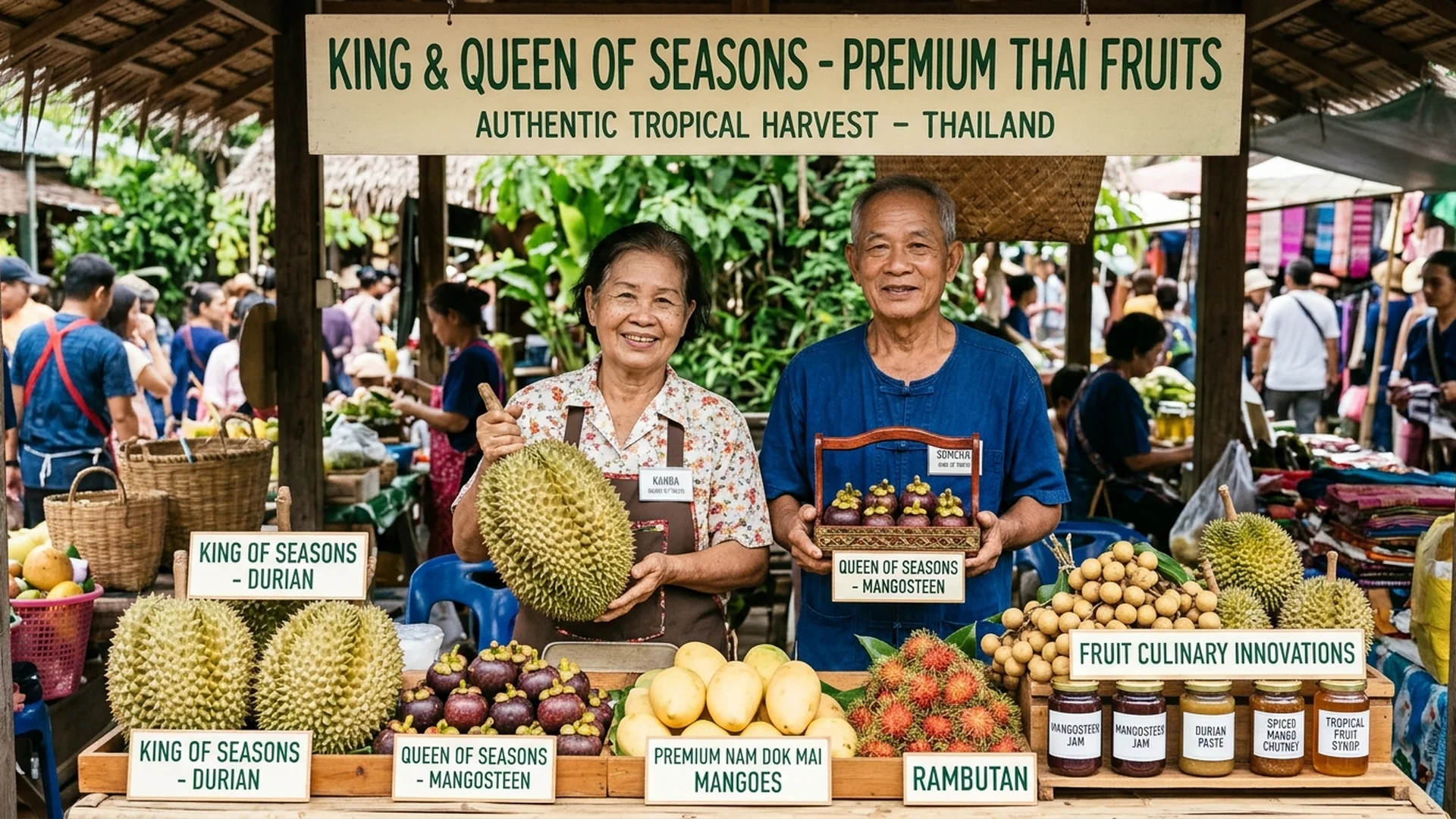
When the humid monsoon breezes sweep across the fertile plains of Suvarnabhumi, connoisseurs of rare flavours across the globe awaken to a quiet anticipation. This ancient land is far more than a sanctuary of rich biodiversity; it is a grand stage where nature meticulously performs her annual masterpiece. Here, the ‘King’ and ‘Queen’ of fruits are summoned forth, offering a sensorial depth and complex harmony that transcends ordinary produce. Velvety, cream-laced durian, deep violet mangosteens concealing pristine velvet pods, and ruby-hued Tabthim Siam pomelos present a sensory lexicon written in volcanic soil, mineral-rich waters, and the quiet devotion of generational farmers.
In the realm of contemporary high-end travel, fruit tourism has evolved beyond the simple pleasures of a refreshing dessert. It has ascended into the sophisticated domain of ‘Fruit Gastronomy,’ drawing discerning global epicureans to seek out provenance and rare heritage cultivars. Whether tracing the subtle, non-pungent aroma of authentic Nonthaburi durian or savouring the crisp sweetness of pomelos from the Pak Phanang river basin, this is not merely consumption. It is an immersive cultural pilgrimage connecting the traveller directly to the soulful terroir of the Thai kingdom.
The Kingdom of Elite Durian: Heritage Soils, Microclimates, and Ancient Cultivars
To speak of the undisputed King of fruits is to invoke Thailand’s crown jewel of agriculture, whose legendary status resonates across international borders. Yet, true appreciation lies in the nuanced geography of its terroir. Authentic Nonthaburi durian stands as an unmatched masterpiece in the pomological pantheon. Nourished by the mineral-dense alluvial silt of the Chao Phraya River and cultivated through ancient raised-bed farming techniques, cultivars such as Ganyao and Monthong yield a silk-like texture, an exceptionally delicate fragrance devoid of harsh pungency, and a perfectly rounded, creamy sweetness.
Venturing eastward to Chanthaburi, the nation’s verdant fruit treasury, one encounters a robust array of commercial and heritage exports including Chanee and Puang Manee, celebrated for their intense, assertive palates. Simultaneously, in the rugged southern reaches of the Isan plateau, ‘Sisaket Volcanic Durian’ takes root in ancient, mineral-soaked volcanic earth. This arid yet nutrient-dense terrain imparts a distinctive dry, fine-grained texture, a refined melt-on-the-tongue delicacy, and a deeply singular aroma. Tasting these fruits at the precise zenith of ripeness remains a pinnacle of fine travel—one that inspires global epicureans to journey directly to the orchard gates.
The Sovereign Queen and GI Pomelos: Symbols of Botanical Precision
Matching the King in stature is the Queen of fruits: the mangosteen, encased within a luxurious deep-purple rind that safeguards pristine, ivory segments. The ideal mangosteen possesses an immaculate, honeyed acidity that dissolves upon the palate without a trace of fibrous resistance. This perfection is especially evident in organic heritage groves, while the traditional southern craft of hand-peeling ‘mangosteenคัด’ demands extraordinary artisan dexterity to harvest pristine, unbruised segments ready for immediate enjoyment.
Within the citrus family, international acclaim firmly rests upon the Tabthim Siam pomelo of Pak Phanang district in Nakhon Si Thammarat. Distinguished by pulp as richly crimson as rubies, tender vesicles, and a refreshing, non-bitter sweetness free of excess moisture, this Geographical Indication (GI) treasure is born from the unique convergence of brackish tides and coastal sea breezes. It is an ingredient revered by elite international chefs for both its visual splendour and its immaculate flavour profile.
Fruit Gastronomy: Elevating Indigenous Produce into Royal Savoury Fare
Perhaps the most captivating evolution in contemporary Thai culinary arts is the integration of premium fruit into savoury preparations—a profound ancestral wisdom reflecting an intimate comprehension of flavor architecture. In classical Thai gastronomy, tart or starchy fruits were never mere garnishes; they served as principal actors designed to elevate complex main courses. Consider, for instance, the traditional mangosteen sour curry (Kaeng Som Mangkhut), where the sweet-tart segments are folded into a fiery, fresh-chilli broth. The fruit’s gentle acidity tames the heat while coating the palate in a velvety, harmonious embrace.
Equally masterful is unripe or semi-firm durian Massaman (Massaman Thurian), where dense, starchy durian flesh replaces conventional potatoes. Simmered slowly alongside aromatic spices and rich, split coconut cream, the durian absorbs the layered aromatics, yielding a texture superior to root vegetables while retaining a luxurious, distinct creaminess. Similarly, the Tabthim Siam pomelo salad (Yam Som-o) fuses the crisp freshness of ruby citrus with roasted chili paste and succulent prawns, orchestrating a masterclass in balance spanning sour, salty, sweet, and fiery notes.