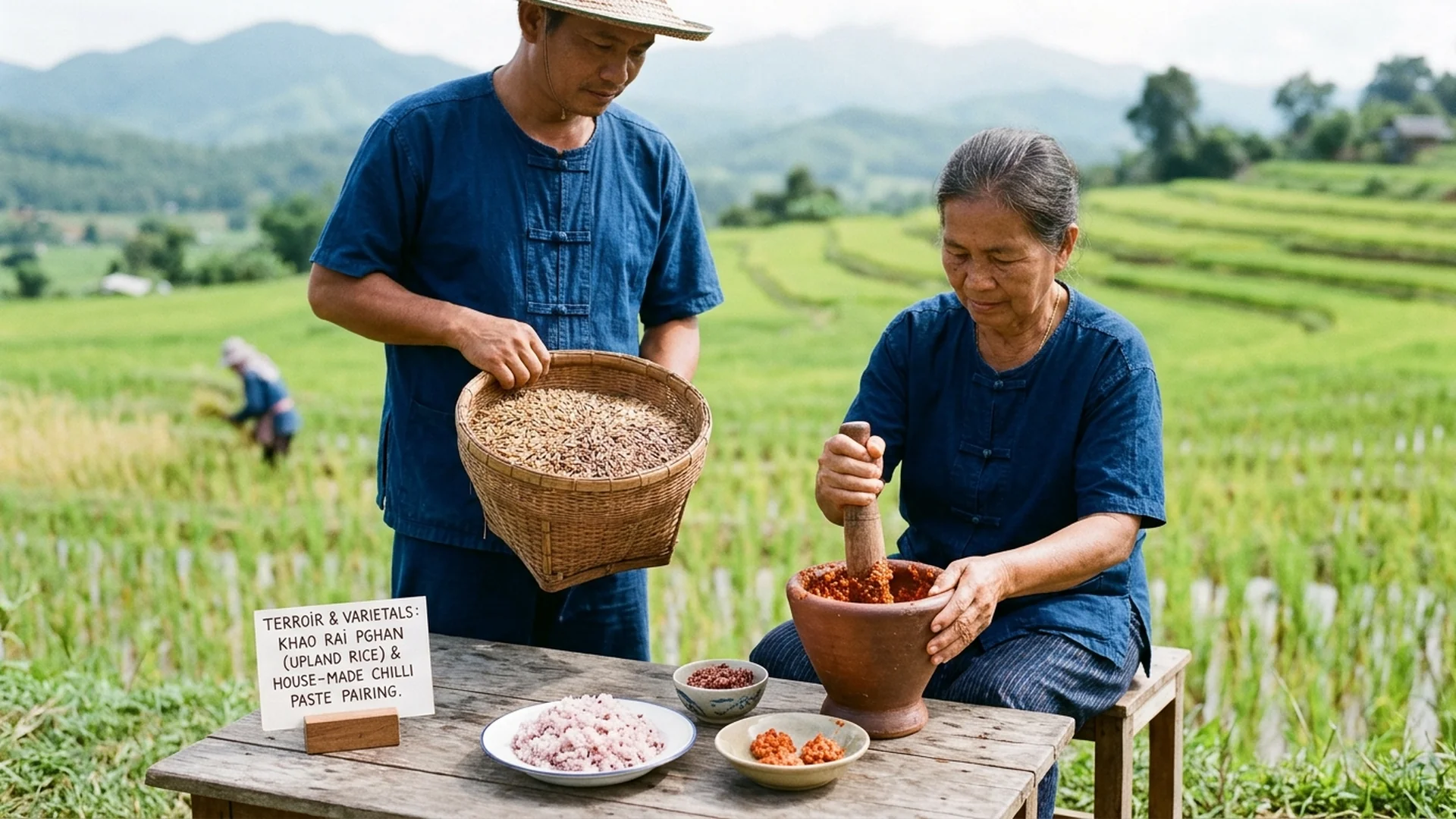
When translucent white or deep crimson grains shimmer within a celadon bowl, they represent far more than a mere culinary accompaniment designed to quiet hunger. They form the beating heart and gravitational center of the entire Thai dining tradition. Across centuries of unbroken heritage, each distinct rice varietal quietly records the whispers of local earth, pure water, open skies, and the dedicated labor of agrarian communities.
Embarking into the realm of Thai rice transcends simple gastronomy; it demands an intimate understanding of the philosophical equilibrium uniting the grain and its accompaniments. When the soaring fragrance of freshly harvested paddies meets the profound, fiery depths of an heirloom chilli paste, an extraordinary sensory alchemy occurs—one that encapsulates an enduring culinary wisdom every discerning traveler should strive to decode.
1. The Geography of Aroma: How Saline Soils and Seasonal Winds Shape Thai Rice Terroir
Much like the finest vineyards producing distinct vintages across secluded European valleys, Thailand’s verdant paddies articulate their own unique terroir through subtle variations in mineral composition, soil structure, and microclimate humidity. The preeminent illustration of this phenomenon is found in Tung Kula Hom Mali rice, cultivated across an expansive, semi-arid plain where sandy loam soils are naturally touched by saline deposits during the dry season. The gentle environmental stress experienced by these resilient stalks stimulates the accumulation of 2-Acetyl-1-Pyrroline, the volatile organic compound responsible for the intoxicating, pandan-like fragrance impossible to replicate elsewhere.
Similarly, Sangyod Phatthalung—a revered deep-red landrace originating from the ancient floodplains surrounding Songkhla Lake—absorbs the rich alluvial nutrients of ancient river terraces. This symbiotic relationship yields a grain characterized by a wonderfully tender-chewy texture and exceptional nutritional density.
2. The Art of Rice Pairing: Culinary Aesthetics Between Grain and Chilli Paste
Within classical Thai culinary arts, pairing every spoonful of rice with a pungent chilli paste is never left to chance; it reflects a sophisticated, intuitive mastery of structural flavor profiles. Practicing intentional rice pairing is an elevated discipline, selecting specific grains to complement or counterbalance the vibrant, pungent raw herbs or complex broths defining local accompaniments.
When confronting a robust grilled mackerel relish or a sharp, fermented shrimp-paste dip driven by sea-salt salinity and vibrant lime acidity, the connoisseur selects newly harvested Hom Mali rice. Its plump moisture and abundant starch gently enfold the soaring heat, simultaneously drawing out the grain’s inherent natural sweetness to achieve absolute balance. Conversely, when presenting rich crab-roe relishes or dried-prawn chilli pastes distinguished by deep, complex oils and concentrated umami, a sturdy, rustic highland or Sangyod rice with its pleasantly separated, resilient bite provides a vital textural contrast, ensuring the palate remains invigorated throughout the meal.
3. Highland Heritage and Organic Paddies: The Life and Spirit of the Thai Farmer
Behind every polished grain lies a quiet existence inextricably bound to seasonal rhythms. Across the towering northern highlands, indigenous communities such as the Pgaz K’Nyau (Karen) preserve ancient rotational farming systems to cultivate native upland rice varieties, known locally as Khao Kam. These resilient grains withstand seasonal droughts while displaying mesmerizing shades ranging from deep violet to midnight black, richly endowed with antioxidant anthocyanins.
Journeying to these organic farming enclaves in the quiet hours of dawn—while wispy mountain mists still drift lazily across emerald terraces—reveals a profound tranquility. One witnesses firsthand the reverence farmers hold for Mae Phosop, the Rice Goddess, honored through meticulous hand-planting and traditional scythe harvesting that preserves the structural integrity of every single golden panicle.