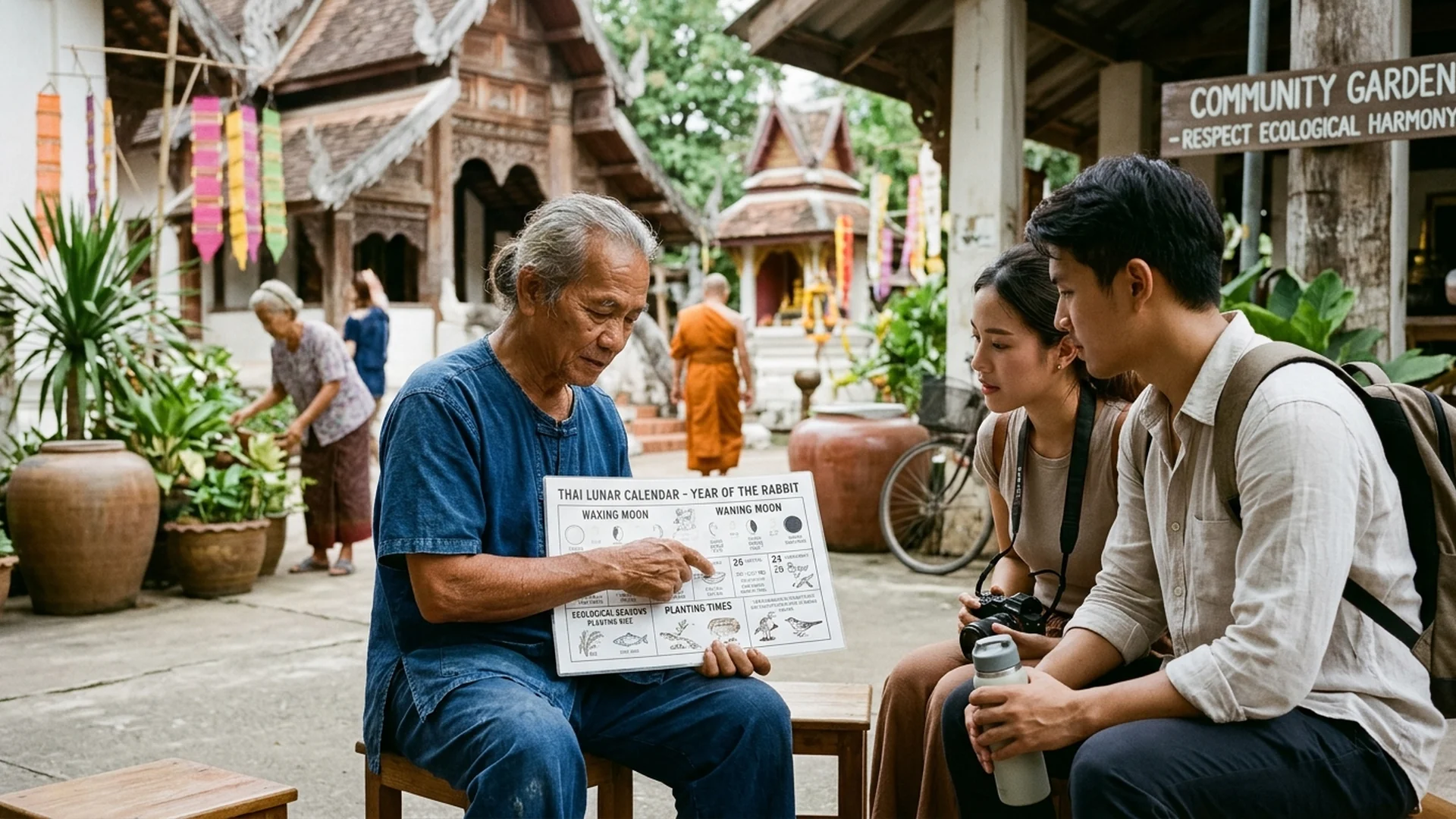
When contemplating a journey through Thailand, standard travel literature often confines the experience to a rudimentary triad: the hot, the wet, and the cool. Yet, for the discerning traveler willing to look closer, the kingdom operates on a far more nuanced cadence. This is the realm of micro-seasons and a sophisticated lunar calendar intimately woven into the daily breath of the land. Aligning oneself with these hidden rhythms is not merely a logistical measure to dodge rainfall or catch the sun; it is a way to attune one’s senses to the very pulse of the earth, revealing a profound beauty hidden behind the veil of ordinary time.
Throughout the lunar year, the moon serves as a celestial timepiece, orchestrating the ebb and flow of tides, rare ecological spectacles, and centuries-old spiritual observances. Truly meaningful travel begins with learning to read these ancient codes—cues that signal precisely when the jungle will erupt into emerald vitality, when coastal sandbars will emerge in pristine white, and when agrarian cycles will transform sleepy valleys into living canvases of agricultural heritage.
The Architecture of Time: When Solar Precision Meets Lunar Wisdom
While the modern world is rigidly anchored to the Gregorian solar calendar, traditional Thai society historically maintained a delicate equilibrium between solar positioning and lunar phases. Lunar month calculations, governed by the moon’s orbit, create alternating sequences of full thirty-day months and twenty-nine-day hollow months, punctuated periodically by intercalary months to keep human chronology tethered to terrestrial seasons.
For the mindful traveler, understanding this dual system unlocks secrets inaccessible through standard guidebooks. During full moons or dark moons, for instance, gravitational forces create spring tides that expose shallow reefs or reveal remarkable sandbars such as the famous parting sea. Calibrating an itinerary according to lunar phases grants access to natural phenomena orchestrated with absolute astronomical precision.
Micro-Seasons and the Art of Transition: Beyond the Monsoons
Upon closer inspection, Thailand does not experience static climatic blocks; rather, it moves through a continuum of twelve subtle monthly shifts. For naturalists, the most compelling moments occur during these seasonal transitions. The shift from the dry heat into the monsoon in May, for example, brings the first life-giving rains to parched soils. The resulting scent of petrichor hangs thick in the old-growth forests, accompanied by the sudden awakening of endemic insects and forest flora unfurling tender emerald leaves.
Similarly, across the mist-veiled highlands of the north and northeast, the threshold between the rainy season and the cooler months in October and November marks a breathtaking climax. Morning fogs drape languidly over terraced golden rice paddies, capturing an ephemeral moment where geography and human cultivation merge in perfect harmony.
The Breath of the Earth: Traveling with Agrarian Rhythms
Mindful travel invites us to decode the agrarian heartbeat of local communities. Historically and presently, the lunar calendar dictates when farmers sow, transplant, and rest. Visiting rural heartlands during moments that mirror these cycles transforms the traveler from a detached spectator into a welcome participant in a warm, living narrative.
In the post-harvest stillness of November and December, for instance, valley floors open into expansive communal gathering places. Festive local traditions celebrate agricultural abundance, and regional cuisines shift to highlight hyper-local seasonal harvests. Embracing these organic windows of community rest and celebration offers an authentic window into traditional craftsmanship and unhurried hospitality that mainstream itineraries simply cannot replicate.