When morning mists weave through the intricate, undulating ridges of Thailand’s ancient highlands, the rhythmic cadence of boots crunching on dry earth and damp loam becomes a meditative heartbeat. Yet behind the breathtaking panoramas of mist-shrouded peaks lies a profound physical and mental crucible that demands respect from every traveler.
Navigating the nuances of trail difficulty ratings in the Thai wilderness transcends mere numerical distances; it requires a deep understanding of tropical gradients, shifting terrain, and microclimates. This ensures that every step taken across sacred ancestral forests balances security with profound personal discovery.
Embarking on a trekking journey through the Kingdom reveals a stunning spectrum of landscapes, from gentle lowland nature paths to exposed, razor-sharp ridges requiring absolute technical composure. Accurately assessing one’s physical threshold and preparing methodically transforms apprehension into effortless immersion. This publication-grade dossier examines the taxonomy of Thai hiking routes alongside a progressive conditioning regimen designed for discerning adventurers at any level.
Decoding Trail Difficulty: From Gentle Canopies to Razor-Edged Ridges
Thailand’s geographical topography is remarkably diverse, producing radically distinct trail morphologies across its various regions. Grasping the prevailing classification tiers allows travelers to align their ambitions with their authentic physiological capacity. These routes generally divide into four foundational categories:
-
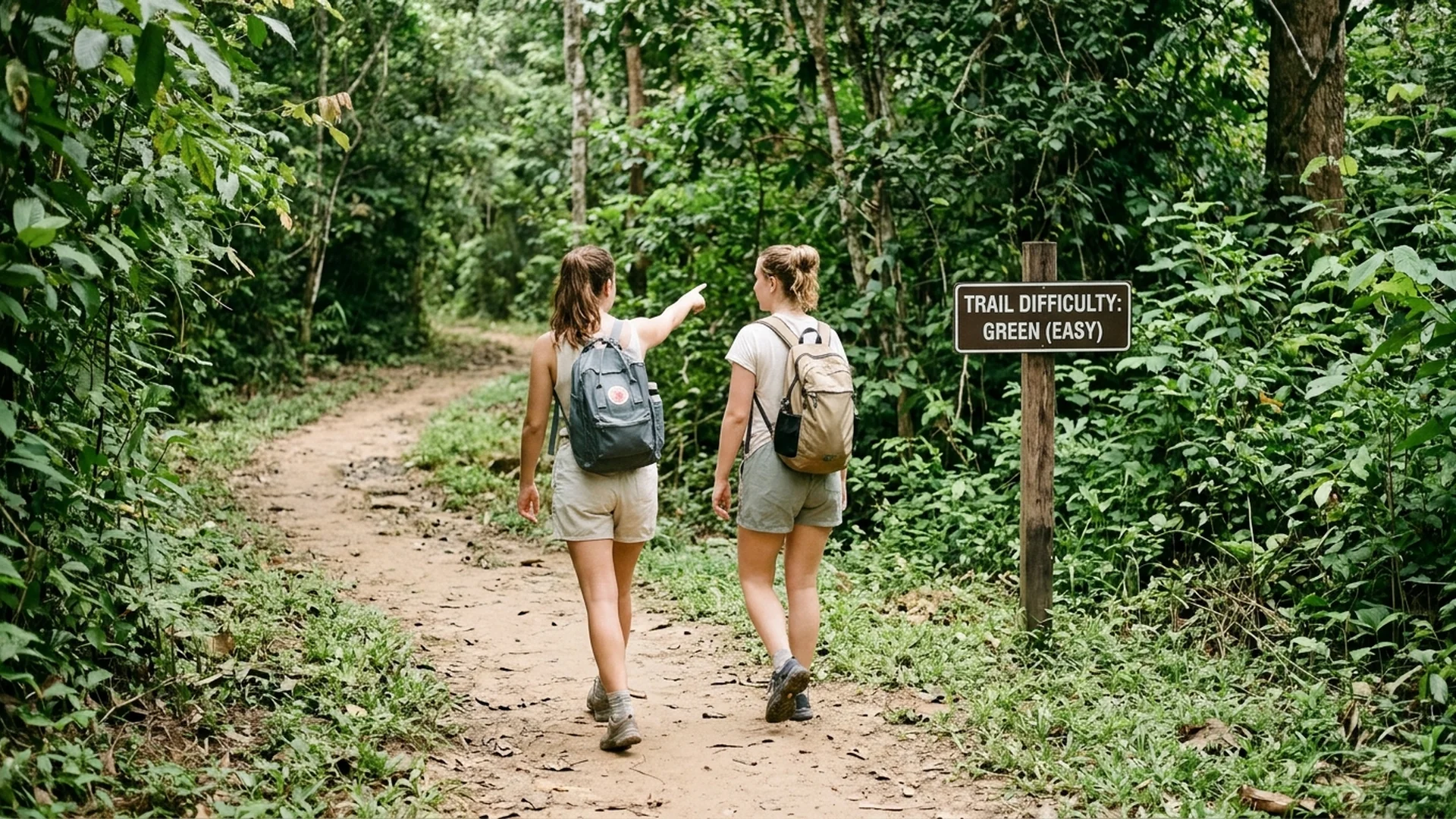
Easy: Short-format routes under five kilometers featuring gentle gradients or level terrain, typically found within protected national parks in the northern and central highlands. These are perfectly suited for beginners seeking an introductory immersion into the forest canopy within a half-day excursion.
-
Moderate: Spanning six to twelve kilometers with sustained inclines that demand greater cardiovascular engagement, requiring roughly four to six hours of daily foot travel. Examples include ascents along the rolling ridges of Mon Jong or select trails within the western frontier ranges.
-
Hard: Extended routes exceeding twelve kilometers or featuring relentless, steep ascents demanding six to eight hours of daily navigation. The footing frequently comprises loose soil, embedded rock stairs, or exposed, narrow ridgelines, exemplified by the formidable slopes of Doi Luang Chiang Dao or remote multi-day wilderness traverses.
-
Technical: Exacting itineraries requiring scrambling proficiency, hand-over-hand rock maneuvering, or navigation across steep cliff faces, often compounded by nocturnal alpine chill. These demand seasoned mountaineering experience and peak physical conditioning.
The Four-Week Conditioning Roadmap: Forging Cardiovascular and Muscular Foundations
Conquering formidable peaks is never the result of sudden, fleeting exertion; rather, it requires the systematic accumulation of lower-body muscular endurance and aerobic resilience. A disciplined four-week preparatory regimen is vital before stepping onto the trailhead:
-
Weeks 1 to 2 (Building Foundation): Focus intently on cardiovascular endurance through steady-state jogging or cycling three to four times weekly for thirty to forty-five minutes. Pair this with functional bodyweight movements, including deep squats and alternating lunges, to fortify the quadriceps, hamstrings, and gluteal complexes.
-
Week 3 (Increasing Intensity): Elevate physiological stress by incorporating weighted step-ups using a secure platform or staircase to simulate continuous mountain climbing. Begin introducing a weighted daypack carrying three to five kilograms, allowing skeletal muscles and stabilizers to adapt to external loads.
-
Week 4 (Tapering and Core Stability): Scale back training volume during the final week to allow muscle fibers to fully repair and supercompensate. Maintain joint mobility through dedicated stretching routines while prioritizing core stabilization exercises to ensure impeccable balance along uneven, sloping terrain.
Environmental Realities: Navigating Tropical Microclimates and Hidden Fatigue
The true trials of trekking through the Thai landscape extend far beyond mere elevation gain; the omnipresent interplay of tropical humidity and ambient temperature serves as a profound variable of exhaustion. Elevated ambient heat combined with high relative humidity within dense jungle canopies rapidly accelerates electrolyte depletion and dehydration, inducing heat exhaustion even along nominally gentle paths.
Furthermore, during seasonal transitions or unseasonal monsoon downpours, dry earthen trails transform into slick, treacherous mud channels where every forward stride demands double the kinetic output. Rigorous pacing strategies, meticulous hydration planning, and the selection of highly breathable, moisture-wicking technical apparel remain indispensable details that no discerning traveler should overlook.