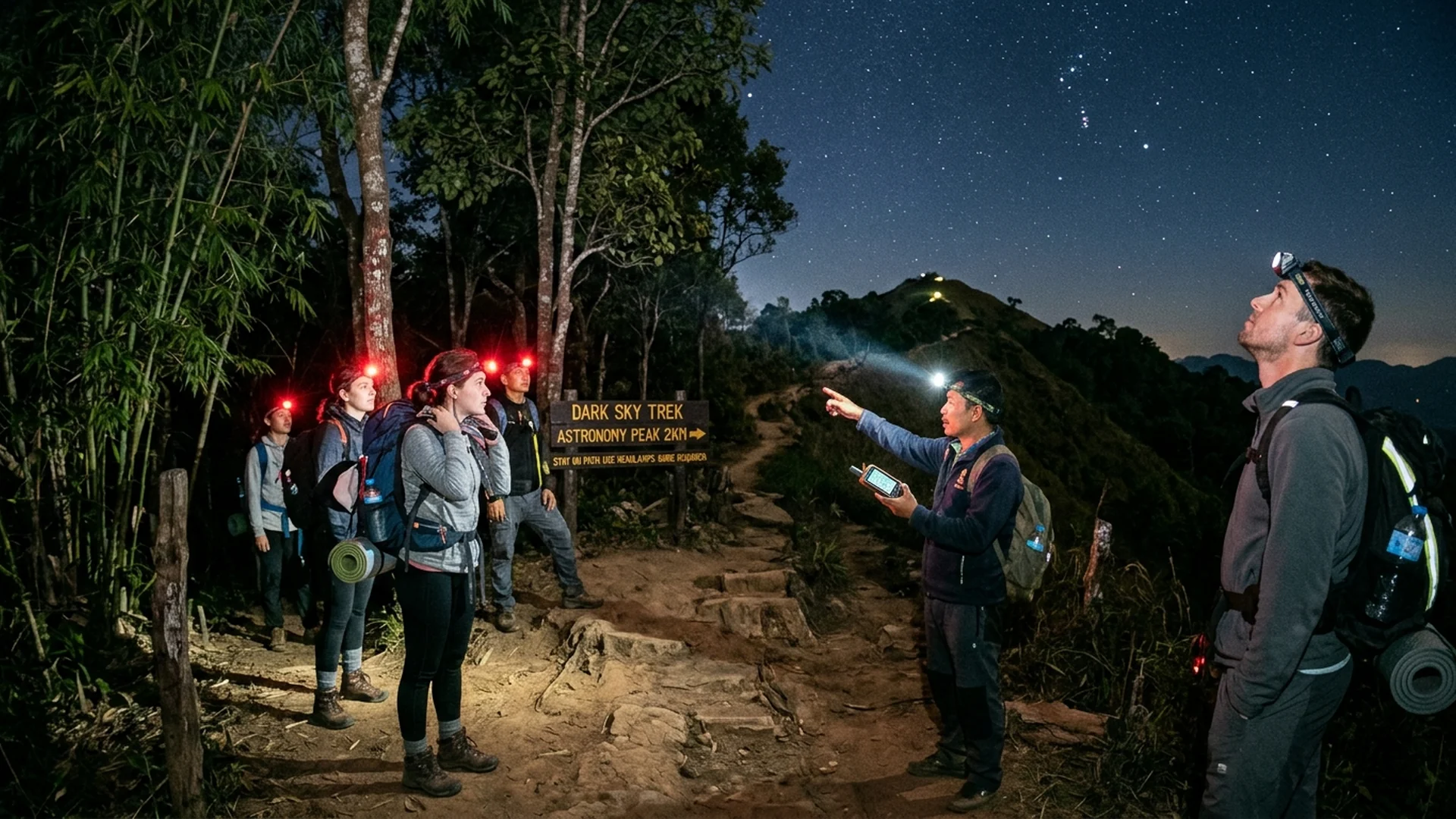
When dusk settles over the ancient rainforests, the wilderness does not sleep; rather, it unveils an alternate dimension composed of whispering winds, the rich scent of damp earth, and an infinite obsidian canvas pierced by millions of distant stars. Setting forth on a nocturnal trek toward high mountain summits is far more than a mere test of physical endurance. It is a contemplative, almost meditative pilgrimage into the magnificent vastness of the cosmos. Along trails untouched by urban luminescence lies a realm where the Milky Way stretches overhead like a luminous filament of dreams, patiently awaiting those who seek the profound serenity of the dark.
The Optics of Illumination: Headlamp Selection and Energy Preservation in the Dark
Stepping into the profound shadows of the deep forest requires deliberate mastery over your illumination tools. A headlamp yielding between 200 and 400 lumens proves entirely sufficient for navigating forest trails without blinding your fellow trekkers. Crucially, a dedicated red light mode is indispensable; its longer wavelength preserves the human eye’s natural dark adaptation, sparing the pupils from painful resets every time a light is switched on while keeping troublesome nocturnal insects at bay. Furthermore, the biting chill of high-altitude ridges drains lithium batteries far faster than standard conditions. Storing spare power cells securely within an inner chest pocket close to your body heat is a timeless trade secret passed down among veteran alpine hikers.
Instinct and Protocol: Nocturnal Safety and Communication in the Wild
The shroud of night transforms familiar landscapes into enigmatic puzzles, where the snapping of a distant twig or the rustling of wind through foliage takes on an entirely new resonance. Night trekking thus demands a heightened level of discipline. Maintaining visual contact with the headlamp of the hiker ahead, positioning experienced leaders at both the front and rear of the procession, and mastering universal light signals—such as rhythmic blinking to denote distress—form the bedrock of safety. Moving at a deliberate, unhurried cadence while utilizing trekking poles to verify the stability of unseen terrain radically mitigates the risk of misstep or injury.
Celestial Navigation: Unlocking the Prime Hours of the Milky Way
Witnessing the Milky Way across Thailand’s mountainous spine follows a precise seasonal rhythm. The golden window traditionally falls within the late dry season, stretching from February through April, when the Galactic Center ascends above the eastern horizon during the pre-dawn hours between 3:00 AM and 5:00 AM. Crafting your ascent requires careful alignment with the lunar calendar, deliberately shunning the radiant interference of a full moon. By scheduling your push for the absolute darkness of a New Moon, you allow the faint, ethereal glow of billions of distant suns to drape unhindered across the silent mountain crests.
Five Celestial Sanctuaries: Peaks Offering Unobstructed 360-Degree Views
Thailand harbors exceptional alpine destinations tailor-made for the astronomical traveler. Begin with Doi Luang Chiang Dao in Chiang Mai province, a soaring limestone monolith completely untamed by tall canopy trees, offering sweeping panoramic horizons. Further south, the formidable ascent of Mount Mokochu within Mae Wong National Park rewards the resolute with profound isolation. Phu Soi Dao in Uttaradit presents a sweeping pine plateau open to crisp alpine breezes, complemented by the ridges of Doi Moi and the razor-thin, knife-edge precipice of San Nuan Kha Thalu in Kanchanaburi, where standing atop the spine imparts the breathtaking sensation of floating directly through the cosmos.