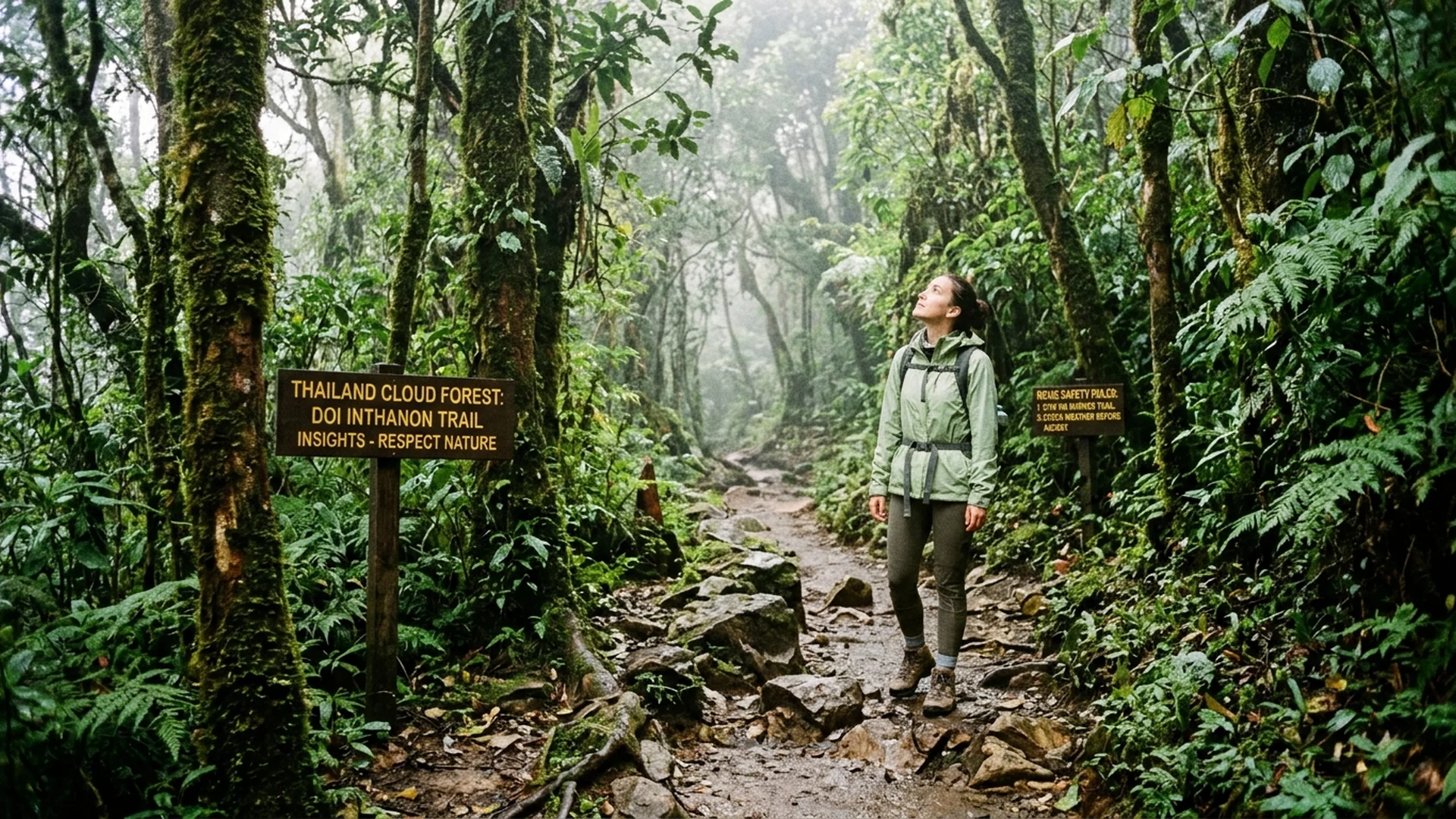
When elevation surpasses the ordinary boundaries of the canopy, another world emerges—one cradled in dense, low-hanging mist and crisp alpine air. The high-altitude cloud forests atop Thailand’s loftiest peaks resemble ancient natural cathedrals where time itself seems to decelerate. Here, gargantuan trunks are swathed in emerald carpets of primordial moss and ferns, evoking the quiet enchantment of a forgotten fable.
Stepping onto a high-altitude ridge trail within these mist-shrouded realms offers more than sweeping 360-degree panoramas. It is a profound test of composure and reverence for the raw, untamed elements. Along these razor-thin mountain spines, sudden gusts of wind perpetually challenge the inner stillness of every traveler fortunate enough to pass through.
The Architecture of Mist: Understanding Ancient Cloud Forest Ecosystems
Montane cloud forests materialize at elevations where persistent clouds and vapor envelop the upper slopes year-round. This extreme relative humidity fosters a hyper-specialized ecosystem where flora relies less on direct rainfall and more on a process known as ‘cloud stripping’—capturing airborne water droplets directly through foliage. Consequently, the branches and trunks of towering trees teem with dense layers of moss, ferns, wild orchids, and epiphytes that store vital moisture and nutrients. Within the cloud forest, the atmosphere remains hushed and reverent, heavy with the scent of damp earth and pure vapor, imparting an otherworldly tranquility.
A Study in Contrasts: The Majestic Ridges of Northern and Central Thailand
Thailand’s ridge topography delivers remarkably distinct experiences depending on latitude and geography. In the north, the Kew Mae Pan nature trail atop Doi Inthanon in Chiang Mai compresses immense ecological diversity into a compact journey. Trekkers transition seamlessly from dense montane rainforests to seasonal alpine meadows and cliffs draped in red rhododendrons—the stately queens of the high forest. Conversely, central and western routes like San Nok Khaew offer the rugged challenge of overnight wilderness trekking. These paths climb steeply through mixed deciduous and dry evergreen forests before opening onto razor-sharp limestone ridges exposed to sweeping 360-degree winds, highlighting the geological diversity of the Thai highlands.
The Art of Balance: Essential Protocols for Narrow Ridge Traverses
Navigating knife-edge ridges with precipitous drops on either side—such as those found along Kew Mae Pan or San Nok Khaew—is far from a casual stroll. Survival and comfort depend entirely on technique and heightened vigilance. High, gusty winds during early morning hours or sudden weather shifts can easily compromise a hiker’s equilibrium. Essential protocols include lowering your center of gravity, packing your rucksack high and tight against the spine to eliminate swaying loads, and maintaining absolute mindfulness with every single footfall. Avoid crossing your feet or attempting to pass fellow travelers in confined spots. Should the wind become overwhelming, pause in a sheltered, stable niche until the gusts subside before proceeding with deliberate grace.