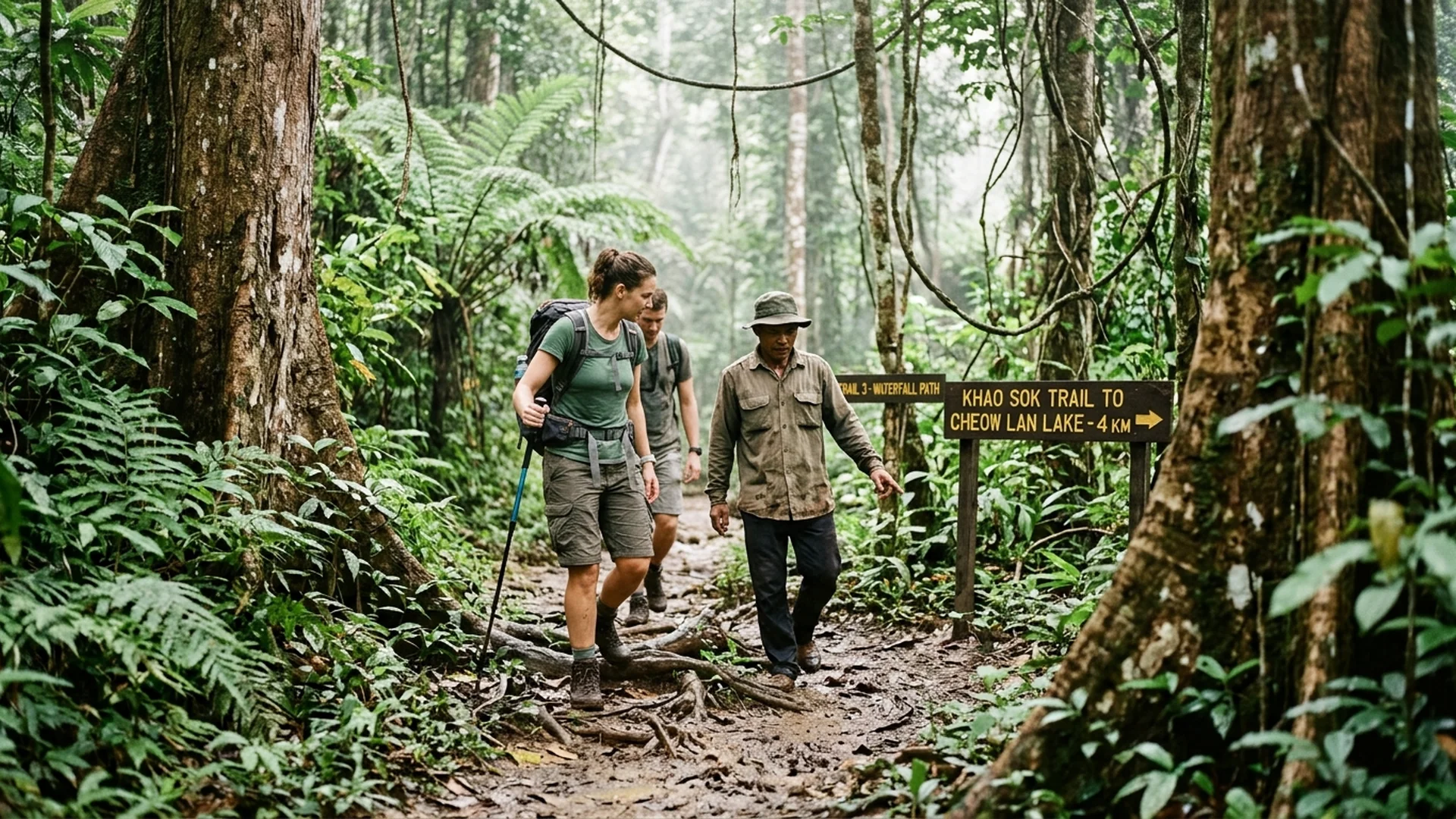
When conjuring visions of trekking in Thailand, imaginations often wander to the mist-shrouded northern pine ridges. Yet far down the country’s limestone spine, the ancient evergreen rainforests of the southern peninsula—rivaling the Amazon in sheer biological complexity—harbor an entirely different tier of adventure. This is a primordial realm of humidity and unhurried rain, where every measured footstep tests physical endurance and mental fortitude alike. The echoing calls of gibbons harmonize with the cascading roar of hidden waterfalls, serenading travelers entering a hundred-million-year-old sanctuary.
Journeying deep into protected sanctuaries such as Khao Sok National Park or Khao Luang National Park in Nakhon Si Thammarat is far more than an exercise in distance; it is an initiation into living in harmony with extreme wilderness. With soaring relative humidity, year-round precipitation, and a fiercely vibrant ecosystem, understanding the dynamic rhythm of the southern rainforest transforms what could be grueling hardship into an unforgettable, soul-stirring pilgrimage.
The Anatomy of the Southern Rainforest: When Humidity Becomes the Crucible
The primary realization confronting any trekker is the pervasive nature of humidity. The southern rainforests do not experience the prolonged dry seasons characteristic of other regions; even during sunnier months, sudden downpours are a constant companion. This atmospheric saturation prevents sweat from evaporating normally, heightening the risk of chafing at skin folds and under clothing layers. Essential preparation begins with technical, quick-drying synthetic apparel, strictly avoiding cotton, which retains water and becomes punishingly heavy when damp. Furthermore, protecting delicate electronics and photographic gear within high-grade dry bags is a non-negotiable discipline, as ambient vapor can infiltrate equipment even without direct rainfall.
The Craft of Stream Crossings and Choosing Jungle Footwear
Nature trails winding through Khao Sok and Khao Luang routinely intersect pristine streams, rushing rivulets, and slick waterfall margins. Rather than fully sealed waterproof boots, experienced local guides favor heavy-duty rubber jungle boots or specialized trekking footwear equipped with dedicated drainage ports. Even when water inevitably enters across the ankle, the shoe must rapidly expel moisture and dry upon reaching dry ground. Socks should possess sufficient thickness to buffer friction, layered beneath tightly woven, insect-resistant leech socks designed to seal out the forest invertebrates lurking along damp foliage.
The Art of Managing Leeches and Tropical Insects
The forest leech serves as a living emblem of the rainforest’s startling vitality. Effective defense begins with proper attire: shirts tucked securely into trousers, and trouser hems tucked firmly into socks. Applying DEET-based repellents or concentrated anti-mosquito sprays around ankles and footwear joints establishes a reliable chemical barrier. Alternatively, traditional folk remedies such as saline solutions mixed with coarse tobacco or wood vinegar offer natural deterrents. Should a leech attach, never yank it away abruptly, as this tears delicate skin tissue and invites infection. Instead, apply a touch of saline, rubbing alcohol, or soap to encourage natural detachment before cleansing the area with pure water and sealing it with a waterproof bandage.
Flash Flood Dynamics: Instinct and Safety at the Water’s Edge
The enchanting waterfalls gracing Khao Luang and Khao Sok harbor a silent, swift-moving hazard: flash floods. Because elevated catchment areas feature steep limestone and granite topography incapable of retaining sudden downpours, rainwater funnels rapidly into narrow gorges within minutes. Nature’s immediate warning sign is a shifting current that transitions from crystal clarity to deep, opaque turbidity, accompanied by drifting twigs and floating bubbles. Spotting these indicators demands an immediate ascent to higher ground. When crossing active streams, utilize trekking poles to maintain a continuous three-point stance, or link arms in a horizontal line to distribute weight and prevent the current from sweeping you downstream.