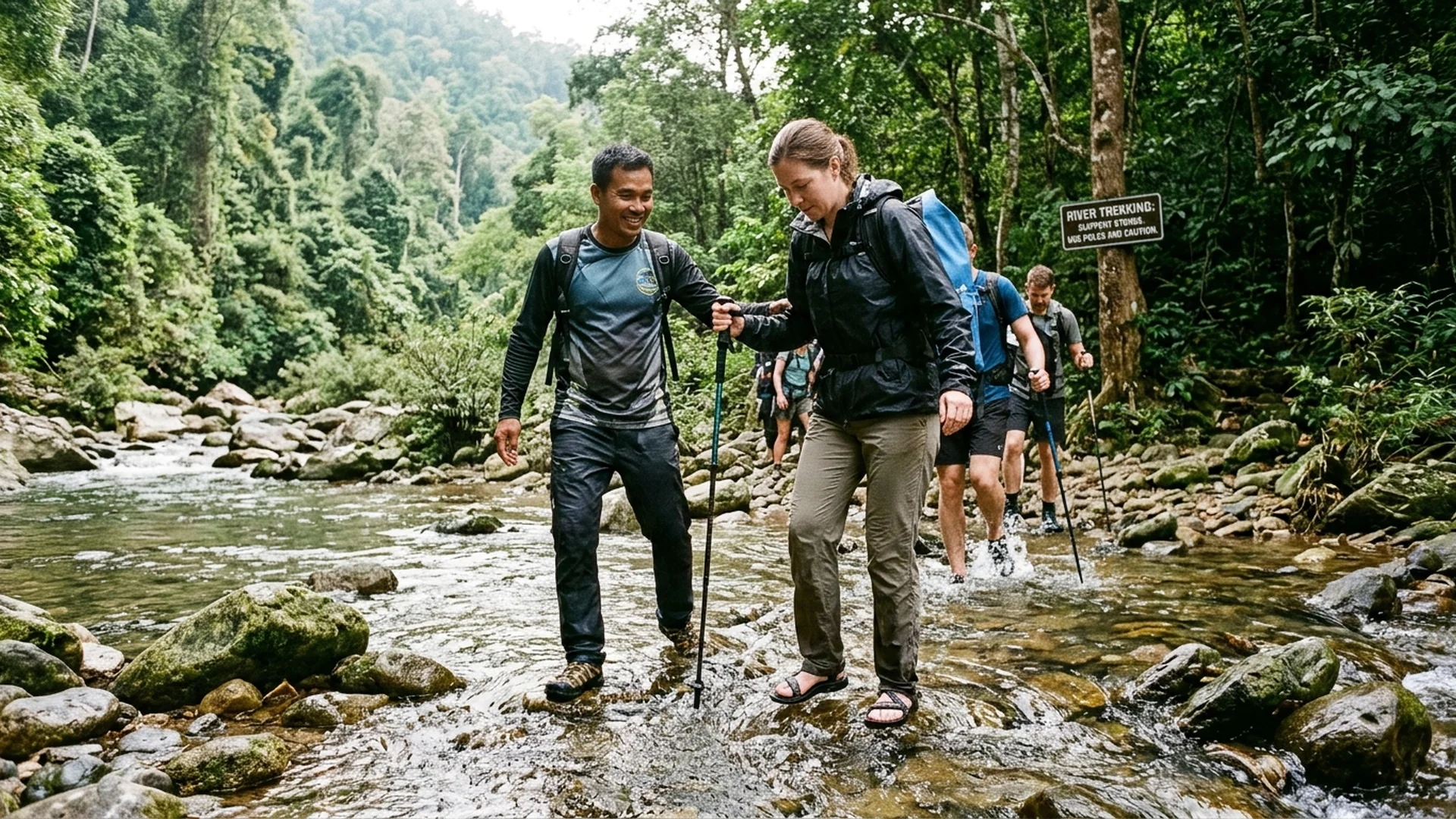
When wild mountain streams carve their way through the ancient, emerald-draped rainforests of Thailand, the cascading rush of water is more than a sensory delight—it is a rigorous test of preparedness for the discerning backcountry traveler. Stepping purposefully into crystal-clear, icy currents to negotiate hidden riverbeds or scaling moss-slicked boulders reveals a raw, untamed allure that conventional dry trails simply cannot replicate.
Yet behind this undeniable natural splendor lies a complex physical challenge requiring specialized knowledge, nuanced technique, and gear engineered expressly for aquatic environments. River trekking across Thailand’s tropical topography demands far more than adventurous spirit; it requires an intimate understanding of hydrological behavior, moisture-resilient materials, and disciplined pack management. In this editorial guide, we delve deep into the science of wilderness water travel, ensuring every stride across moisture-laden terrain is executed with absolute confidence and unwavering safety.
The Aesthetics of Moisture: Why Thailand’s Forests Demand Respect
Across Thailand’s diverse geographic tapestry—from the rugged western sanctuaries and deep southern rainforests to the mist-veiled northern ranges—hydrological ecosystems thrive with astonishing vitality. Countless trekking routes feature perennial watercourses, and on many occasions, the trail itself becomes the active waterway. Traversing such terrain requires travelers to embrace moisture not as an obstacle, but as an integral medium of travel. The true challenge lies not merely in distance, but in the capricious fluctuation of water levels, the treacherous slickness of submerged stone surfaces, and highly unpredictable atmospheric shifts. Comprehending current dynamics and flash-flood indicators is the fundamental prerequisite before any boot meets the water.
The Science of Traction: Stud Doi Versus High-Tech Trail Shoes on Slick Stone
The cornerstone of any river-trekking kit is footwear, prompting a perennial debate among seasoned explorers: should one choose traditional rubber studded boots (commonly known as ‘stud doi’ with metal pins or thick raw rubber soles), or high-performance trail running shoes from elite technical brands?
Traditional studded rubber boots offer exceptional flexibility. Their pliable soles and aggressive tread patterns mold seamlessly around the jagged, slippery contours of algae-covered river stones while shedding mud effortlessly at an accessible price point. Their primary limitation lies in ankle protection and underfoot cushioning; traversing miles of dry, hard-packed earth in them can induce rapid foot fatigue.
Conversely, technical trail running shoes feature advanced rubber compounds (such as Vibram Megagrip) engineered specifically for wet adhesion, paired with robust structural support for the foot and ankle. However, in Thai streams choked with dense algae, overly rigid rubber compounds may occasionally lack the malleability required to grip micro-crevices. The ideal choice ultimately depends on the specific micro-topography of the intended route.
Waist-Deep Waterproofing: The Triple-Layer Defense Strategy
When a route mandates wading through chest- or waist-deep channels, the primary anxiety shifts to the contents of the rucksack. Relying on a single dry bag introduces unacceptable risk should an unexpected slip or powerful current compromise a seam.
Veteran wilderness travelers employ a rigorous triple-layer waterproofing system. Electronics and sleeping attire are first sealed within heavy-duty zip-lock bags. These are subsequently placed inside a robust dry bag rated at 210D or higher. Finally, the entire rucksack is shielded with an exterior waterproof rain cover, or lined internally with an exceptionally thick, puncture-resistant polymer liner. Weight distribution inside the pack is equally critical: dense items must be positioned flush against the spine at mid-torso level to prevent water pressure from destabilizing the traveler amidst turbulent currents.
The Art of the Crossing: Reading Currents and Maintaining Foot Health
Crossing swift-moving channels requires a synthesis of applied physics and sharp hydrological observation. One must strictly avoid deceptively calm, deep stretches, which frequently conceal dangerous eddies. Instead, seek wider, shallower sections where the current disperses evenly. Crossings should always utilize trekking poles to establish a reliable three-point stance—two feet and one pole—orienting the body sideways to the water flow to minimize surface resistance. Step deliberately, sliding one foot at a time, and never lift both feet off the riverbed simultaneously.
Furthermore, vigilant post-trek foot care is paramount. Permitting feet to remain damp inside wet socks for extended periods invites trench foot or fungal infections. Upon reaching camp, immediately shed wet footwear and socks, cleanse the feet thoroughly, dry them completely, apply preventative balms, and don dry merino wool socks to rejuvenate the skin for the following day’s journey.