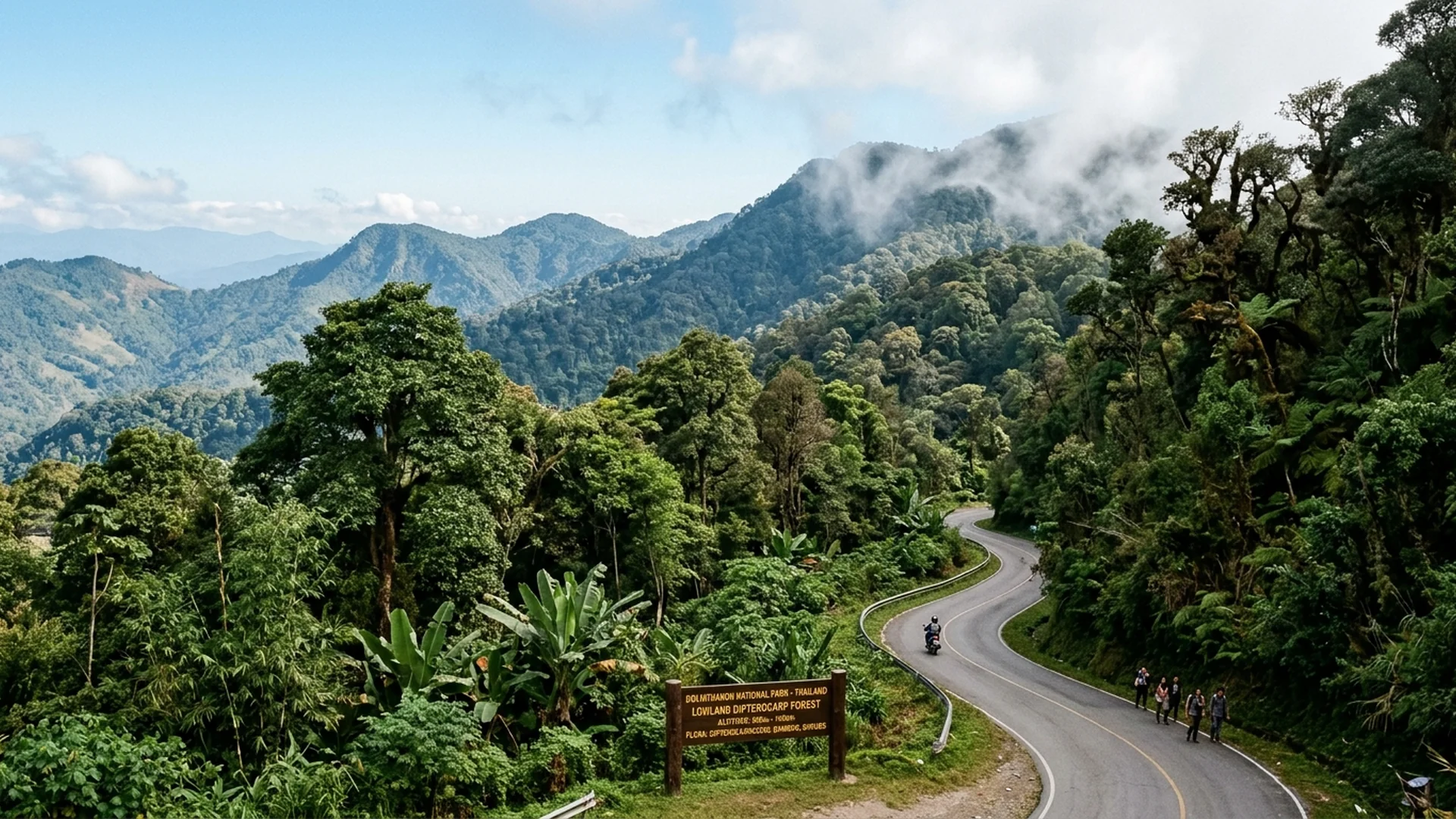
When time and gravity conspire to draw boundaries across the green realm, Thailand reveals a landscape far more complex than a single uniform jungle. Within its diverse topography lies the subtle, breathtaking phenomenon of altitudinal zonation. With every hundred meters gained in elevation, shifting temperatures and lingering humidity act as nature’s master architects, curating entirely distinct botanical societies.
From scorched lowland plains where flora adapts fiercely to relentless sunlight, to dense, mist-shrouded tropical rainforests, and finally culminating in ancient cloud forests atop the kingdom’s highest peaks—where every trunk wears an emerald cloak of velvet moss and lichen—this vertical journey transcends mere geography. It is a passage backward through time and across global climatic zones in a single breath.
From the Lowland Earth: The Realm of Dipterocarp and Mixed Deciduous Woodlands
The ecological journey across Thailand begins in the lowlands and gentle foothills, stretching from sea level to roughly 300 or 500 meters. Here, under unsparing sunlight and enduring prolonged dry seasons, the deciduous dipterocarp forest displays a rugged, resilient beauty. Trees such as the Yang, Teng, and Rang stand protected by thick, fire-resistant barks. Their broad leaves shed entirely during the dry months to minimize transpiration, leaving behind an open canopy where native grasses and wild forest mushrooms thrive on the sun-dappled floor.
Ascending slightly into nutrient-rich soils, the mixed deciduous forest takes over. Here, the shade deepens with the presence of Burma padauk, Afzelia xylocarpa, and various bamboo groves. This intermediate zone exhibits staggered leaf-shedding, acting as a crucial ecological bridge balancing the arid lowlands with the moisture of higher realms.
The Verdant Heart: Tropical Rainforests and Semi-Evergreen Sanctuaries
Crossing the threshold between 500 and 1,000 meters in elevation, the atmospheric character shifts abruptly. The rich scent of organic loam and cool vapor hangs thick in the air. This is the domain of the tropical rainforest and semi-evergreen forest, where towering canopies intertwine so densely that barely a fraction of direct sunlight reaches the forest floor.
Flora here competes fiercely for light. Understory shrubs, epiphytes, gargantuan lianas, and forest palms weave together a complex three-dimensional ecosystem. Roots and microscopic organisms bustle ceaselessly on the forest floor, rapidly decomposing fallen biomass to recycle nutrients. The echoing calls of hornbills and gibbons serve as living testaments to the supreme vitality of this sanctuary.
The Misty Sanctuary: Cloud Forests and Hill Evergreens Upon the Summit
Beyond the 1,000-meter mark and up to the kingdom’s zenith at Doi Inthanon, temperatures drop markedly. Atmospheric pressure and mountain winds drive oceanic moisture against high ridges, midwifing the birth of the cloud forest—known to naturalists as the hill evergreen forest.
At these heights, trees drink not only from the soil below but harvest moisture directly from the clouds drifting through their branches. Every square inch is swathed in sphagnum moss, a plush natural sponge storing vital water to sustain the micro-habitat. Crimson rhododendrons bloom in defiance of the alpine chill, while rare epiphytic orchids and terrestrial ferns hide among sheltered rock crevices. Enveloped in perpetual quiet and drifting mists, these cloud forests remain untouched sanctuaries suspended outside the reach of time.