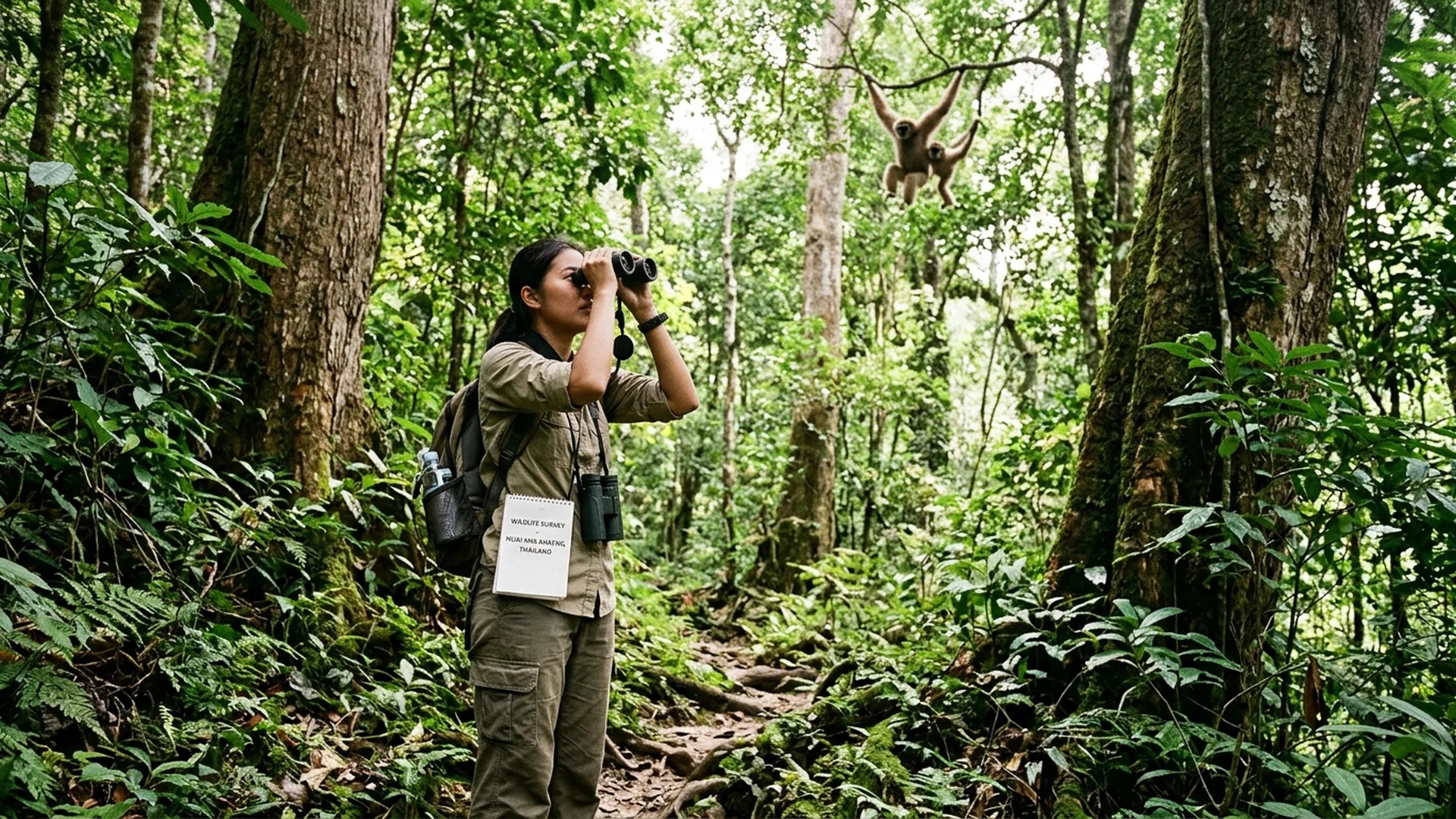
As the morning mist slowly lifts above the primeval canopy of the Hala-Bala rainforest, the powerful beat of the great hornbill’s wings echoes like a sacred cadence of natural abundance. Thailand is far more than a celebrated tropical sanctuary; it is a grand living laboratory and a vital habitat where intricate webs of biodiversity pulse with timeless rhythm.
From the dense, mist-shrouded montane forests of the north to the sun-dappled coastal shallows of the south, the kingdom’s protected landscapes shelter an irreplaceable heritage of rare fauna. Here, the preservation of wilderness is not merely an administrative policy, but a profound cultural and environmental commitment to safeguarding the delicate balance of life for generations to come.
The Pulse of the Deep Forest: Reserved Species and Ecological Equilibrium
The Western Forest Complex and the Dong Phayayen-Khao Yai forest span majestic landscapes that act as the vital beating heart for Thailand’s protected and reserved wildlife. Encompassing nineteen legally protected species—ranging from the elusive Malayan tapir and serow to the stealthy clouded leopard—each creature plays an indispensable role in maintaining forest food webs and ecosystem health. Their presence serves as an irreplaceable ecological health index that human intervention can never replicate. Through the tireless dedication of forest rangers and field researchers who track wildlife behavior, we gain profound insight into a fundamental truth: a forest can never truly be whole without the resonant roar of a wild tiger or the gentle, earth-shaping passage of wild elephants.
Wildlife Corridors: Architectural Innovations for Ecological Freedom
In an era where modern infrastructure inevitably intersects with pristine natural domains, habitat fragmentation poses an acute, severe threat to regional biodiversity. The revolutionary concept of the wildlife corridor has thus emerged as a critical lifeline. The construction of dedicated overpasses and underpasses allowing wildlife to traverse safely between the Khao Yai and Thap Lan national parks stands as a magnificent testament to harmonizing human progress with conservation imperatives. These verdant bridges empower vulnerable populations to migrate, diversify their gene pools, and expand their ancestral ranges without risking deadly encounters with modern transport.
The Cobalt Realm: Marine Megafauna in Thai Waters
Moving from verdant forest canopy to the expansive azure sea, Thailand’s coastal waters remain sanctuaries of astonishing marine wonder. The inner Gulf of Thailand serves as an essential seasonal feeding ground for the resident Bryde’s whale, whose graceful lunges through schools of anchovy mirror the profound nutrient richness of the sea. Meanwhile, along the Andaman coastlines of Trang and Krabi, serene seagrass meadows harbor fragile populations of dugongs, depending entirely on these submerged pastures for nourishment and shelter. Protecting these aquatic realms demands an unwavering synthesis of community stewardship and rigorous marine science.